

6 things you’ll learn
- Why a wobbling railing often points to the base, and how to tell in one push.
- Which signs at the foot of a post (cracks, crumbling, rust in the socket) mean repair, and which mean replace.
- Why the edge of the step decides how an anchor holds, and why no single distance fits every job.
- How we treat a new pour: 14 days before the posts go in, and sand instead of salt in the first winter.
- What Saint-Jean-sur-Richelieu and Brossard say about permits, and where their pages say nothing.
- What published price ranges include, and what they leave out.
In this article (contents)
- Push first, then look at the foot of the post
- Tighten, repair or replace: what you see and what to do
- Anchoring outdoor handrails to concrete steps: top or side
- A new pour: our 14-day wait and the first winter
- Keep the iron or switch to aluminum
- The rules that touch a stair rail
- Permits: what Saint-Jean-sur-Richelieu and Brossard say
- Exterior stair railing prices: what is published and what is left out
- When the work can happen
- 2 Real Cases
- Frequently Asked Questions
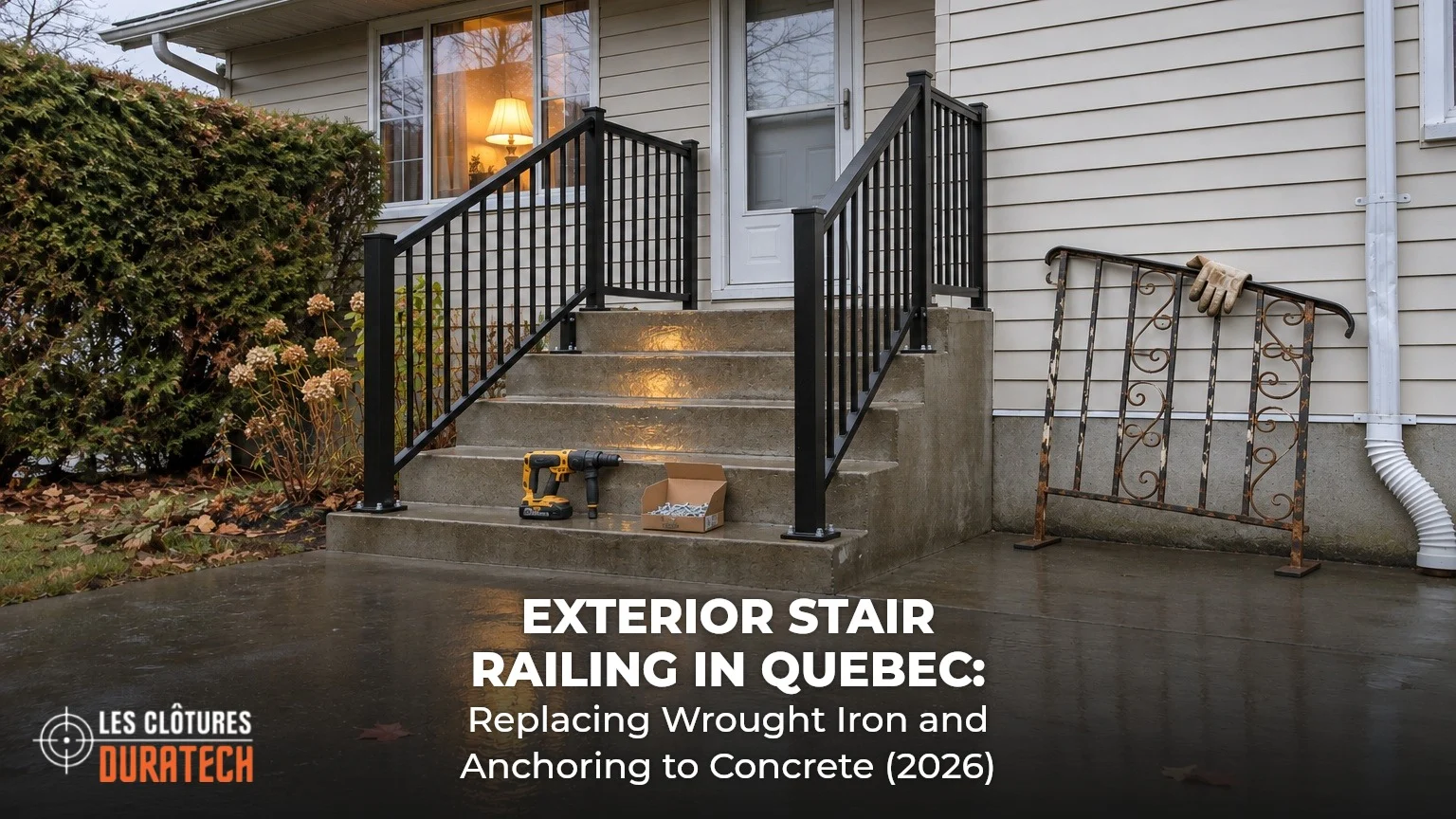
You grab the iron railing at your front steps and it gives a little. There may be a rust stain running down the concrete from the foot of a post. The steps will soon be wet, then icy, and the railing is where your hand goes.
A wobbling railing often turns out to be a base problem: the concrete around the foot, the anchor, or rust in the socket. So the first question about any exterior stair railing on concrete steps is what it stands in, and that does not change whether you keep the old iron or switch to aluminum.
On a visit we measure the run and assess the mounting surface. On concrete steps, the condition of that concrete usually decides whether you tighten, repair or replace.
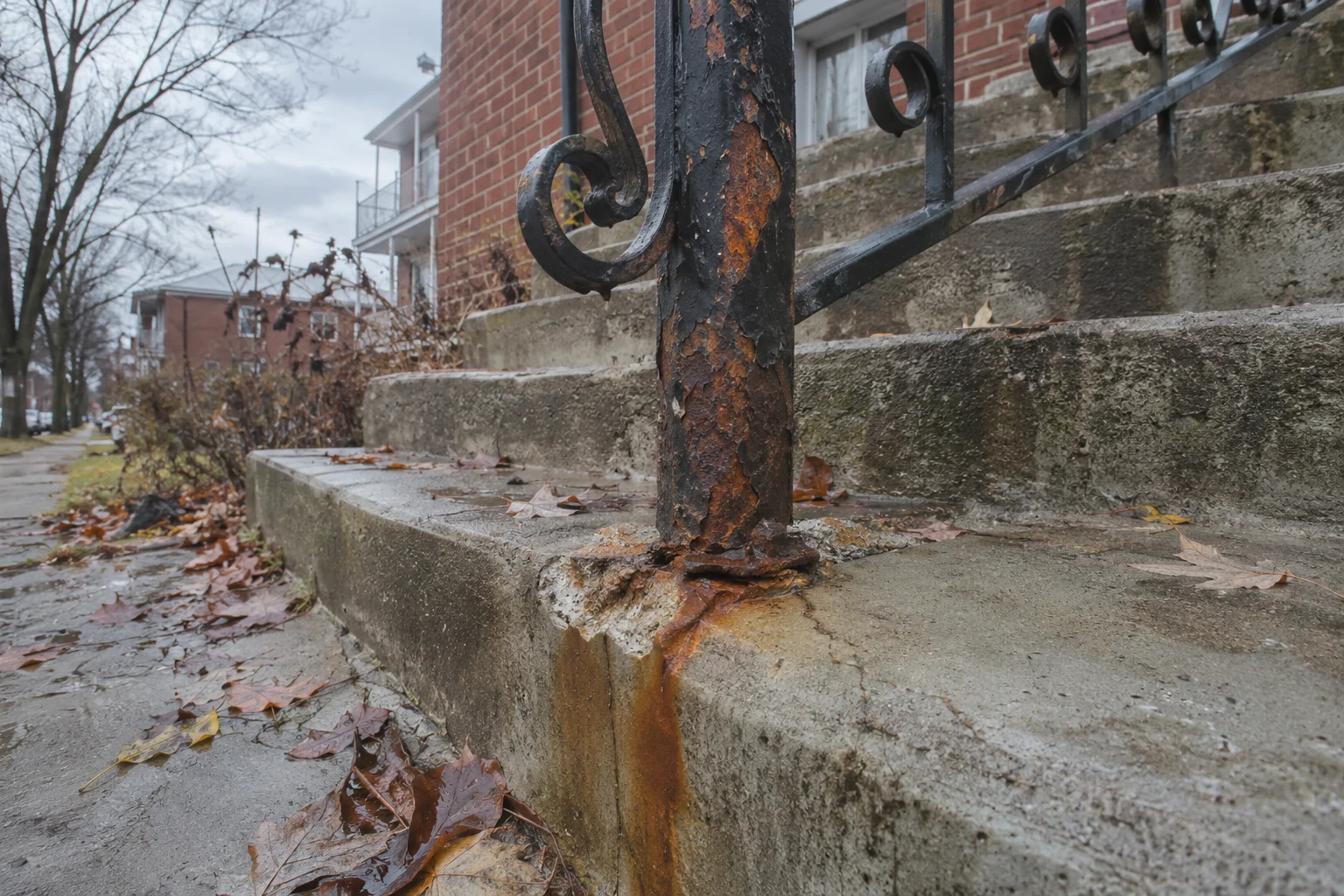
Push first, then look at the foot of the post
Stand beside a post. Put a hand on the top rail and push gently along the stair, then across it. Watch the foot. If it moves against the concrete, the problem is in the base. If the foot stays put and the rail flexes or a joint clicks, look higher up, at a weld or a fitting.
Then crouch down and look for four things:
- a crack running out from the post;
- crumbling or flaking concrete around the foot;
- a chipped or broken corner near the post;
- rust stains or flaking rust where the steel enters the concrete.
Where a post sits in a pocket or socket, water can get in and the steel inside can corrode. Corrosion can crack and chip the concrete around it, and in a Quebec winter, freezing water adds to the damage.
What the sources say
A US trade journal. The Construction Specifier (2019) writes that the concrete around a rail post pocket “cracks, then spalls, quite spectacularly in some cases.” It names corrosion of embedded metal, including the post itself, as a cause that can crack the surrounding concrete and sometimes push the post out of the pocket. A sealant bead around the post base is one option, it says, but sealant can fail and is a regular maintenance item.
A concrete-coating company. In an April 2026 article, the company says stairs are particularly vulnerable because water collects on the treads. It adds that concrete that is damaged but still structurally sound can be repaired and protected.
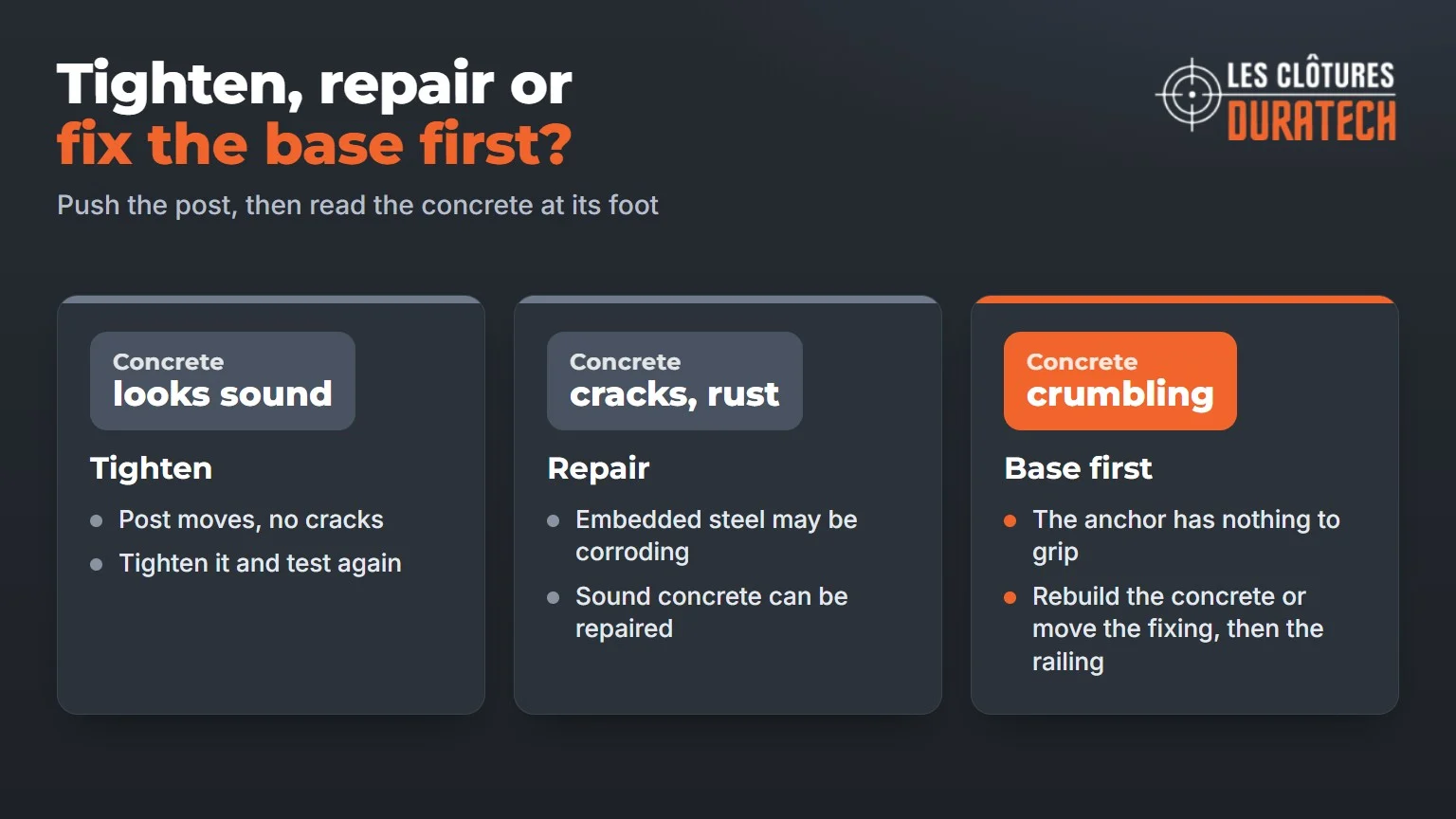
Tighten, repair or replace: what you see and what to do
Match what you found at the foot of the post, and at the welds, to the closest row below. Each row says what it usually means and what to do next.
| What you see | What it usually means | Next move |
| Post moves, concrete looks sound, no cracks | A fastener or anchor has worked loose | Tighten and test again. If it will not tighten, the hole itself may have failed (see the crumbling row) |
| Hairline crack from the post, rust stain at the socket | Embedded steel may be corroding and cracking the concrete | Sound concrete can be repaired, but have the post checked too, since corrosion may be the cause. Check any sealant regularly |
| Concrete crumbling or chipped at the foot, step edge broken | The anchor has nothing solid to grip | Repair the concrete, pour a new pad, or move the fixing to better concrete before any railing goes on |
| Rust on the iron, post solid, welds intact | A surface problem | Brush and repaint. Or replace, if you are done repainting |
| Cracked welds, or a post rusted through near the base | The metal itself is failing | Re-weld, or replace if the post has rusted through |
| The whole stair moves, or a tread rocks | The stair itself is loose | Stabilize the stair first, then deal with the railing |
Anchoring outdoor handrails to concrete steps: top or side
Surface-mounted posts usually attach in one of two ways: on a base plate fixed to the top of the tread or landing, or to the side of the concrete. Which one is possible depends on how thick the concrete is and how much sound concrete lies between the fixing and the edge.
Published numbers exist, but they belong to a specific product.
What the sources say
The same trade journal. The Construction Specifier says that edge distance, and avoiding interference with embedded objects such as reinforcing steel, are critical. It gives no minimum number.
One railing maker’s sheet. Viewrail’s installation sheet (2016) covers its own posts and methods. For top mounting it asks for concrete at least 4.5 inches thick and fasteners at least 3 inches from the edge. For side mounting it asks for a slab at least 11½ inches thick, with the top hole at least 3 inches from the edge. It assumes uncracked concrete of 3,000 psi or stronger. Viewrail sells railings, so read this as one manufacturer’s instruction.
One builder’s account. Don Boivin, writing in Journal of Light Construction (2019), says he keeps fasteners well away from the nose of the step. He fixes at the side, where there is more concrete to bite into. On an old step he found concrete not solid enough for the anchors to tighten in their holes, and he notes that on older, unstable concrete some anchors may work better than others.
No single distance fits your steps: it depends on the anchor and the concrete. We settle it on site, after looking at the edge and the condition of the concrete.
A new pour: our 14-day wait and the first winter
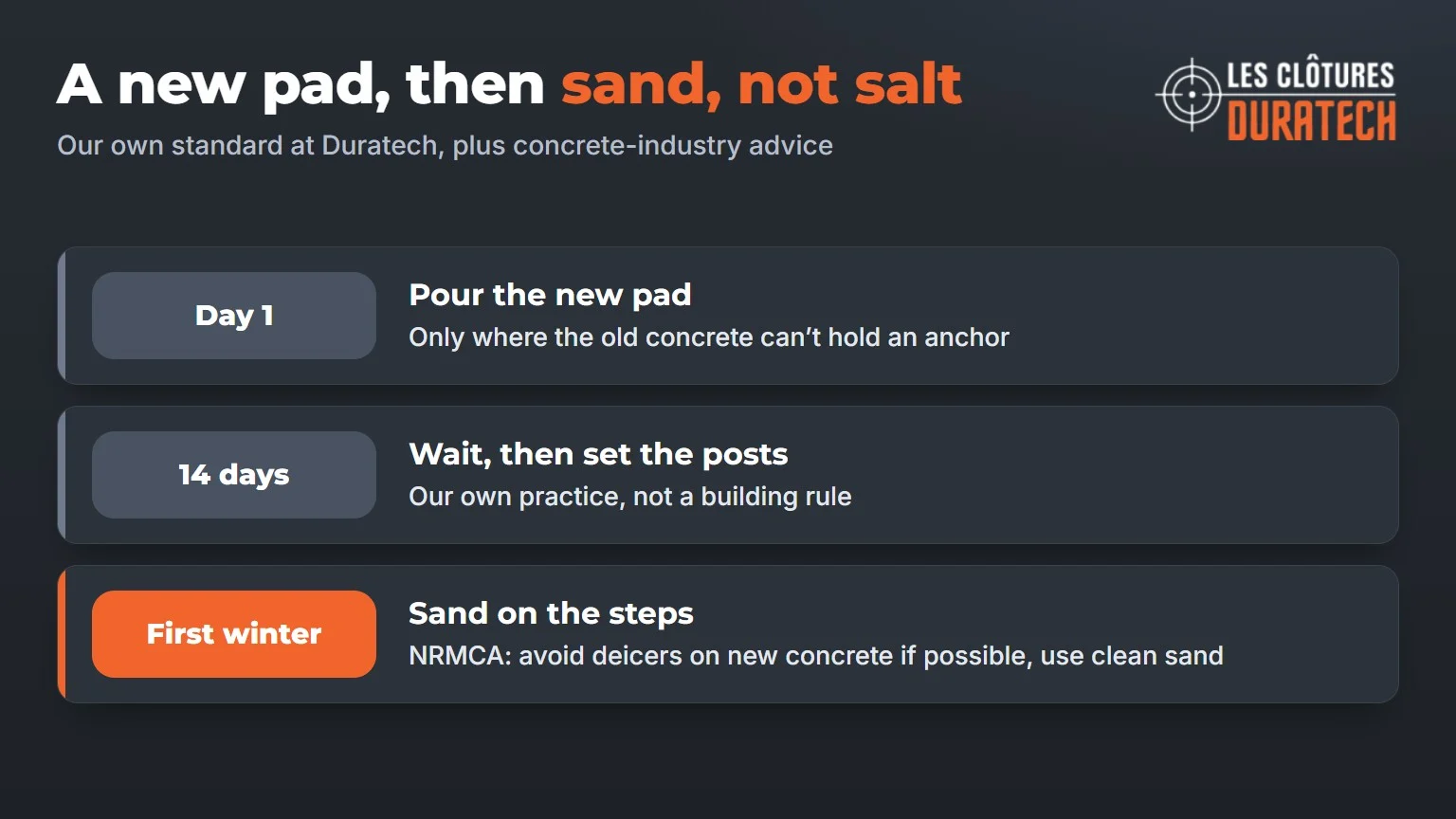
If the steps or a pad need new concrete, our standard at Duratech is to wait 14 days for it to cure before we install the posts. That is our own practice, not a building rule: we would rather drill into concrete that has had time to cure than hurry the job. Where a post needs a new footing in the ground instead of a pad, our practice is also to go below the frost line (the depth frost reaches), which helps keep frost heave from lifting it. The first winter needs care too.
What the sources say
A US concrete association. The National Ready Mixed Concrete Association (NRMCA) advises avoiding deicing chemicals on newly placed concrete if possible and using clean sand for traction. When chemicals are used, it advises moderate amounts. It also says poor drainage letting salt solutions collect on the surface increases the risk of scaling, the local flaking or peeling of a finished surface.
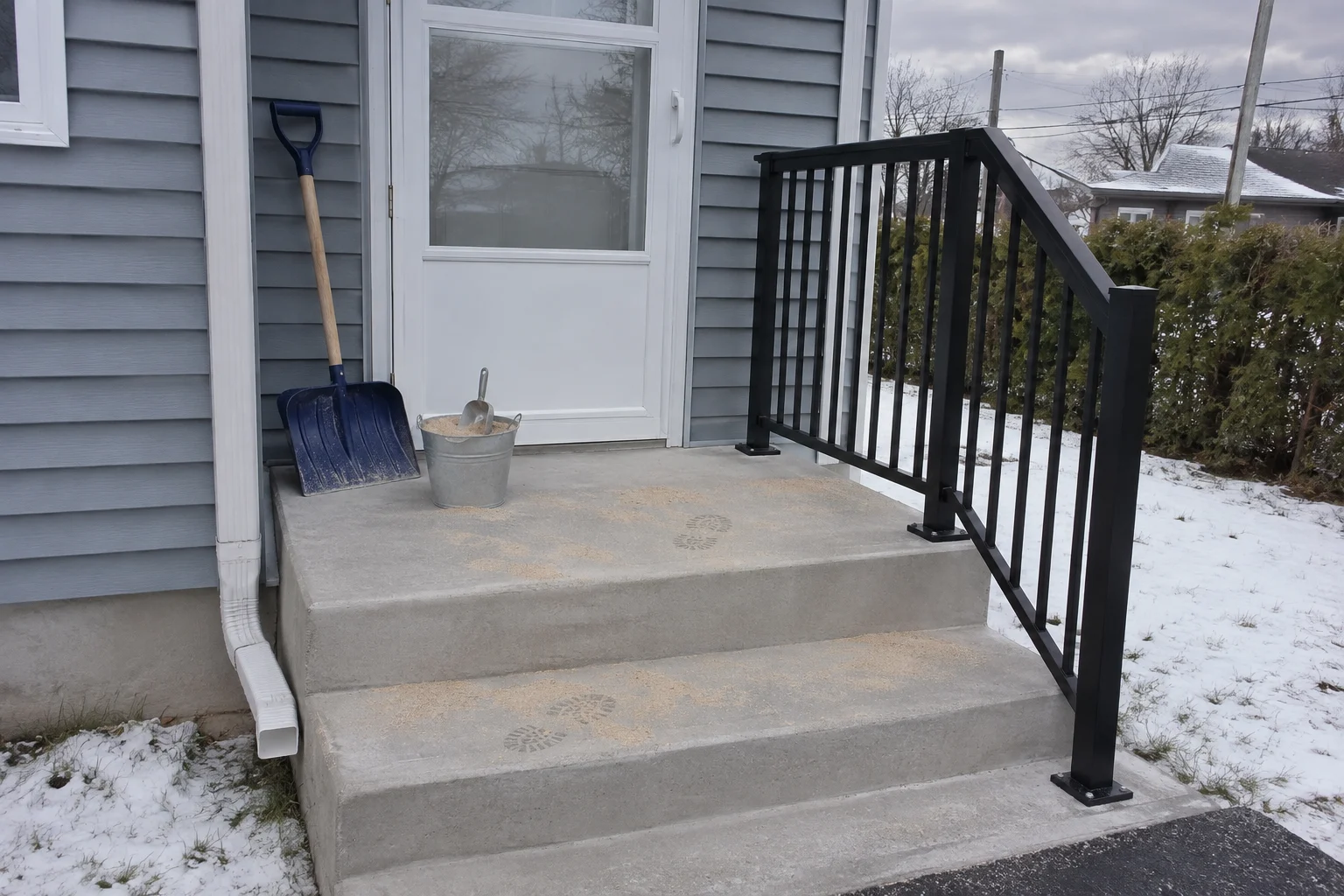
If we pour a pad for your railing, use sand on the steps in the first winter, shovel early, and check that meltwater runs away from the posts.
Keep the iron or switch to aluminum
Keeping the iron is reasonable when the posts are solid, the welds are intact and you do not mind repainting. Switch when you are done repainting or a post has rusted through. When we install aluminum, we set the posts, mount the railing sections, secure the top caps, then test every section for stability. Black is by far the most popular finish, and white is also available.
Replacing old iron also leaves something behind. Iron posts are often set into holes in the concrete, and when they come out, those holes stay in the step. Left empty or half-filled, they hold water that freezes, and a new post fixed beside a cracked pocket starts on weak concrete.
What the sources say
The trade journal, on post holes and aluminum. The Construction Specifier advises filling post holes fully so water cannot pond and freeze in them. It also says aluminum railings should be kept from contact with cementitious materials by separation materials or coatings, to prevent an aluminum-concrete reaction.
A coatings-side article, on salt. A 2013 article in Metal Architecture, written from the coatings side of the industry, says deicing chemicals can attack aluminum and its coating if they are allowed to dwell on the surface. The evidence on salt and aluminum is thin beyond that.
Aluminum ends the rust-and-repaint routine, but salt still matters. Do not leave salt sitting on the posts and rail, rinse the base of the posts in spring, and watch the finish near the steps. Before work starts, ask how the old post holes will be closed, where the new posts will be fixed and how the aluminum will be kept from direct contact with the concrete.
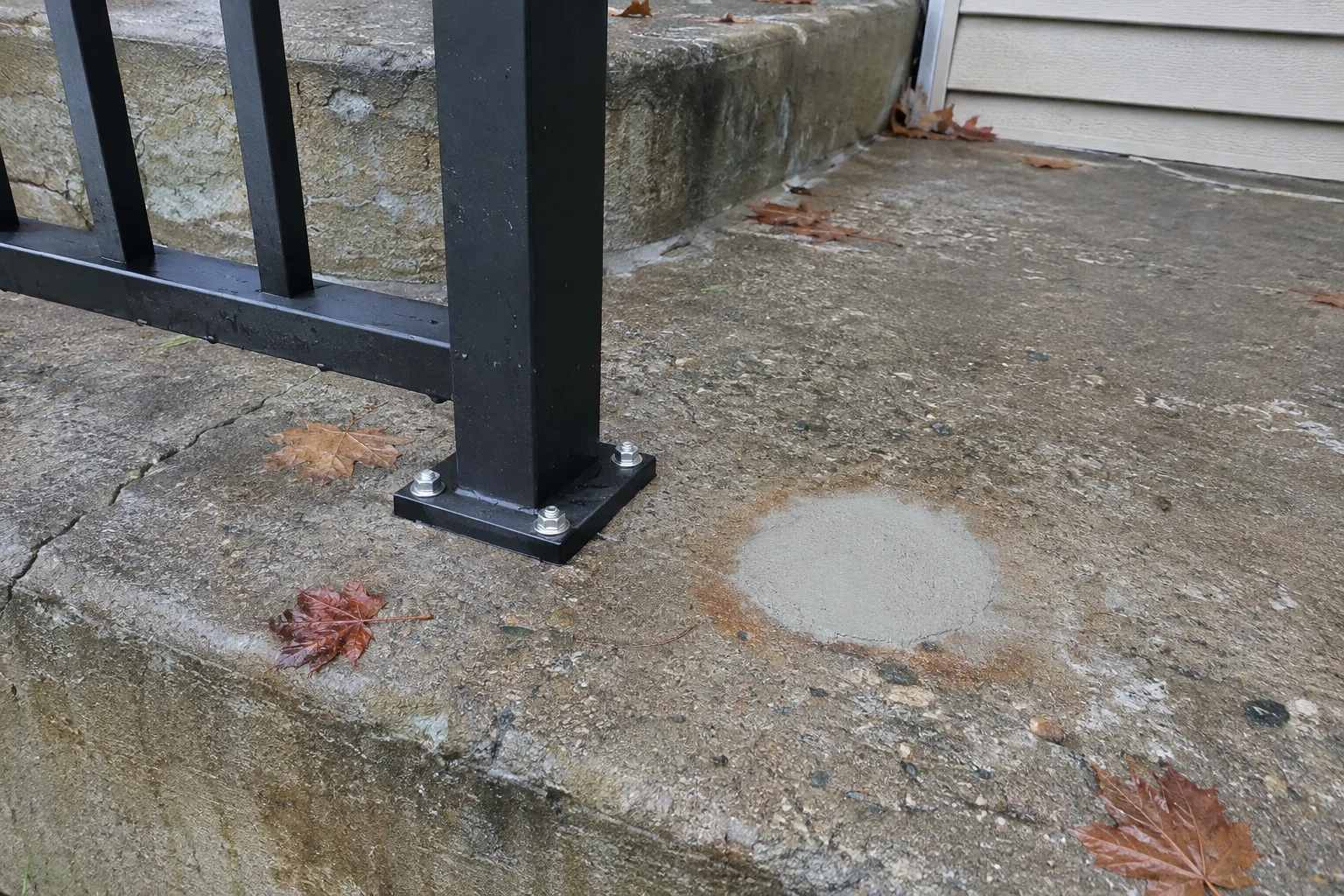
Does your railing wobble when you lean on it? Send close-up photos of each post foot through our quote form. We look at the base first, on site, and give you a written quote.
The rules that touch a stair rail
A stair rail means a handrail you can grip and, where there is a drop, a guard. Heights and openings change with the situation and with the edition of the code, so we keep them in one place: our aluminum railing height guide for Quebec. If you are choosing between glass and pickets, our glass vs picket comparison covers that.
CAA-Québec’s page on guardrails and handrails, published in 2016 and referring to the 2010 building code, says an exterior handrail is required for stairs with more than 3 risers serving a single dwelling. The current code text may differ, so confirm with your municipality what applies to your steps.
Permits: what Saint-Jean-sur-Richelieu and Brossard say
You obtain the municipal permit. If we dig new footings in the ground, we handle the Info-Excavation utility check. The cities do not all say the same thing, and neither South Shore page below mentions replacing a railing on its own.
Saint-Jean-sur-Richelieu. Its renovations page lists building, enlarging or renovating a porch, an exterior stair, an access ramp or similar among the cases where a permit is required. A “declaration of works” can replace the permit for a single-family home when the work is in the rear or side yard, not adjacent to a street. Work subject to the city’s architectural review (PIIA) cannot use that route, and front steps facing the street do not fit it either. The city says to wait for the permit before starting.
Brossard. Its page on exterior stairs, ramps or lifts says “permit required” and points to an application form. It states no conditions or exceptions.
Montréal, for comparison. The city’s page says you do not need a permit to maintain or repair an exterior stair, for example by replacing a step, but you do need one to build or replace a stair or an element of its structure, such as a railing or guard. Boroughs add their own conditions, and none of this is a South Shore rule.
Where a page is silent, call the permit office and ask about your address.
Exterior stair railing prices: what is published and what is left out
We do not publish a price for stair railing installation. Here is what others have published and what their figures include.
| Source | What it prices | Range | What is inside |
| A railing contractor (undated page citing 2025 standards) | Aluminum with pickets | $55 to $150 per linear foot | Materials; installation may add 30% to 50% to the total price. The same page gives $80 to $250 for aluminum elsewhere |
| A renovation-leads site (updated November 2023) | Aluminum patio railing | An average starting at $78 per linear foot | Contents not stated |
These are ballpark figures, not quotes, and both sources are commercial. Each prices by the linear foot, and neither prices a staircase.
What moves the total on your steps:
- the length of the run, and how many posts it needs;
- the condition of the concrete, since repair or a new pad comes before any posts;
- whether the old iron railing has to come out (ask every contractor if removal is in the price);
- pickets or glass panels;
- the permit fee, if your city charges one.
When the work can happen
If your railing moves under your hand, treat it as unsafe and have it looked at now, even if the work itself has to wait.
Our quote form takes requests for work periods from early April through late November. A job with a new pad needs the 14 days of curing inside that window, so on the visit we can tell you what can be done this season and what should wait for spring.
2 Real Cases
Chambly: wrought iron on front steps. The owners of a bungalow noticed their iron railing rocking when they carried groceries. The posts were rust-stained where they entered the concrete, and fine cracks ran out from two of the feet. A push by hand showed the base moving. The concrete around them was still sound, so we repaired the cracks and closed the old post holes. The owners were done repainting, so we anchored aluminum posts in good concrete away from the edge of the step. The owners obtained the city permit before we started.
Saint-Jean-sur-Richelieu: side-door steps. On a single-family house, the step edge beside the old railing had broken away, and the concrete crumbled around the nearest post. A new anchor would have had nothing to grip. We poured a new pad, waited 14 days for it to cure, and then set the aluminum posts. The owner checked with the city before we started and used only sand on the new concrete until spring.
Frequently Asked Questions
1. Can I tighten the railing myself?
Sometimes. If the concrete is sound and a fastener has loosened, tightening may fix it. If the bolt keeps turning or the hole is wider than the bolt, the concrete may have failed, so stop and have it checked.
2. Do I need a permit to swap the railing?
It depends on your city. The South Shore pages we read list exterior stairs among permit cases, but not replacing a railing alone. Call your permit office with your address. The permit is yours to obtain.
3. How long does the job take?
On an existing deck, mounting takes us 1 to 2 days. On concrete steps we give a number after the visit, because it depends on what the concrete needs. A new pad adds a 14-day cure before the posts go in.
4. What does an exterior stair railing cost?
We price after seeing the steps. The published ranges are per linear foot and say nothing about repair or a new pad, so a phone figure would be a guess. Attach photos to the quote form and we book the visit.
5. What decides how long an aluminum railing lasts, and what upkeep does it need?
How long it stays solid depends on the anchors and the concrete as well as the metal, since a good rail cannot make up for a failing base. There is no rust to brush and repaint. Each spring, rinse salt off the post feet, push each post, and look for new cracks.
6. What should I prepare before the visit?
Clear snow and ice from the steps, and take a close photo of each post foot. Note where the railing moves and when the rust first appeared.
Disclaimer: Prices are ballpark figures from third-party sources, not quotes. A final price comes after an on-site evaluation, since it depends on the condition of the concrete, access to the site and material costs. Municipal rules differ from city to city; confirm with your municipality, and note that the permit is obtained by the homeowner. This article is general information, not an engineering or legal opinion.
If your railing wobbles or rusts and your steps are concrete, send us a few photos through our quote form. We look at the base first. For what we install, see our aluminum railing installation.
Phone: (438) 830-3436
Email: lescloturesduratech@gmail.com
Website: lescloturesduratech.com
We serve homeowners across the South Shore and Montérégie, in English and French.