

5 things you’ll learn
- Frost usually means mesh with a coloured vinyl coating, and chain link usually means bare silver galvanized mesh. The two words are very often mixed up, so ask which one a quote means.
- Black mesh is galvanized under the vinyl too, but with far less zinc than bare galvanized mesh, so a chip in the vinyl matters more than it looks.
- Vinyl-coated is not one specification. ASTM F668 has three classes, and you can ask for the class by name.
- Colour barely moves the price. Height, wire gauge and the number of gates matter more, so those are the lines to compare between quotes.
- Sellers’ lifespan figures disagree by up to a factor of two. The firmer number is a manufacturer’s 15-year warranty, and it covers the mesh, not the posts or the installation.
In this article (contents)
- Frost or chain link: which one is on your quote?
- Black or galvanized: where each one fits
- What protects the wire: vinyl on one, zinc on the other
- Three vinyl classes: what to ask your supplier for
- Price: gauge and height move it more than colour
- How long each lasts: what sellers say, and what a warranty is
- Where each one fails first: salt, cold and chips
- 2 Real Cases
- Frequently Asked Questions
A quote says “clôture Frost noire”. A store roll says “galvanized”.
The fence at the farm down the road is silver, the one next door is black, and in Quebec people often call all of them Frost. So which belongs on your lot: black or galvanized chain link?
The short answer: black Frost is galvanized steel wire with coloured vinyl on top, and bare chain link is steel wire with a much heavier zinc coating and no vinyl.
At Duratech the price gap is small, and galvanized is generally the most affordable option. Black suits a residential yard. Bare galvanized suits long perimeters. Each one is protected differently, so each one wears out in a different place.
Frost or chain link: which one is on your quote?
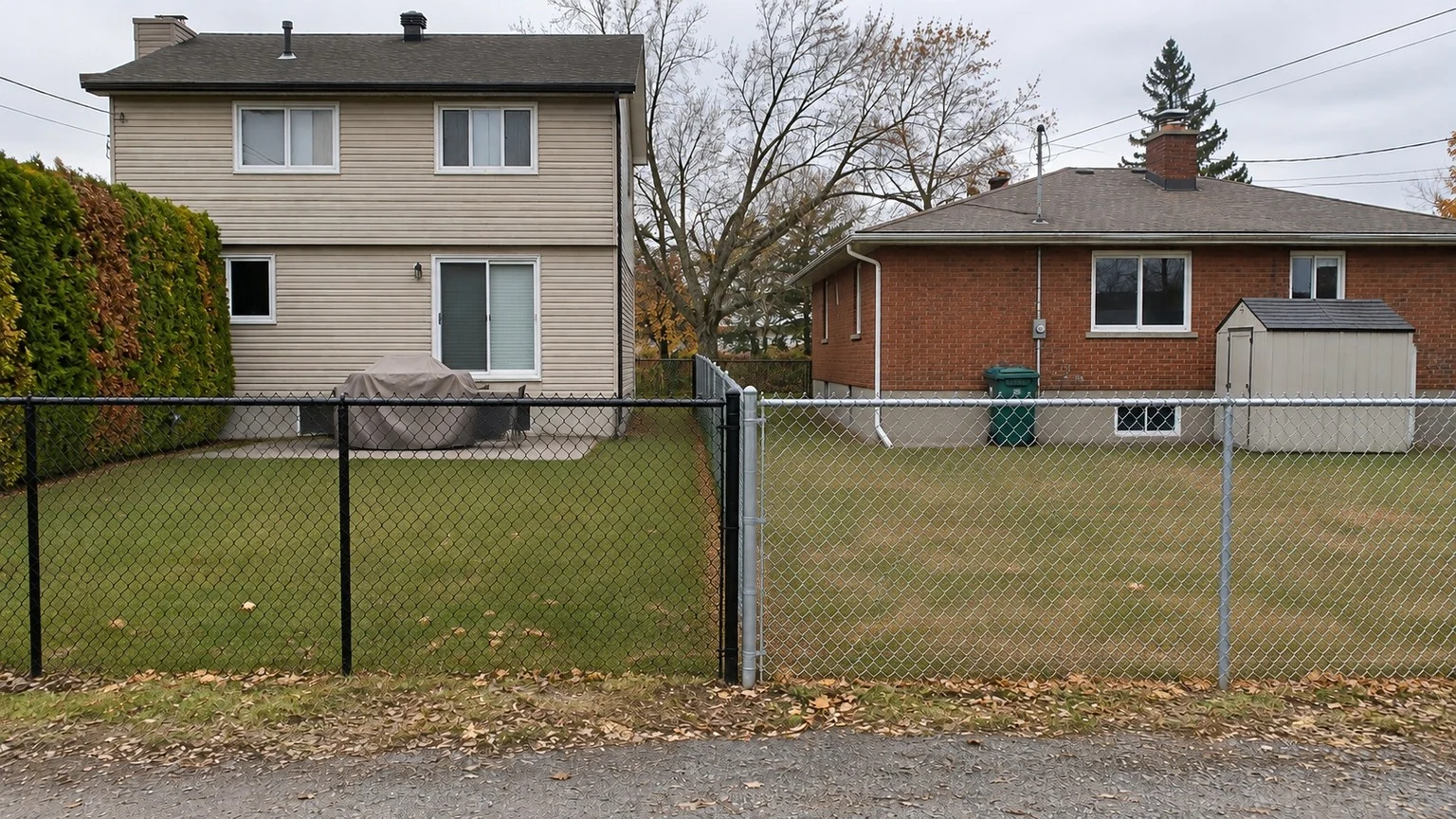
In Quebec, “Frost” usually means residential mesh with a coloured vinyl coating: black, white, brown, green or taupe, with black the most popular.
“Chain link” usually means the raw, silver galvanized mesh you see around commercial and industrial sites. Strictly, vinyl-coated mesh is chain link too: the word names the weave, and the two finishes differ in what covers the wire.
But the two words are very often mixed up: many people call any chain-link fence a Frost, and one Quebec price guide lists “Frost galvanisée” and “Frost enduite de vinyle” side by side.
So when a quote, a search result or a store shelf says Frost, ask one question: vinyl-coated or bare galvanized? Our Frost fence guide explains what a Frost fence is. This article starts from the choice between the two finishes.
Black or galvanized: where each one fits
| Black (Frost) | Galvanized (chain link) | |
| What you see | Vinyl in black, white, brown, green or taupe | Raw, silver zinc-coated steel |
| Main protection | The vinyl, with thinner zinc behind it | The zinc |
| Where we use it | Residential yards | Commercial and industrial sites, large secured perimeters |
| Price at Duratech | Small premium | Generally the most affordable |
| Watch | Cuts and chips in the vinyl | Salt and time |
| Ask your supplier | Which ASTM F668 class | Which ASTM A392 class |
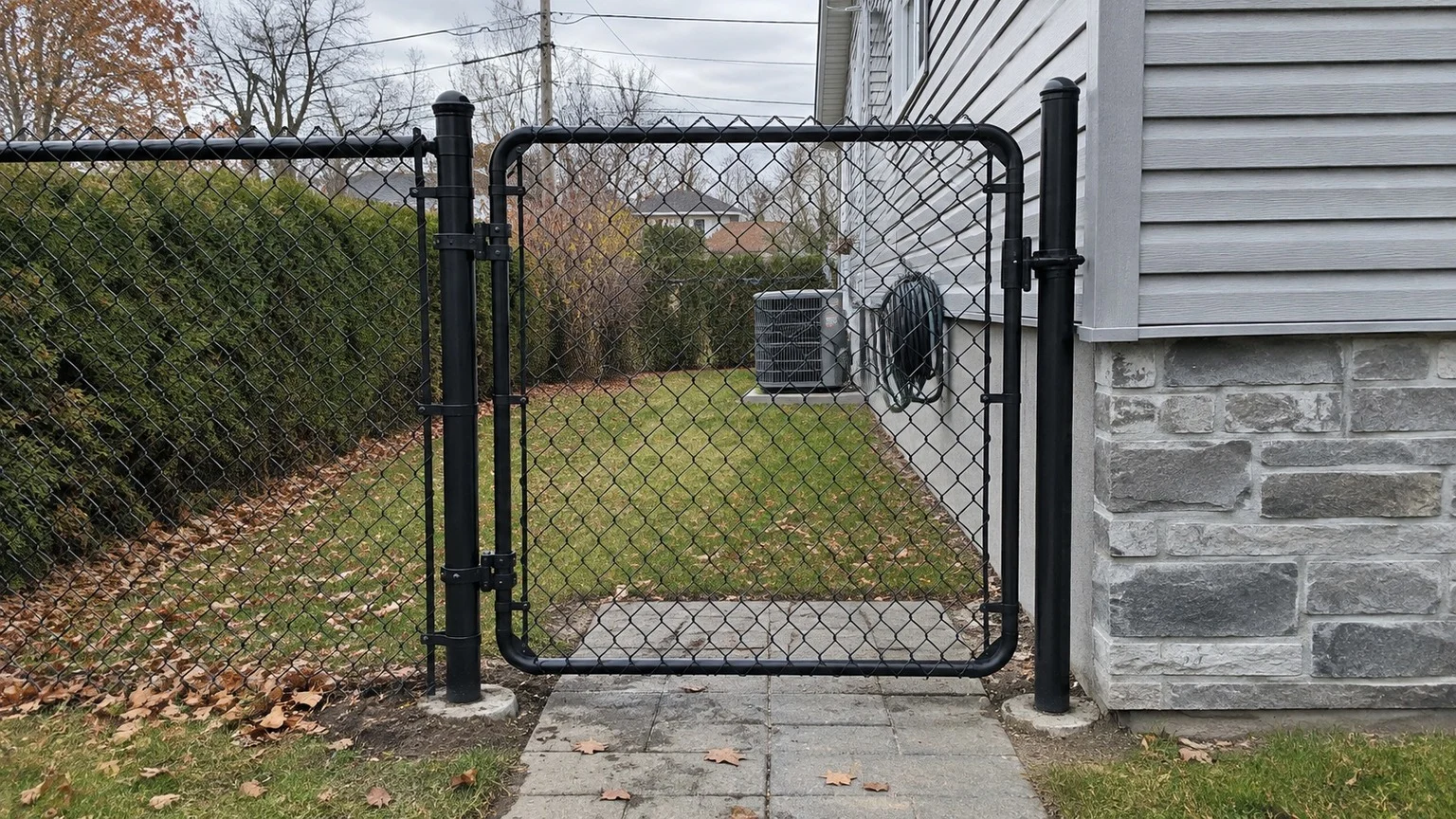
For a front, side or back yard that people look at every day, we install black. It is the favourite because it blends into landscaping.
If you have a dog, we custom-fit Frost mesh flush to the ground, with no gap underneath.
For a storage yard, outbuildings or a large perimeter where looks matter less and footage matters more, bare galvanized is the economical match.
Not for a pool. We don’t use chain-link, black or galvanized, to enclose a pool. For a pool we install an ornamental aluminum or steel fence, and the pool rules apply: see our pool gate guide.
Our Frost fencing and chain-link pages show both finishes.
What protects the wire: vinyl on one, zinc on the other
Both fences typically start with zinc-coated steel wire. Under the vinyl, the ASTM F668 standard also allows aluminum or a zinc-aluminum alloy, but the manufacturer we cite below uses a galvanized steel core. Bare chain link is zinc-coated fabric.
The difference is how much zinc each carries.
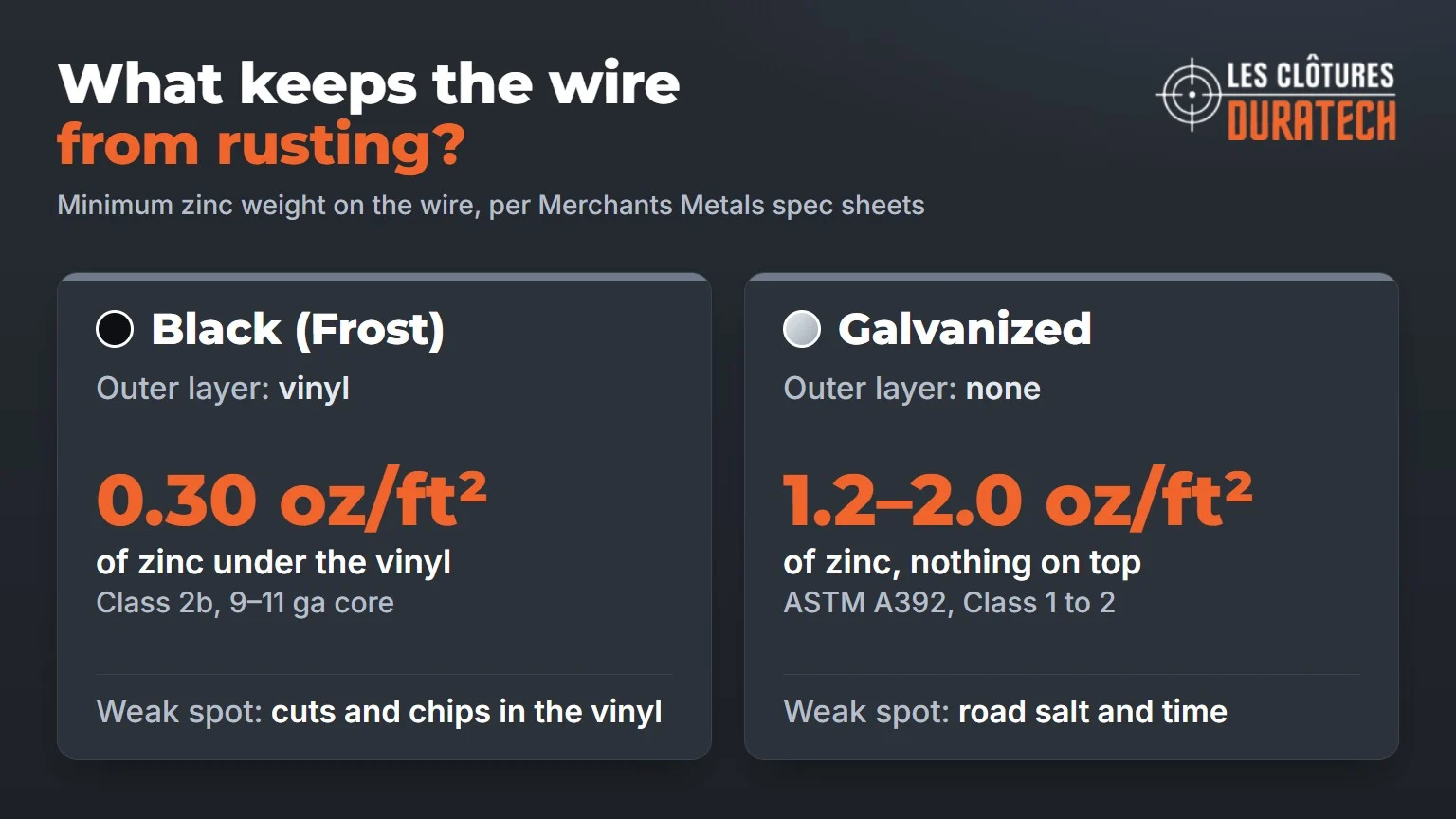
In the spec sheets cited in the box “What the sources say” below, the wire under fused-and-adhered (Class 2b) vinyl carries a third of the zinc on bare galvanized wire or less, depending on the gauge and the class.
This is not a defect. The vinyl does the main work, and the zinc is the layer behind it. On bare mesh the zinc is the only layer.
That is our reading of one manufacturer’s spec sheets, not a Quebec rule or a test of the fence we install. It still explains why the two fail differently.
Black mesh is hurt where the vinyl is cut or chipped, because the zinc behind it is thinner. Galvanized mesh is worn down by time and salt.
Three vinyl classes: what to ask your supplier for
“Vinyl-coated” is not one specification. ASTM F668 defines three classes by how the polymer meets the wire: Class 1 is extruded over the wire, Class 2a is extruded and adhered, and Class 2b is fused and adhered.
Sellers put fused-and-adhered (Class 2b) at the top (see the box “What the sources say” below). That is a sales ranking, not a test result.
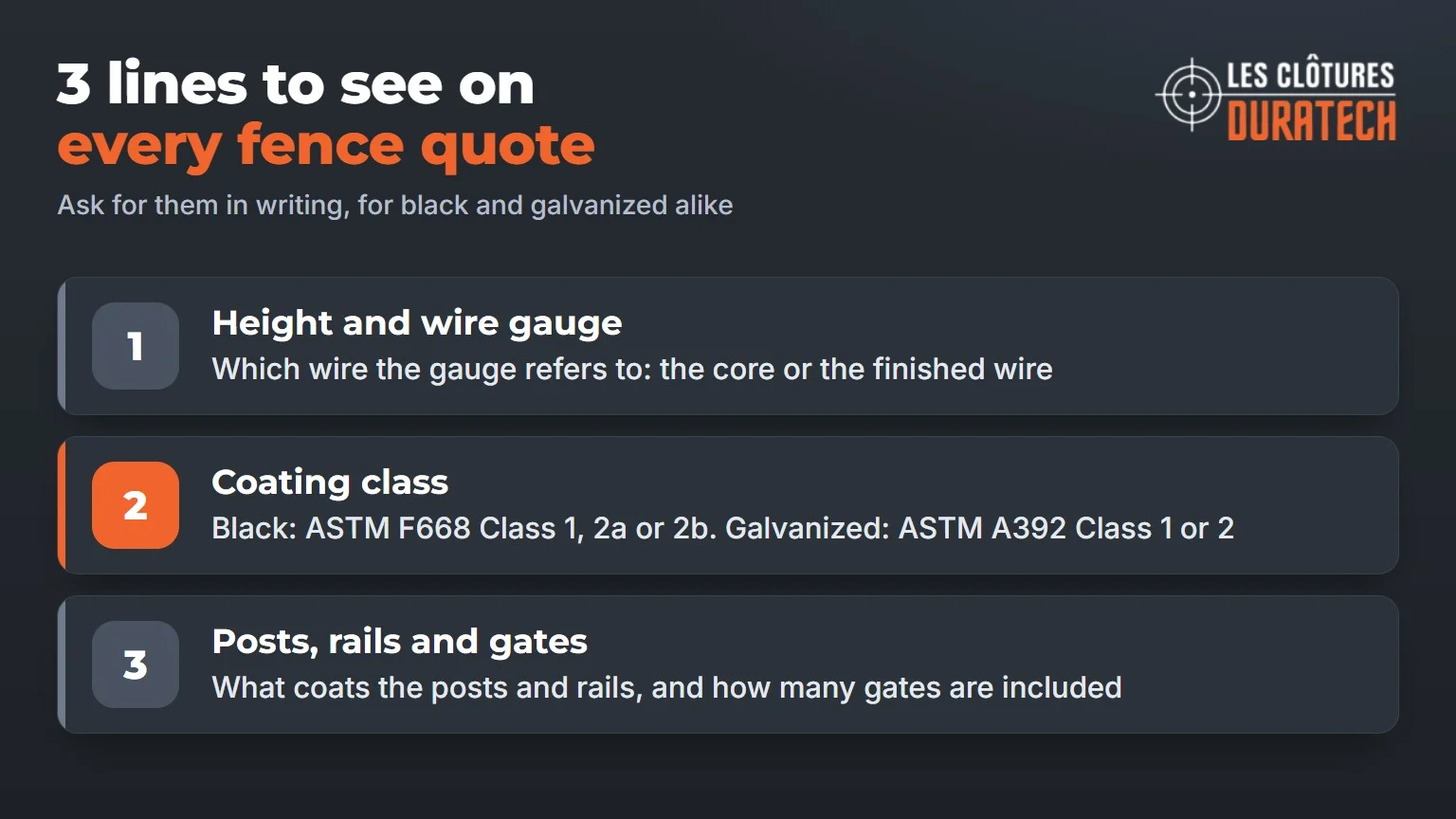
When you compare two black fences, compare the class. Ask the supplier or installer for it by name and have it written on the quote. Our privacy slats article makes the same point about F668.
For bare galvanized mesh, the question is the A392 class: Class 1 or Class 2.
And ask what is on the posts and rails, not only on the mesh: a black fence on bare silver posts is a different fence from one coated top to bottom.
What the sources say
Class names (Merchants Metals and a fittings supplier). Merchants Metals, a manufacturer, labels Class 1, 2a and 2b Good, Better and Best. The fittings supplier likewise says fused-and-adhered offers the most corrosion and weather resistance.
Zinc under the vinyl (Merchants Metals, spec sheet revised April 2021). For fused-and-adhered (Class 2b) fabric, the spec sheet lists a minimum zinc coating weight of 0.30 oz/ft² (92 g/m²) on 9 or 11 gauge core wire, and 0.40 oz/ft² (122 g/m²) on 6 gauge core wire.
The vinyl is 0.006 to 0.010 in (0.15 to 0.25 mm) thick. For Class 2a (extruded and adhered), its sheet gives a vinyl thickness of 0.015 to 0.025 in (0.38 to 0.64 mm). So the top-ranked class has the thinner vinyl; a retailer’s guide says fusing and adhering reduces the risk of the coating separating from the wire.
Zinc on bare galvanized mesh (Merchants Metals, ASTM A392). The same maker’s galvanized fabric sheet lists two coating classes: Class 1 at a minimum of 1.2 oz/ft² (366 g/m²) and Class 2 at 2.0 oz/ft² (610 g/m²).
ASTM’s A392 page describes the standard as covering zinc-coated steel chain-link fence fabric.
Classes in the standard (ASTM F668-25). Section 1.2 defines Class 1 as polymer extruded over the coated wire, Class 2a as extruded and adhered, and Class 2b as fused and adhered.
The coating on the wire underneath may be zinc, aluminum or a zinc-5 % aluminum alloy.
Warranty (Merchants Metals). Its spec sheets for Class 1, 2a and 2b each say the fabric is “warranted for 15 years against failure due to rust or corrosion”.
It is the same term for all three classes. This is that manufacturer’s warranty, not a Duratech warranty, so read its terms before you rely on it.
Posts and rails (Merchants Metals). The same maker offers framework with a colour coating over a galvanized substrate: 3 mils (light) or at least 10 mils (heavy), a mil being a thousandth of an inch.
Prices from other sources (ballparks, not quotes). A Quebec lead-generation site (page modified 12 September 2026) lists galvanized mesh at $18 to $35 per linear foot and vinyl-coated at $25 to $45. On 150 linear feet, the gap between those two ranges is about $1,050 at the low end and $1,500 at the high end.
It also says colour itself has no real effect on price, and that black and brown are the most requested.
A US installer’s own data (May 2026) puts black vinyl-coated and bare galvanized at about the same installed price per foot. It adds that it has fewer vinyl projects in its sample.
Lifespan from sellers. One chain-link supplier’s comparison page (February 2026) lists 10 to 20 years for galvanized and 15 to 25 years for PVC-coated, depending on environment.
The retailer whose guide we cited on vinyl thickness says galvanized mesh typically lasts 20 to 40 years inland when properly specified and maintained, about twice the chain-link supplier’s figure for galvanized.
The fittings supplier cited above says fused-and-adhered fabric can last up to 20 years, depending on the environment.
Salt and zinc (a galvanizer’s note). A galvanizer’s technical note (February 2026) says galvanized steel is not incompatible with magnesium chloride: “The system still works, but it operates under more demanding conditions”.
It adds that this “does not mean the coating fails immediately”, only that the corrosion rate increases relative to a clean atmosphere. It also says sodium, calcium and magnesium chloride all introduce chloride ions that can take part in corrosion.
Price: gauge and height move it more than colour
For a professionally installed 6-foot residential fence, we typically quote $25 to $60 per linear foot. Our Frost fence price guide gives that range for black vinyl-coated mesh and lists what it includes.
Galvanized is generally the most affordable option; at Duratech, the premium for black is small.
Third-party ranges in the box “What the sources say” above land in the same place: vinyl-coated level with galvanized or up to about $10 a foot above it, and the vinyl, not the colour, is what adds the cost.
Store rolls show no consistent colour premium either. These are prices shown on two national retailers’ websites on 2 November 2026, before tax, with a Montreal-area store selected on each site.
Prices per 50-ft roll:
| Roll | Black, vinyl-coated | Galvanized |
| Retailer A, 4 ft × 50 ft | $129 | $154 |
| Retailer A, 5 ft × 50 ft | $183 | $185 |
| Retailer B, 5 ft × 50 ft | $266 (listed gauge 9) | $169 (listed gauge 11.5) |
| Retailer B, 5 ft × 50 ft, another brand | $186 (black steel; coating and gauge not listed) | — |
At retailer A, black was cheaper on both rolls, by $25 at 4 ft and $2 at 5 ft, and the listing titles give no gauge.
At retailer B, where the two rolls with a listed gauge are sold online only, the gauge-9 black roll cost $97 more than the gauge-11.5 galvanized one; another brand’s black roll on the same site was $186, $17 above the galvanized.
Gauge labels are not always comparable: on colour fabric the gauge can refer to the core wire or to the finished, coated wire, and the retailer B listing does not say which one its 9 is. A lower number means heavier wire either way.
Where a gap is large, as at retailer B, look at the wire first. When you compare quotes, ask what height, what gauge and how many gates are in each number.
Comparing a “Frost” quote with a “chain link” one? Send us your footage, height and gate count through our fence quote form. We come to the site and give you a written quote.
How long each lasts: what sellers say, and what a warranty is
Our own Frost guide says that with quality materials, proper installation and reasonable maintenance, a high-quality Frost fence can often last 20 years or more. That is a conditional estimate, not a promise.
Seller figures run wider than ours and disagree with each other by up to a factor of two (see the box “What the sources say” above). They don’t agree on which finish lasts longer either: one supplier ranks vinyl-coated ahead of galvanized, while a retailer’s inland figure for bare galvanized is higher than that supplier’s figure for vinyl.
We found no source showing one finish reliably outlasting the other. On your lot, it comes down to where each one wears: chips for black, salt for galvanized (next section).
The one hard number on paper is a warranty: 15 years against rust or corrosion from one manufacturer, on all three vinyl classes. It covers only that maker’s fabric, not the posts or the installation, and its wording says nothing about the colour fading.
The mesh is also only part of it. Our standard is to drill below the frost line and set the posts in concrete, so winter frost heave is far less likely to push them up.
We then wait 14 days for the concrete to cure before tensioning the mesh. That is our practice, not a code. If the posts heave or lean before the mesh wears out, the fence needs work anyway, whatever the coating.
Where each one fails first: salt, cold and chips
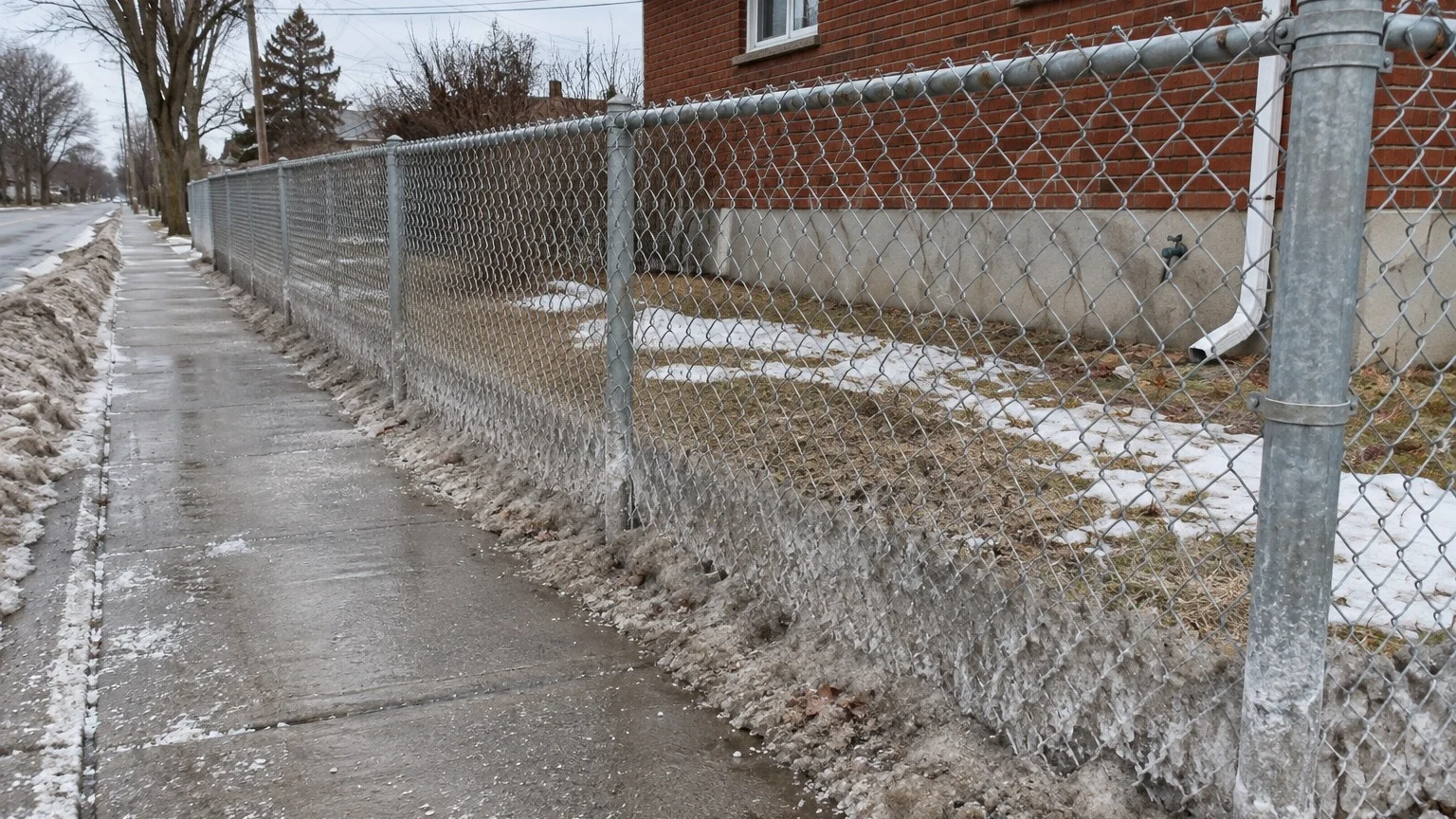
Galvanized and salt. On bare mesh the zinc is the only protection, and road salt is a chloride that makes it work harder (see the box above).
If your fence line runs along a salted sidewalk or street, as many do on the South Shore, expect the zinc to wear faster there than on the back of the lot, and look at that stretch first each spring.
Black and the cold. PVC as a material becomes more brittle as the temperature drops. That is a property of the plastic itself, as our privacy slats article notes.
The same article says the vinyl-coated mesh is designed for our freeze-thaw cycles. In deep cold, keep shovels and ice chippers off the mesh: that is when the vinyl is least flexible. Sun is a separate matter: our Frost guide describes the vinyl as UV-resistant.
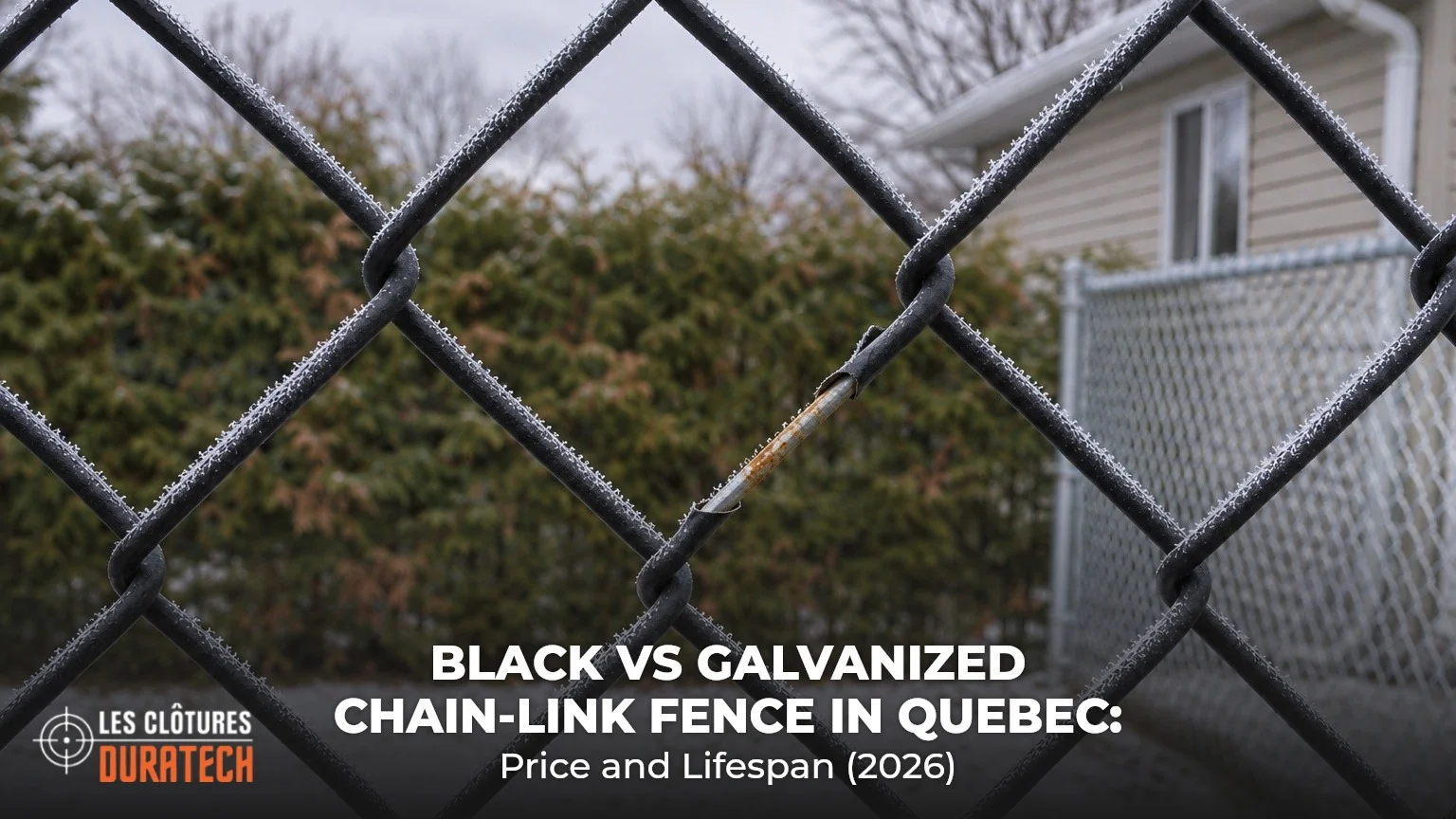
Black and chips. Where the vinyl is chipped or cut, it no longer shields the wire, and the steel there is left with only the thinner zinc layer described above.
Walk the line each spring and look where shovels, snowblowers and mowers get close. A spot that is bare steel is worth a call to your installer, not a wait.
2 Real Cases
Brossard: a rust streak on a black fence. A Brossard homeowner had a black Frost fence along the driveway.
A snowblower had cut the vinyl at the foot of one section, and two winters later a rust streak followed the cut.
The vinyl was sound everywhere else. We replaced the damaged length of mesh, and the owner moved where the snow gets thrown.
Saint-Constant: two quotes, one word. A Saint-Constant homeowner held two quotes for a 5 ft fence, one saying “Frost” and one “chain link”, and the second was cheaper. Neither listed gauge or coating.
We wrote out height, gauge, coating class, posts and gates for both, and the cheaper one turned out to be bare galvanized with lighter wire.
The two numbers were never for the same fence. She kept that list and asked every installer for the same lines.
Frequently Asked Questions
1. Is a black chain-link (Frost) fence more expensive than galvanized?
Slightly, in our experience. What adds the cost is the vinyl, not the colour, and height, gauge and gate count move the total more.
The price section above has store rolls and our typical range, the box “What the sources say” has third-party ranges, and we give your figure after seeing the site.
2. Does black or galvanized chain link last longer?
Neither reliably outlasts the other, on paper: seller figures disagree, and we don’t promise a number of years for a fence. It depends on the wire gauge, the coating class, the posts and the installation.
The lifespan section above explains one manufacturer’s 15-year warranty, and the box “What the sources say” has the seller figures. If a warranty is part of the sale, ask for its text in writing.
3. Can I paint my galvanized fence black?
You can, but the AGA (American Galvanizers Association) says paint on galvanizing fails when surface preparation is inadequate or the paint system is not compatible with zinc.
The surface must be cleaned and then profiled, by sweep blasting, wash primer or acrylic pretreatment.
How much work that takes depends on whether the steel is new, partly weathered or fully weathered. We can’t give you a number of years for a home paint job.
4. Is black or galvanized better for a dog?
Neither finish makes a difference to a dog. What matters is the gap under the mesh, and a dog finds a gap fast.
We fit the mesh to the ground line. Mention your dog when you request a quote, and we will go over it with you on site.
5. Can a damaged section be fixed, or does the whole fence need replacing?
Often one section is enough. When the vinyl is cut in one spot and the rest is sound, the damaged length of mesh can be replaced, as in the Brossard case above.
When rust shows along much of the line, a section repair may no longer be enough. When posts lean, look at them first: our article on leaning fence posts covers that decision.
6. What do I have to do before the crew comes?
The municipal permit is yours, and rules on height and setbacks vary by city, so ask your city hall first.
We handle the Info-Excavation locate request. The concrete around our posts gets 14 days to cure before the mesh goes on, so plan for that wait.
Disclaimer: Prices are ballpark figures from third parties and from our own typical range, dated or recorded between May and November 2026, and are not a quote. The final price follows an on-site evaluation, since it depends on slope, site access, wire gauge and material costs.
Lifespan and warranty figures come from sellers and manufacturers and are not a rating. Municipal rules on fence height, setbacks and permits vary from city to city, so confirm yours with your city hall; the homeowner obtains the permit. This article is general information, not an engineering or legal opinion.
Ready to price black or galvanized for your lot? Tell us your footage, height and gates in our fence quote form.
Phone: (438) 830-3436
Email: lescloturesduratech@gmail.com
Website: lescloturesduratech.com
We serve homeowners across the South Shore and Montérégie, in English and French.