

6 things you’ll learn
- What Quebec’s code asks of a glass railing — and why your municipality, not the province, usually enforces it on a house
- How framed and frameless glass railings differ, and why that changes the quote
- Why glass railings kill birds, and the 5 cm marker rule that cuts the risk without spoiling the view
- Why a glass panel can occasionally break on its own, and what to ask your installer about glass type and warranty
- What glass and picket railing cost in Quebec, per foot and for a whole deck, and what moves the price
- Which style fits your deck: view, upkeep, privacy, and winter care compared
In this article (contents)
- Two Railing Styles, One Code to Meet
- What Quebec’s Building Code Actually Requires
- Who Needs a Contractor’s Licence — and Who Gets the Permit
- Glass vs Picket Railing: A Side-by-Side Comparison
- The Issue Most Railing Guides Skip: Glass Railings and Birds
- Privacy: Can You Still See Through It?
- Living With Glass Through the Quebec Seasons
- Can a Glass Railing Break? What to Ask Your Installer
- What Glass or Picket Railing Costs in Quebec
- New Concrete Pads: Why We Wait 14 Days Before Installing Railing Posts
- Existing Deck or Concrete Balcony: What the Railing Bolts Into
- Quick Way to Decide
- 2 Real Cases
- Frequently Asked Questions
Glass panels open up the view. Aluminum pickets ask less of you for the rest of the year. If you’re comparing deck railing ideas and wondering whether a glass railing is worth it for a Quebec deck or balcony, that’s really the whole decision — view and openness on one side, lower maintenance and a lower bird-safety risk on the other. Both styles can meet the same building code; what changes is what you live with every season after installation.
We at Duratech install both glass and picket aluminum railing across the South Shore, and homeowners regularly ask us to compare the two. This guide covers what the code actually requires for each, what they cost, how they hold up through a Quebec winter, and one issue most railing articles skip entirely — what glass does to birds.
Two Railing Styles, One Code to Meet
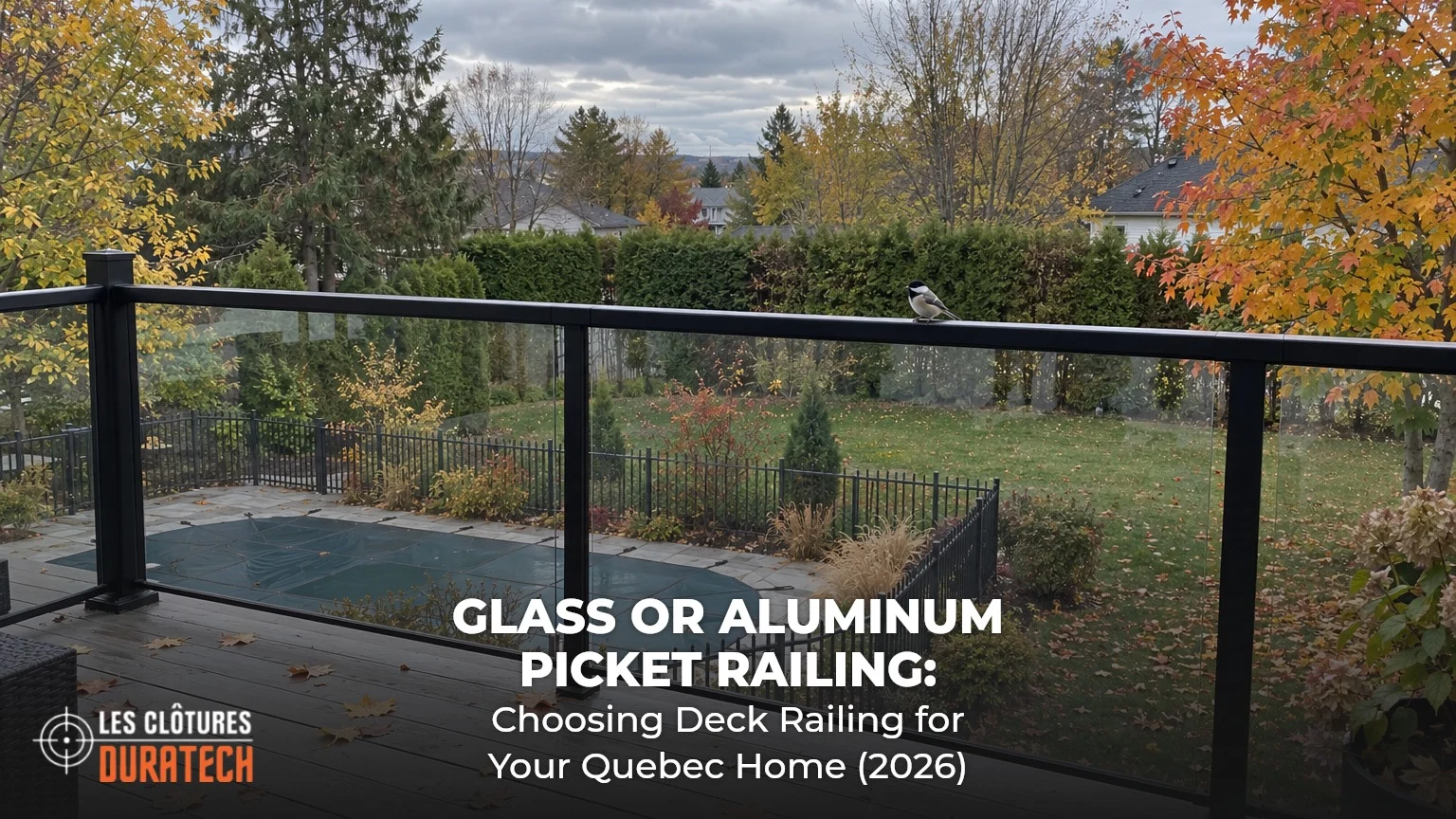
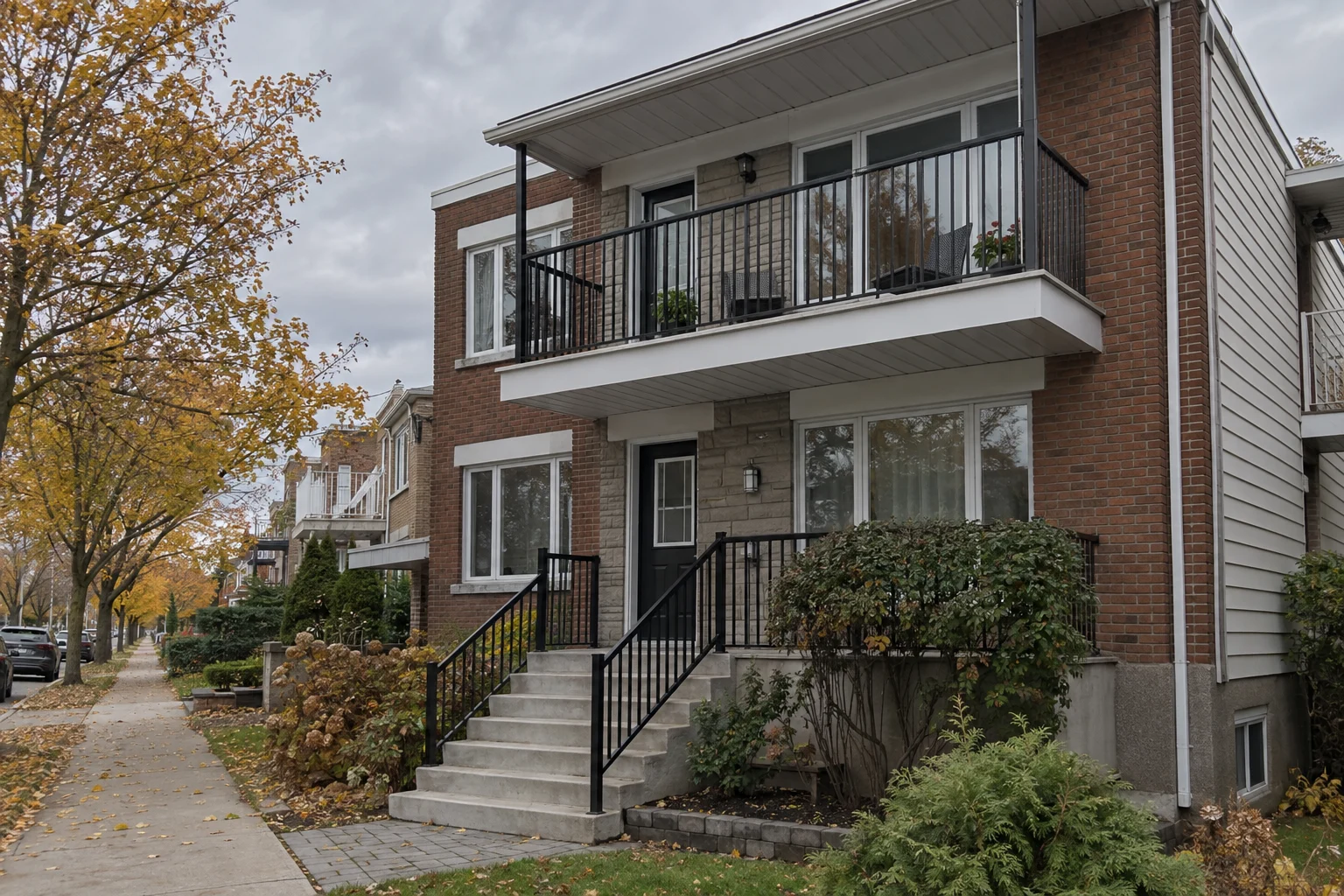
Our own aluminum railing page lists two main fill options. Standard Picket is a run of vertical aluminum bars, black or white, for what we describe as a timeless look. Glass Panel Style swaps the bars for glass panels, aimed at maximum visibility — we point to it especially for pools and waterfront lots, where blocking the view defeats the point of the deck.
Both belong to the same aluminum railing line and have to meet the same guard requirements, with a few extra rules for the glass itself. So the choice between them isn’t a structural safety trade-off. It’s mostly view versus upkeep, plus two questions unique to glass: birds, and what happens if a panel breaks.
Not every glass railing is built the same way, and that’s where most of the price confusion comes from. In a framed (post-and-rail) system, glass panels sit between posts under a top rail — the same frame a picket railing uses. In a frameless system, there are no posts between panels: the glass is held by spigots (clamps fastened to the deck surface or its side), by standoffs (pins bolted through the glass into the edge of the deck), or by a continuous aluminum base shoe, so the glass itself becomes part of the guard’s structure.
Frameless looks cleaner, and in one glass-railing specialist’s price list below, standoff and base-shoe systems sit at the top of the range. It also puts more weight on the anchoring base and on the structural engineer’s approval covered in the next section. Before comparing two quotes, ask which family each one is for: a framed price and a frameless price aren’t measured on the same basis.
The two fills can also share a run — glass on the side with the view, pickets along the other sides — and the combination is worth asking about. We offer aluminum railing systems that can accept glass panels — mention it when you request a quote, and we can discuss specific models.
What Quebec’s Building Code Actually Requires
We already cover required heights, the handrail-versus-guard distinction, and the gap limits for picket spacing in our aluminum railing height guide, so we won’t repeat the full set of numbers here. One general principle worth knowing for either style: openings in a guard generally can’t let a 100 mm sphere pass through — a rule that isn’t limited to picket spacing, and the same logic extends to any gap around a glass panel installation.
For glass specifically, a technical fact sheet from the Association de la construction du Québec sets out what the code asks of the glass itself: it has to be tempered (verre trempé) or laminated (verre feuilleté) safety glass that meets the CAN/CGSB-12.1 standard, chosen so that if it breaks, it doesn’t fall apart into large sharp shards: tempered glass crumbles into small granular pieces, while laminated glass has its sheets bonded to a plastic interlayer. Glass used in a guard also has to be engineered to resist wind and impact loads, and the design has to be approved by a structural engineer before it goes in.
That ACQ fact sheet is written against the 2010 edition of the Code de construction du Québec. Quebec’s official list of modifications made when it adopted the newer 2020 edition doesn’t touch the glazing requirements for guards, so the substance appears to carry forward — your designer or municipality can point you to the exact wording in the current edition.
One more nuance worth knowing: for most single-family homes, the Code de construction du Québec doesn’t apply directly. It’s usually your municipality’s building bylaw — which generally borrows the same Part 9 rules — that actually requires compliance on a private house. Confirm the current requirement with your own municipality before you order a railing.
Who Needs a Contractor’s Licence — and Who Gets the Permit
Installing or modifying a guard or handrail is construction work, so the contractor you hire for it generally needs a licence from the Régie du bâtiment du Québec (RBQ), unless the job falls under one of its specifically listed exemptions. Railing installation isn’t one of them: the RBQ’s list of work that doesn’t require a licence covers narrow items like concrete pumping, rock excavation at a quarry, and inspections of all types — not railing work. A licensed contractor should be doing the structural work, glass or pickets alike.
On our jobs, the municipal permit itself is the homeowner’s responsibility to obtain, not ours — the same split we use on every fence and railing project. Permit rules vary by city, so confirm what your municipality asks for before work starts.
Glass vs Picket Railing: A Side-by-Side Comparison
| Picket railing | Glass panel railing | |
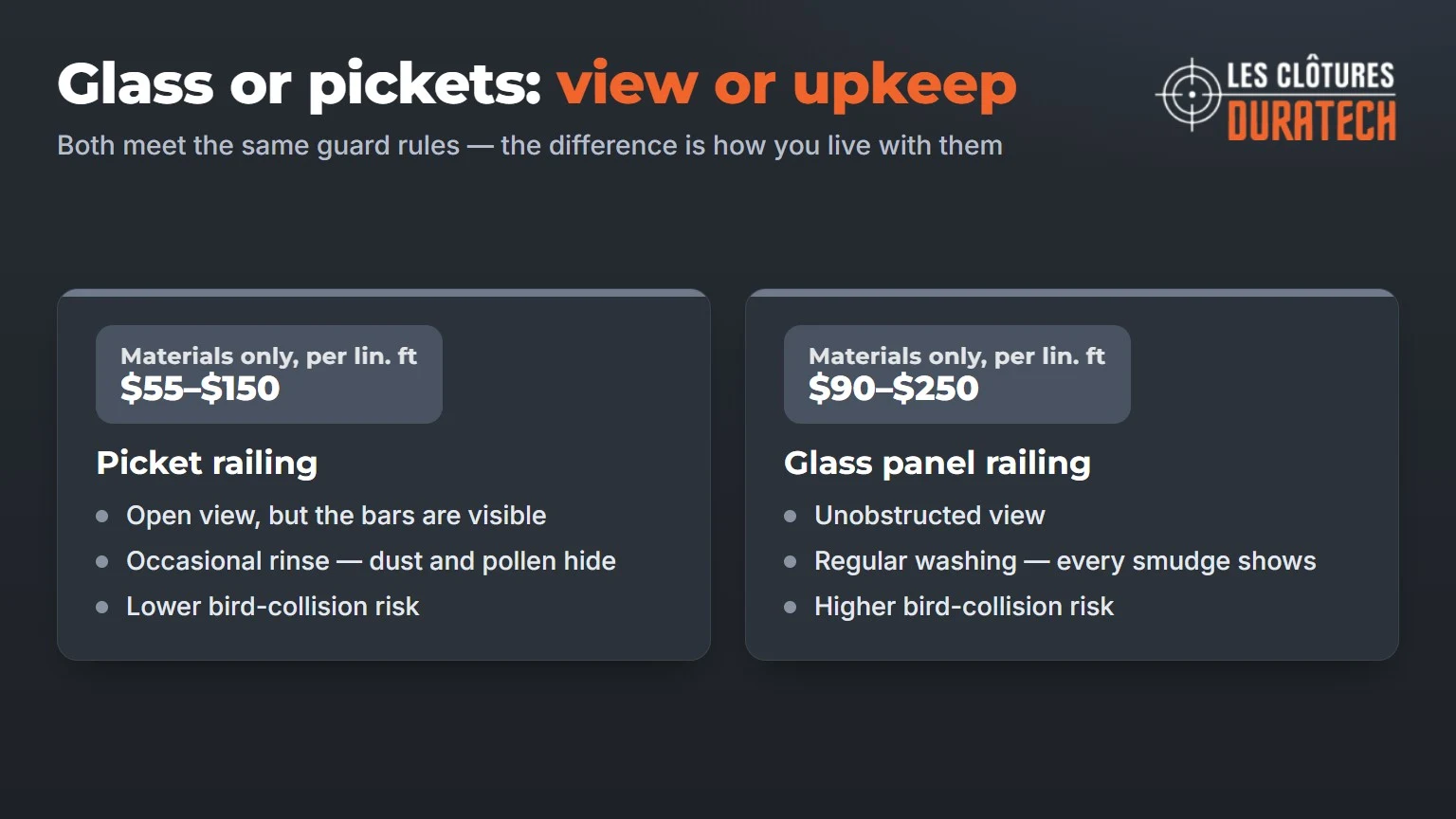
| View | Open, but the vertical bars are visible | Unobstructed — closest to no railing at all |
| Privacy | Low; gaps show through | Low with clear glass; frosted (givré) glass is an option for more privacy |
| Maintenance | Occasional rinse; dust and pollen are less noticeable | Needs regular washing — fingerprints, pollen, and everyday dust show on a clear surface |
| Bird safety | Lower risk; no large transparent surface | Higher risk; ECCC names clear, reflective materials as the most dangerous to birds |
| Price, Quebec ballpark | Roughly $55–150 per linear foot in materials (one installer’s list); installation extra | Roughly $90–250 per linear foot in materials (one installer’s list), or $100–400 installed (a glass specialist’s list), depending on the mounting system |
| Wind on the deck | Passes through the gaps | Cuts the wind across the deck — which is also why the panels must be engineered for wind load |
| Winter | No special handling; snow brushes off the same as any aluminum rail | Same clearing as any railing, plus more visible streaking once the snow melts |
The Issue Most Railing Guides Skip: Glass Railings and Birds
This is the part of the glass-versus-picket decision that rarely comes up in a quote, and the warning comes straight from the federal government. Environment and Climate Change Canada states plainly that “transparent deck railings and windows that face one another are also dangerous” for birds — the same collision risk as a window, because a bird in flight doesn’t register clear glass as a barrier.
What the sources say
What ECCC and FLAP Canada say. ECCC puts window collisions at 16 to 42 million bird deaths a year in Canada — a figure for windows generally, not specific to railings — and notes that only 1% of collisions happen at high-rise buildings; most occur at houses and low-rise buildings. FLAP Canada, a bird-safety non-profit, goes further: its advice for anyone planning a residential project is to choose a railing style other than glass, calling wood or metal “far superior.”
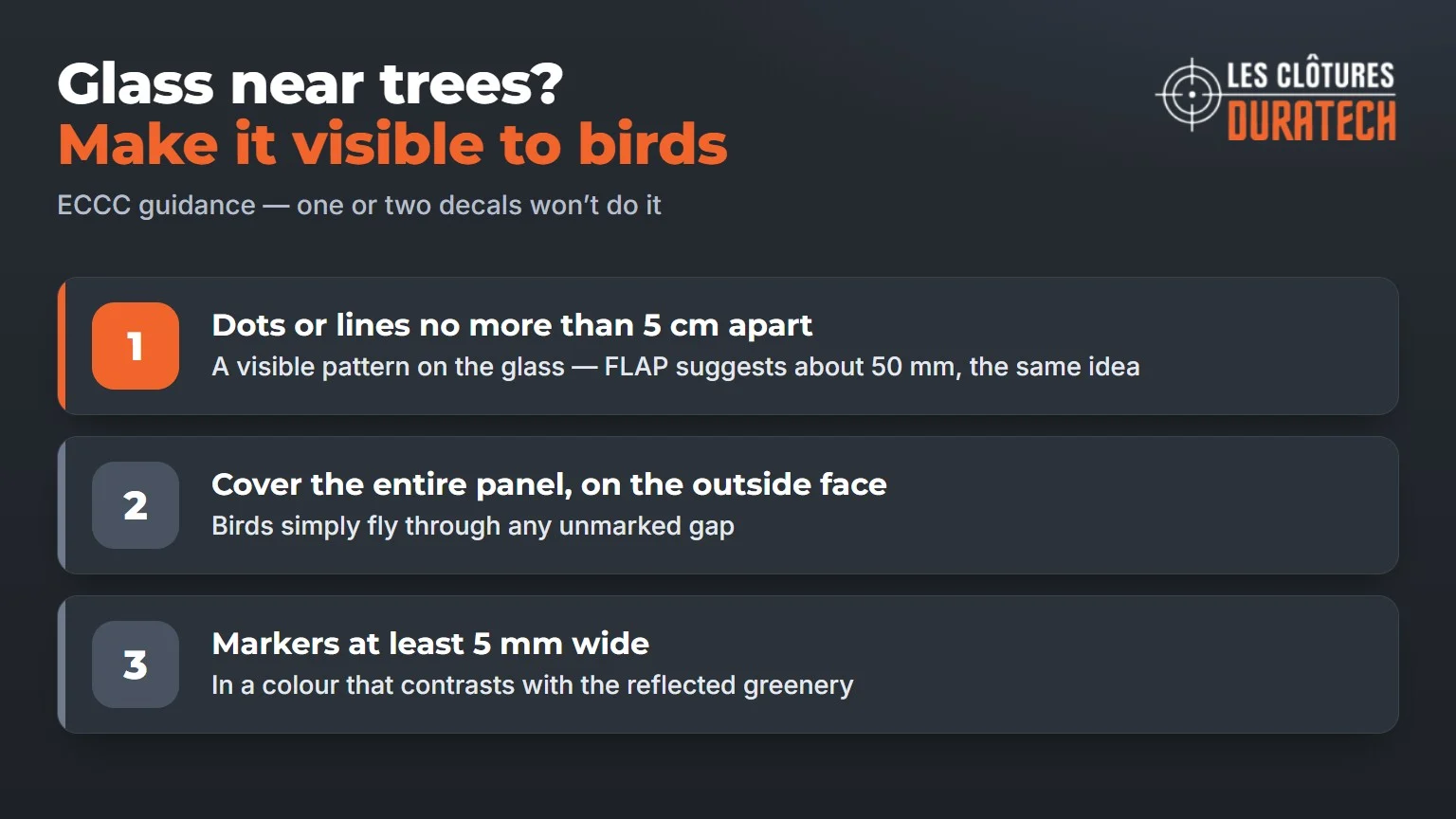
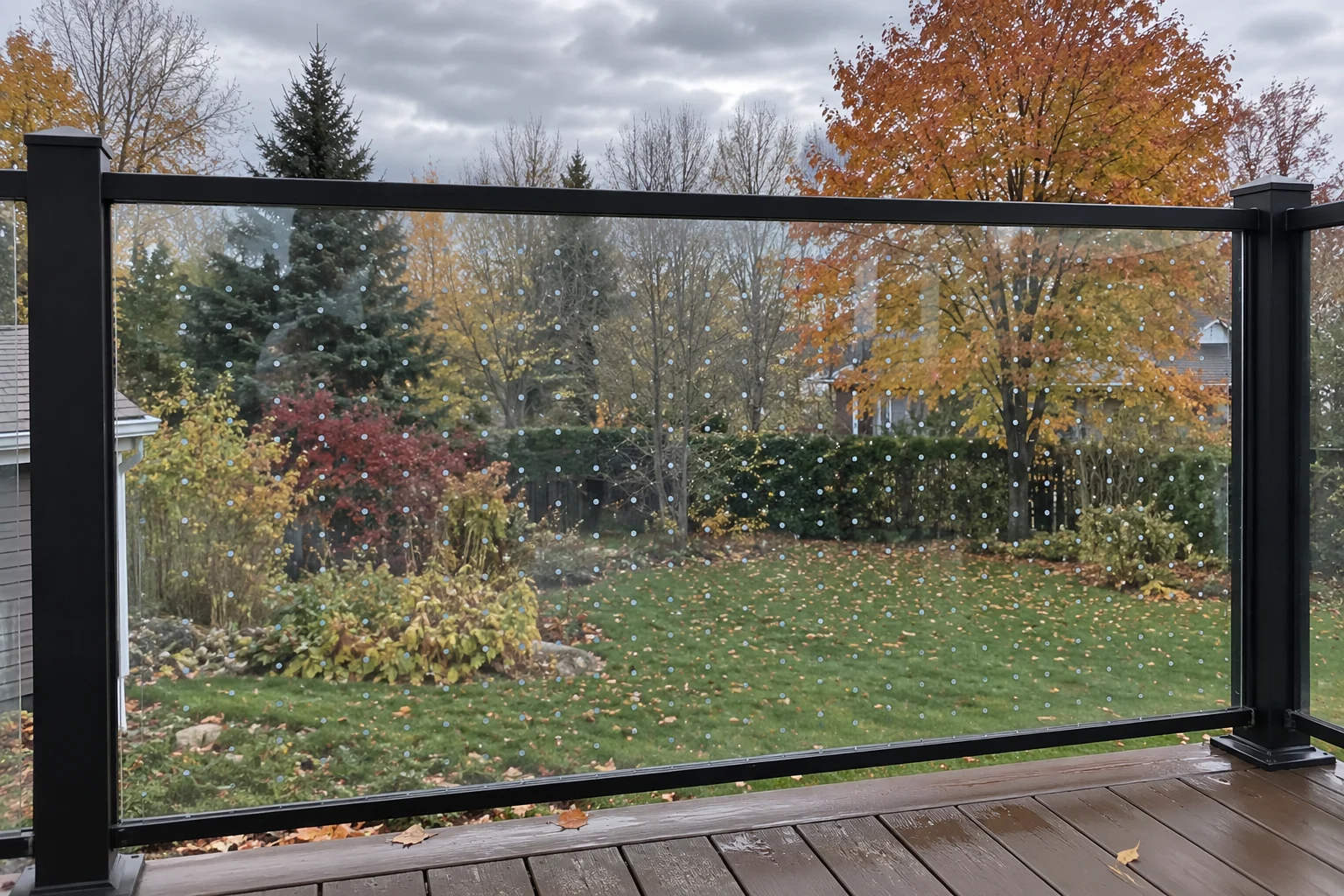
If you do choose glass and want to cut the risk, both sources point to the same fix: a visible pattern of dots or lines on the glass, spaced no more than 5 cm apart (ECCC) — FLAP suggests roughly 50 mm spacing, the same distance. ECCC adds four more rules: the pattern covers the entire glass surface, it goes on the outside face, each marker is at least 5 mm wide, and its colour contrasts with the reflected greenery. One or two decals won’t do it — birds simply fly through the unmarked gap.
If the view is why you chose glass, ECCC addresses that too: a uniform pattern covering the whole pane “should not affect the view,” because the eye looks past it to what’s on the other side. It’s an add-on worth planning, not a reason to rule glass out — but it’s worth knowing before you pick clear glass for a deck near trees, feeders, or open water.
Privacy: Can You Still See Through It?
Clear glass offers close to none. If that’s a concern — a balcony facing a neighbour’s yard or a busy street — frosted (givré) glass is worth asking about: Vitrerie Saint-Laurent, a Montreal-area glazier, for example, lists it as a finish alongside clear, extra-clear, and tinted glass. Frosted glass keeps the brightness and the open feel of a glass railing while cutting down what’s visible through it, which is a reasonable middle ground between a solid panel and fully clear glass.
Picket railing doesn’t really solve privacy either — the gaps are narrower than a sheet of glass, but they’re still gaps. If privacy is the actual goal rather than view or low maintenance, a solid privacy screen, or a privacy fence along the yard, usually does more than either railing style.
Living With Glass Through the Quebec Seasons
Structurally, glass isn’t held to a lower standard than pickets: the same guard load requirements apply to solid panels and vertical pickets alike. What changes is upkeep: a clear panel shows what an opaque one hides. Pollen in spring and dust in summer sit visibly on glass until it’s washed, while the same residue on a picket railing mostly goes unnoticed.
One Quebec-specific point applies to both styles: aluminum doesn’t rust the way steel does, but road or de-icing salt that builds up on it can still wear down its protective layer, so a rinse in early spring is worth doing whichever fill you choose. If you want the open view and don’t mind wiping the glass down a few times a season, glass is a perfectly reasonable choice. If low maintenance matters more to you than the view, that’s the honest case for pickets.
Still deciding between glass and pickets? Send the dimensions and photos of your deck or balcony through our quote form. After an on-site evaluation, we can quote both options.
Can a Glass Railing Break? What to Ask Your Installer
Tempered glass that breaks does so all at once, into small granular pieces — the reason the code asks for safety glass, as covered in the building-code section above. Rarely, a tempered panel breaks with no visible impact at all. The cases that put this on the radar come from Toronto, and the sources below show what they do and don’t mean for a house.
What the sources say
What Toronto Building says. In 2011, tempered glass panels broke on the balconies of several high-rise residential buildings in Toronto, and falling pieces lightly injured one passer-by. Engineers’ reports pointed to “micro-cracking caused by inclusions within the glass itself,” and all of them noted that no practical manufacturing procedure completely eliminates that risk. Those inclusions were within the limits of CAN/CGSB-12.1, and the findings were described as preliminary.
What Ontario did. Ontario responded with SB-13, in force since July 1, 2012. It sets the glass type by distance from the floor edge: heat-strengthened laminated glass at the edge, laminated or heat-soaked tempered glass farther in. (Heat-soaked means the panels went through a factory test meant to weed out those prone to breaking on their own.) SB-13 requires laminated glass to be installed so that, if it breaks, it “does not dislodge from the support framing”; heat-soaked glass still carries “a known level of residual risk of spontaneous breakage.”
What Ottawa’s advisory says. SB-13 applies to Part 3 buildings, the large buildings in Ontario’s code. For houses under Part 9, the City of Ottawa’s advisory on glass guards (June 2023) says tempered or laminated glass meeting CAN/CGSB-12.1 is sufficient. It also reads the glass design standard CAN/CGSB-12.20, which the ACQ fact sheet lists for Quebec as well, as requiring free-standing panels held only at the bottom to be capped by a rail running continuously over two or more panels, so the guard still holds if a panel fails.
What Glas Trösch says. Glas Trösch, a Swiss manufacturer that sells glass, writes that heat-soak testing removes most of the dangerous panels but doesn’t give a total guarantee. It calls spontaneous breakage rare, possible up to 10 years after manufacture, and states that such breakage isn’t covered by its product warranty.
What a glass-railing specialist lists for a replacement. This specialist, which sells these panels, lists a 12 mm tempered panel, 36″ wide, at $130 (34″ high), $140 (40″) or $150 (46″) in its 2026 price list, plus taxes. That is material only, without delivery or installation; non-standard sizes are priced on request.
None of this makes heat-soaked glass a rule for your deck. Toronto’s cases were high-rises, and even in Ontario a house needs only tempered or laminated glass. The ACQ fact sheet we cited earlier doesn’t set a heat-soak requirement either. The top rail is a different matter: it comes from a design standard the ACQ fact sheet also lists, though no Quebec authority spells out that reading — so raise it with your installer and engineer.
What the story does give you is a question for your installer: what type of glass is in this quote — tempered, laminated, or heat-soaked tempered? Laminated is the type designed to stay in the framing when it breaks. Heat-soaking lowers the risk, but not to zero.
If you’re looking at frameless glass, also ask what keeps someone from falling if one panel breaks: a continuous top rail over the panels, or nothing until the panel is replaced. Then ask whether the warranty covers a panel that breaks on its own, since at least one manufacturer excludes it. And ask whether your panels are a standard size: a standard panel has a list price, while a made-to-measure one is priced on request — worth knowing before a panel ever needs replacing.
What Glass or Picket Railing Costs in Quebec
There’s no fixed price per foot for either style, but published Quebec price lists give a usable starting point.
What the sources say
What a Quebec railing installer says. Figures as posted on its website when we checked in fall 2026. This Quebec installer lists aluminum railing with pickets at roughly $55–150 per linear foot, and aluminum with tempered glass at $90–250. Those prices cover materials; the company says installation can add a further 30–50% of the total price.
What the glass-railing specialist says. The same specialist lists $100–400 per linear foot with installation, for standard 1/2″ tempered glass and hardware; taxes and delivery are extra. Spigot systems sit toward the low end, standoff and aluminum base-shoe systems toward the high end. The handrail is priced separately.
What the installer gives for a 20-foot deck. Its example is $1,600–5,000 for aluminum railing, depending on the design, and $3,000–8,000 for glass, depending on the installation. Those totals are 20 feet at the higher per-foot ranges the same page gives further down ($80–250 for aluminum, $150–400 for tempered glass), and the page doesn’t say whether they include installation. It also lists a building permit at $100–500, depending on the municipality.
What the glass-railing specialist lists for a glass gate. A gate isn’t one more panel. Its 2026 list prices the door, the hinge panel, the spring hinges, the latch, and the floor bolt as separate components: several hundred dollars in parts before installation.
Both companies sell these systems, so treat every figure above as a starting ballpark, not a quote. Your own price depends on exact measurements, the mounting system (framed or frameless), site access, stairs and angles, whether you choose glass or pickets, the base the railing anchors to, any demolition of an old railing, slope, and gates. The only way to get a firm number is an on-site evaluation — which is what our own written quote process is built around.
When you compare quotes, check what each one includes. Online estimates often leave out corner posts, gates, and travel fees, so ask whether each quote counts them.
New Concrete Pads: Why We Wait 14 Days Before Installing Railing Posts
If we’re pouring new concrete pads for your railing posts — rather than anchoring into an existing deck or patio — we wait 14 days for the concrete to cure before the posts go in. That’s our own installation standard at Duratech, not a building-code requirement: a post set in half-cured concrete is more likely to shift before it’s ever asked to carry real load, whether it’s holding up glass or pickets. And because new pads mean digging, we take care of the Info-Excavation utility locate request before anything goes into the ground.
Existing Deck or Concrete Balcony: What the Railing Bolts Into
On the site visit, we assess the mounting surface — wood, composite, or concrete — because that decides how the railing is fastened. On a wooden deck, we check for solid wood under the decking where the lag bolts go, and we may add blocking there, provided the structure underneath is sound.
As noted above, frameless glass asks the most of that base. If the boards or joists are soft or rotted, or the concrete is cracked or crumbling at the edge, the base gets repaired first, whichever fill you choose. When you send photos for the quote, include the edge of the deck or slab and tell us roughly how old it is.
Quick Way to Decide
- Choose glass if the view is the point of the deck — pool, water, open yard — and you don’t mind washing the panels a few times a season.
- Plan bird markers if that glass faces trees, feeders, or open water.
- Ask about the glass itself — tempered, laminated, or heat-soaked — whether the warranty covers a panel that breaks on its own, and, for frameless glass, whether a top rail holds the run if a panel fails.
- Choose pickets if low upkeep matters more to you than an unobstructed view.
- Can’t choose? Ask about glass on the view side and pickets along the other sides.
- Look past both if privacy is the real goal: frosted glass, a solid screen, or a privacy fence does more.
- Either way, confirm permit and code requirements with your municipality, and get pricing from an on-site evaluation — checking that each quote counts corner posts, gates, and travel.
2 Real Cases
A pool deck in Brossard. A homeowner wanted an unobstructed view of the pool from the kitchen window and chose our Glass Panel Style for the railing around the deck. Because the deck backs onto a row of mature trees with regular bird activity, we recommended a uniform dot pattern across the glass, spaced to the 5 cm guidance from ECCC, instead of leaving it fully clear. If a deck railing like this one also serves as the pool enclosure, it falls under Quebec’s separate residential pool safety rules — minimum height, gate hardware, and its own opening limits — on top of the general guard requirements covered above, so we check both sets of rules on any pool job.
A street-facing balcony in Longueuil. A different homeowner wanted a railing for a second-floor balcony that looks directly onto a busy street. Between the privacy concern and wanting a lower-maintenance surface, they chose Standard Picket in black — no glass to keep clean, and from the sidewalk below, black pickets break up the view into the living room more than clear glass would, though they don’t block it.
Frequently Asked Questions
1. How much does glass or picket railing cost in Quebec?
One Quebec installer’s price list puts aluminum picket railing at roughly $55–150 per linear foot and glass at $90–250, both for materials only; the same company says installation can account for a further 30–50% of the total price. A glass-railing specialist lists $100–400 per linear foot installed, depending on the mounting system. For a whole 20-foot deck, the first installer’s own example is $1,600–5,000 for aluminum and $3,000–8,000 for glass. All of these are market ballparks, not quotes — your price depends on measurements, mounting hardware, access, and site conditions, confirmed through an on-site evaluation.
2. Is glass railing safe, and does it meet Quebec’s building code?
Yes, when it’s specified and installed correctly. The code calls for tempered or laminated safety glass meeting the CAN/CGSB-12.1 standard, so it doesn’t break into large sharp shards, and an ACQ technical fact sheet on glass guards adds that the design must be approved by a structural engineer. For most private homes, it’s your municipal bylaw — generally built on the same provincial rules — that actually requires this, so confirm specifics with your municipality. Rarely, a tempered panel can break on its own; ask your installer whether the quote is for tempered, laminated, or heat-soaked glass, and what the warranty covers.
3. How do you clean and maintain glass railing through a Quebec winter?
Clear snow from glass by hand or with a plastic brush or shovel — not a metal edge that can scratch the panel — and wash it with mild soap, water, and a soft cloth rather than abrasives. Glass shows dust, pollen, and dried meltwater more than pickets do, so expect to wipe it down a few times a season. On either style, rinse road and de-icing salt off the aluminum frame in early spring.
4. Are glass railings dangerous for birds?
Environment and Climate Change Canada specifically names transparent deck railings as a collision risk, the same mechanism as windows facing each other. FLAP Canada, a bird-safety non-profit, recommends choosing a non-glass railing style where this is a concern; if you do choose glass, a visible pattern covering the whole panel, with no gaps over 5 cm, is what ECCC calls the best way to prevent collisions.
5. Does glass railing offer privacy, or can everyone see through it?
Clear glass offers very little privacy. Frosted (givré) glass is an available finish — ask your glass supplier — that cuts visibility while keeping the open, bright feel of a glass railing, a middle ground between clear glass and a solid panel.
6. How far apart can the pickets be on an aluminum railing?
In practice, the gap between pickets has to stay small enough that a 100 mm sphere can’t pass through — the general rule for openings in a guard, which municipal bylaws generally carry over. We cover the specific height and spacing numbers in our aluminum railing height guide.
7. How long does an aluminum railing last?
There’s no official lifespan figure for aluminum railing. Aluminum doesn’t rust the way steel does, and a powder-coated finish is made for long outdoor exposure, but how long a railing actually lasts depends on installation quality, anchoring, and exposure to road and de-icing salt. The most concrete number you’ll get is the written warranty on the specific system you’re quoted — ask for it, and check what it covers: frame, finish, glass, and hardware.
Disclaimer: Prices in this article are general market ranges from third-party sellers, some for materials only and some installed, not a Duratech quote — your final price depends on an on-site evaluation of measurements, mounting system, access, and site conditions. Building and permit requirements for guards and railings vary by municipality; confirm current rules with your own municipality before starting work. This article is for general informational purposes only and does not constitute engineering, legal, or insurance advice specific to your property.
Once the glass type and anchoring are right, whether the view matters more than the upkeep, or the other way around, is really a personal call. If you’re weighing glass against pickets for a deck, balcony, or pool area on the South Shore, send us the dimensions and a few photos of the space and we’ll book an on-site evaluation and prepare a written quote for both options.
Phone: (438) 830-3436
Email: lescloturesduratech@gmail.com
Website: lescloturesduratech.com
We serve homeowners across the South Shore and Montérégie, in English and French.