

In this article
- What Quebec Law Actually Says About Fences Between Neighbours
- Who Owns the Fence? It Depends Exactly Where It Sits
- Maintaining and Repairing a Shared Fence
- Getting It Right Before You Build
- Where the Property Line Actually Is: Certificate, Bornage, and Piquetage
- If Your Neighbour Refuses to Cooperate
- What If a Neighbour Already Built on Your Land?
- Municipal Rules Still Apply on Top of All This
- 2 Real Cases
- Frequently Asked Questions
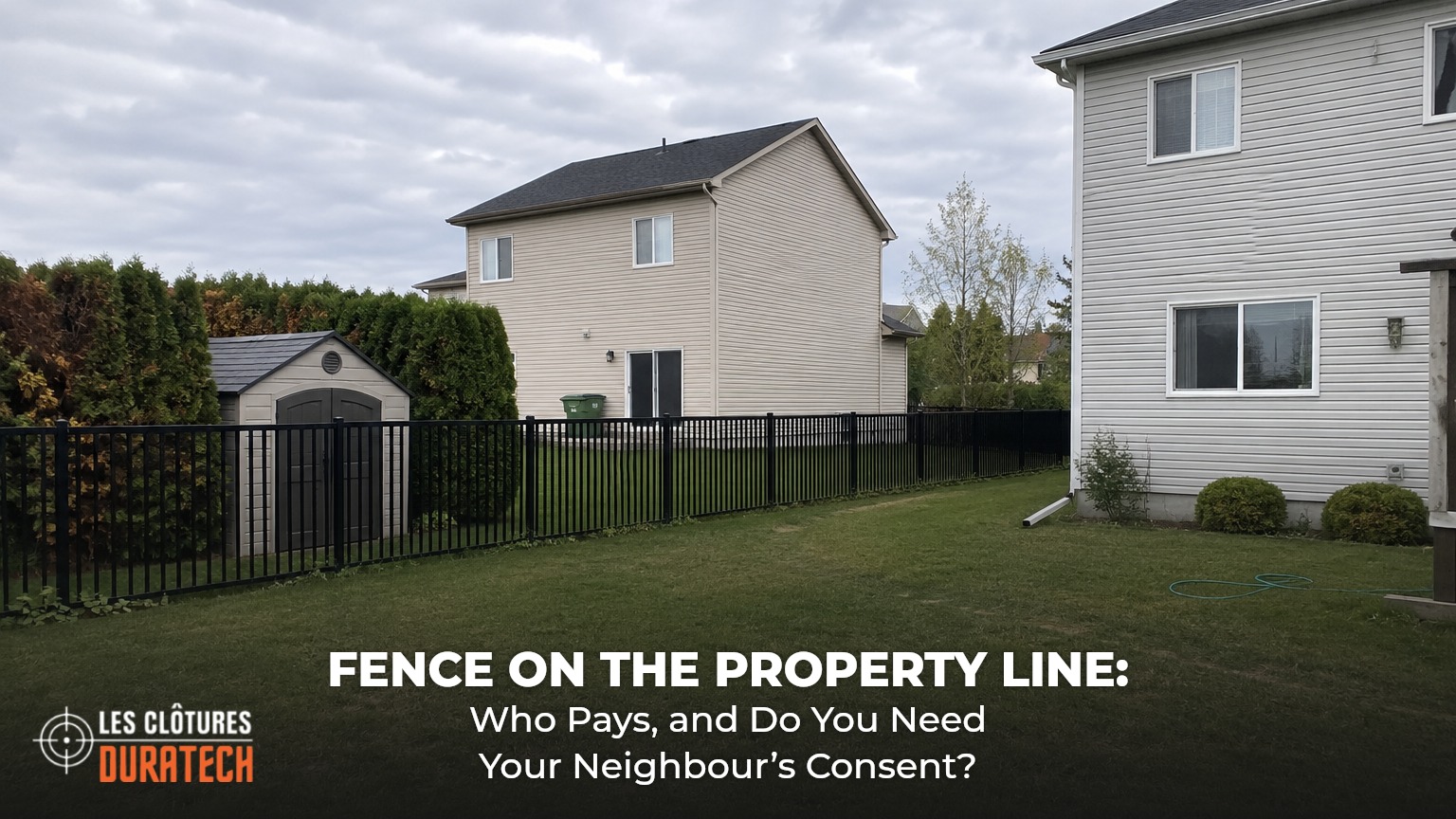
Two neighbours, one fence line, and two different opinions — one wants a fence between the yards, the other isn’t sure about the style, or about paying half. It’s a question we hear often on the South Shore, and it isn’t decided by taste. It’s decided mainly by two articles of the Civil Code of Quebec — 1002 and 1003 — and by exactly where the fence sits relative to the line between the two properties.
This guide covers the part most fencing articles skip: who legally owns a fence on the property line, whether your neighbour has to help pay for it, what “shared” actually obligates each of you to do, and what happens if they simply say no. If you’re still working out exactly where your property line falls, we cover that separately in our guide to locating your property line before a fence project — this article picks up from there.
What Quebec Law Actually Says About Fences Between Neighbours
The starting point is the Civil Code of Quebec, in the section dealing with fences and shared structures. Article 1002 gives every landowner two separate rights, and it’s worth reading both halves carefully:
“Any owner of land may fence it, at his own expense, with walls, ditches, hedges or any other kind of fence. He may also require his neighbour to make, in equal portions or at common expense, on the dividing line between their lands, a fence suited to the situation and use made of the place.”
In plain terms: you can always fence your own land at your own cost, without needing your neighbour’s permission — municipal rules are a separate question, covered further down. And separately, you can require your neighbour to share in a fence built on the dividing line itself — but only one that’s “suited to the situation and use made of the place.” That phrase matters. Your neighbour generally has to contribute toward a reasonable fence for the setting, not whatever style or budget you’d personally choose.
Who Owns the Fence? It Depends Exactly Where It Sits
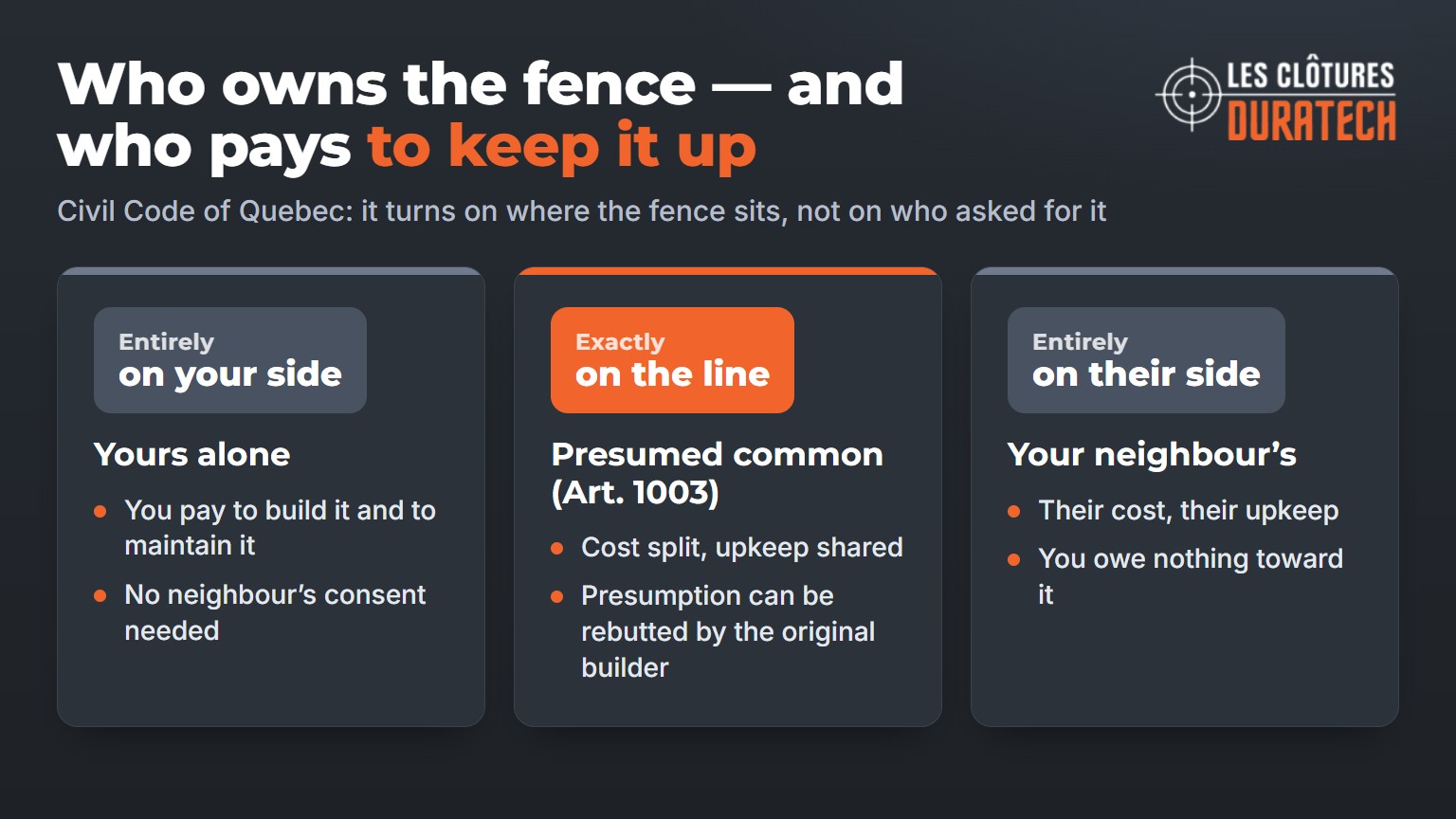
This is the question homeowners actually call us about, and the answer changes completely depending on the fence’s physical position relative to the line — not, in the first place, on who paid, and not on who asked for it first.
| Where the fence sits | Who owns it | Who pays to build it | Who pays to maintain it |
| Entirely on your side of the line | You, alone | You | You |
| Exactly on the dividing line | Presumed a common fence (Art. 1003) — unless the original builder proves they built it alone and never agreed to share it | Split equally or at common expense if your neighbour agrees, or by court order if they don’t (Art. 1002) | Both owners, in equal shares (Quebec government guidance) |
| Entirely on your neighbour’s side, built by them | Your neighbour | Your neighbour | Your neighbour |
The middle row is where most disputes start. Article 1003 sets out a presumption:
“A fence on the dividing line is presumed to be common.”
That presumption isn’t absolute. Quebec’s own government guidance is explicit that it can be rebutted: a fence on the line is presumed common unless the original owner can prove they erected it alone and never agreed to it becoming shared. In practice, that’s why we sometimes suggest a deliberate setback onto the client’s own side — it keeps ownership unambiguous, and the few inches left outside the fence remain yours, just on the other side of it.
Maintaining and Repairing a Shared Fence
Once a fence is genuinely common, the shared cost doesn’t end with the build. Quebec’s government guidance puts it plainly: once you and your neighbour build a common fence, you “share the construction and maintenance costs” going forward, not just the initial build.
When an existing shared fence needs repair or replacement. Repairs are part of the upkeep you share, and the steps further down — conversation, written agreement, formal notice, court — work the same way if your neighbour won’t contribute.
Two limits apply. Since the fence belongs to both of you, agree before changing its style or height: as Éducaloi puts it, you can’t replace an ordinary fence with a luxury fence and ask for half the costs without discussing it with your neighbour. And if one of you damaged the fence, that’s a separate question: the person responsible can be asked to pay for the repair, and if they refuse, that’s the kind of money claim that generally goes to Small Claims.
The Code is more detailed for the common wall (mur mitoyen) — a wall shared by two attached buildings, not a fence. Article 1006 puts its maintenance, repair and reconstruction on the owners in proportion to each one’s rights, and lets an owner who doesn’t use the wall give up their right in it, and with it the duty to contribute, by filing a notice at the land registry office (bureau de la publicité des droits) and sending a copy to the other owners without delay. That opt-out is written for the common wall; the Code provides no equivalent for a shared fence, so don’t plan on stepping away from a fence’s upkeep this way without a notary’s opinion first.
Getting It Right Before You Build
The single biggest way to avoid a dispute is agreeing on the details before the posts go in, not after. Éducaloi makes the same point for a new fence: you can’t just build a fence on the property line and then force your neighbour to pay for half. Agree on the type of fence beforehand; if that proves impossible, a court can settle details such as the materials to be used and the height.
Before work starts, it’s worth putting the following in writing, even as a simple email your neighbour replies to:
- The type of fence and its approximate height
- The material, and who’s supplying it
- Who’s doing the installation
- How the cost is being split, and when each side pays
- Who’s responsible for maintenance once it’s up
- Which of you is the contractor’s client on paper, and how the other household’s share reaches them
Have that conversation before anyone books an installer. A contractor quotes and contracts with whoever signs; the arrangement between two households is theirs to agree on, and it costs far less to write down in advance than to unpick with a fence already standing.
Once the line and the terms are settled, we request the Info-Excavation locate before any digging; the municipal permit, where your city requires one, stays with the homeowner.
Where the Property Line Actually Is: Certificate, Bornage, and Piquetage
None of the above matters if the property line itself is in dispute — and that’s a different question from mitoyenneté, with a different professional attached to it.
A certificate of location is essentially a health check on a property relative to its title, the cadastre, and municipal rules. It’s useful, but it doesn’t legally fix the boundary for your neighbour, and it isn’t designed to settle a disagreement about exactly where the line runs.
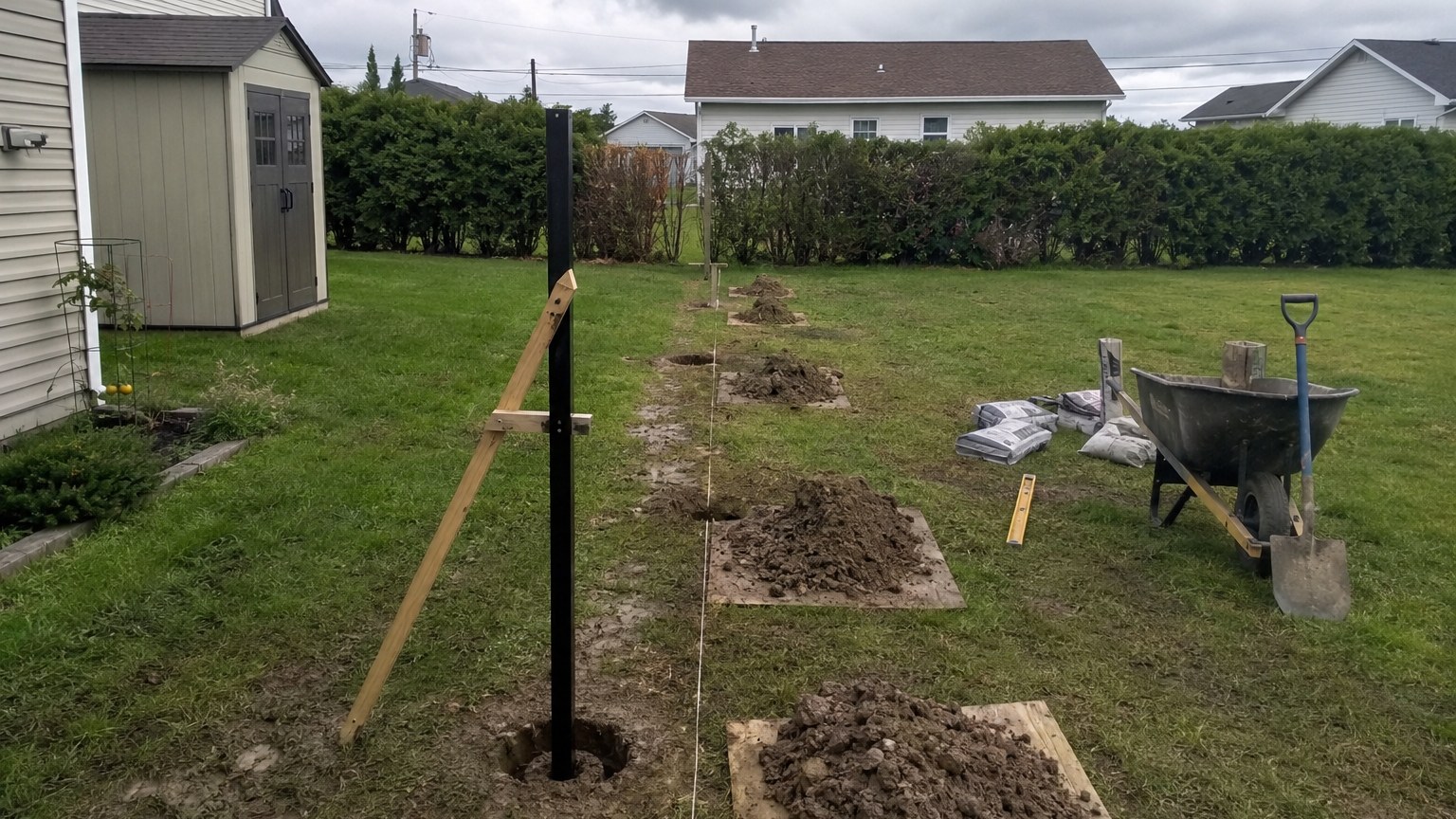
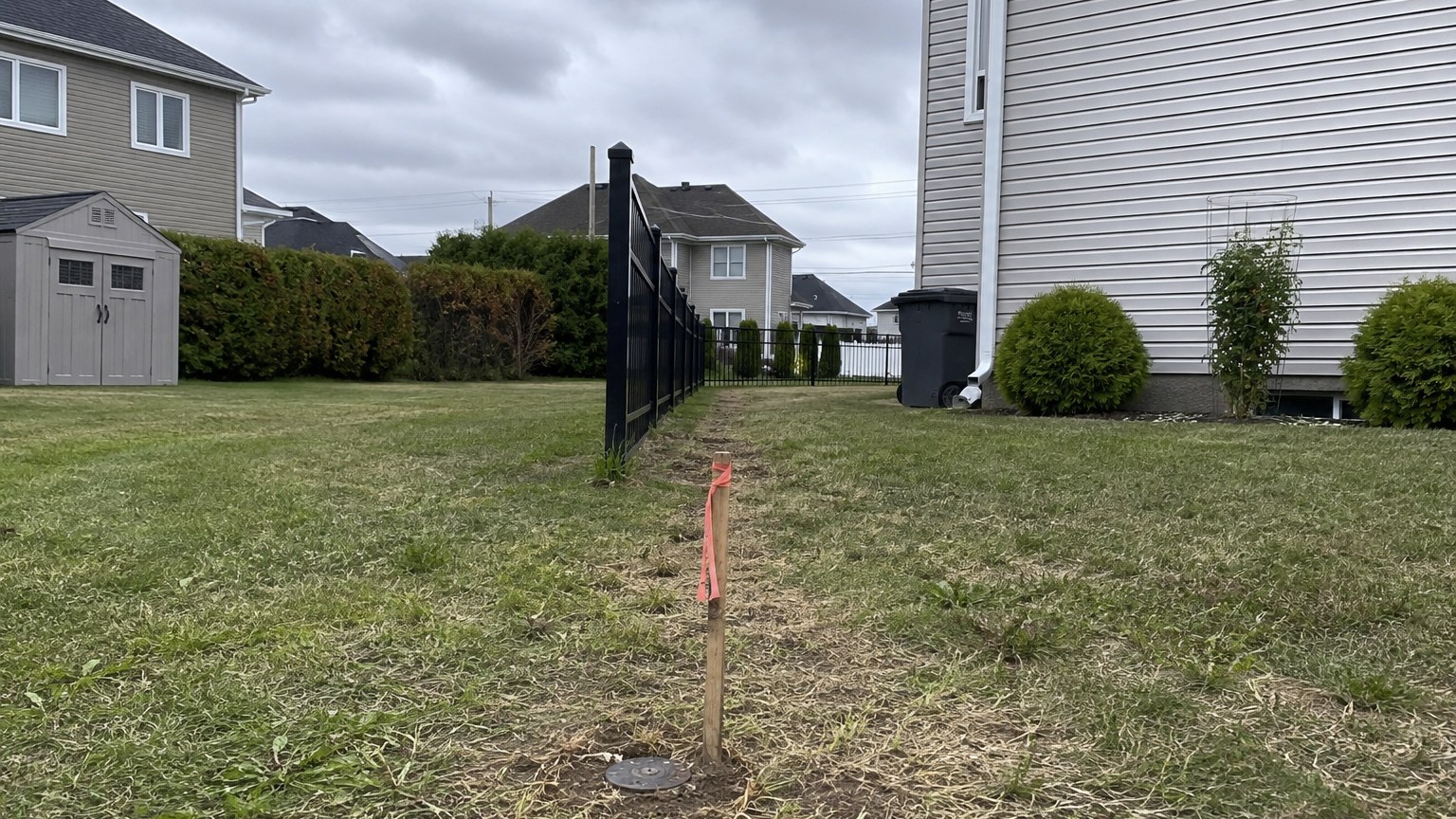
Piquetage is a simple stake-out done for one owner, on request. It marks a line for that owner’s own reference but doesn’t involve or bind the neighbour.
Bornage is the formal process that permanently and definitively fixes a boundary between two adjoining lots, carried out only by a land surveyor (arpenteur-géomètre) and documented in a procès-verbal, according to the Ordre des arpenteurs-géomètres du Québec. It comes in two forms — amicable, when both owners agree to the process, or judicial, when the Superior Court has to decide. Either way, it involves every owner along that boundary, not just the one who requested it.
If you and your neighbour genuinely disagree about where the line falls — not just about the fence on it — bornage is the step that resolves it, not a certificate of location.
If Your Neighbour Refuses to Cooperate
Article 1002 gives you the right to require a neighbour’s participation in a dividing-line fence, but that right isn’t automatically enforced — it generally has to be pursued in a specific order.
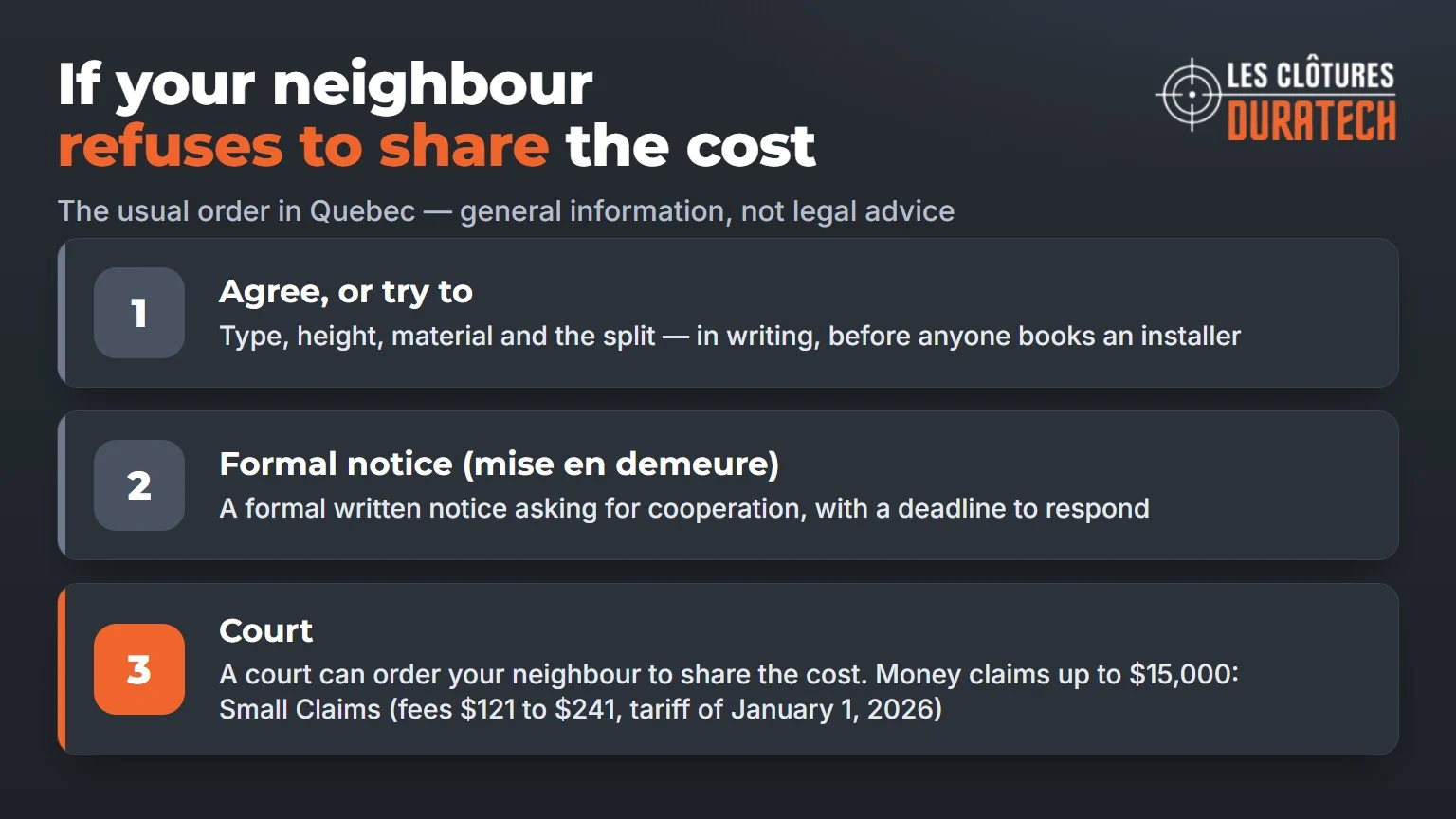
Start with a direct conversation about type, height, material, and cost split. If that doesn’t resolve it, the next step is a mise en demeure — a formal written notice putting your neighbour on record that you’re requesting their cooperation and, typically, a deadline to respond. Only once that step goes nowhere does it typically become a matter for the courts.
Which court applies depends on what you ask for. A claim for a sum of money of $15,000 or less — for example, your neighbour’s agreed half of a fence — generally goes to the Small Claims Division of the Court of Québec, where mediation and arbitration are also part of the process. Asking a court to authorize the fence and order your neighbour to take part is a different kind of request, and it isn’t among the types of claims Quebec lists for small claims; a lawyer can tell you which court and procedure fit before you file.
For small claims, filing fees for an individual, under the tariff in effect as of January 1, 2026, run $121 for claims up to $5,000, $223 for claims between $5,000.01 and $10,000, and $241 for claims between $10,000.01 and $15,000. Those figures are set by the province and can change — always confirm the current tariff before filing.
What If a Neighbour Already Built on Your Land?
This is a genuinely different situation from mitoyenneté, and worth separating clearly: a fence you disagree about the cost of is one thing; a fence actually standing on land that’s yours is an encroachment (empiètement), not a shared-fence question.
If that’s your situation, the first step is confirming exactly where the boundary falls — through a certificate of location, or through bornage if there’s real disagreement about the line itself. Once the boundary isn’t in doubt, it becomes a matter for a lawyer or notary, not something to negotiate informally over the fence.
A related point: years of a neighbour occupying part of your land don’t automatically transfer ownership to them. Under the Civil Code, ten years of possession can support a claim to ownership through prescriptive acquisition — but only by court judgment, never automatically. It’s a genuinely complex area of law, and if it applies to your situation, it’s a conversation for a lawyer, not something a fence estimate can resolve.
Municipal Rules Still Apply on Top of All This
Everything above is about ownership and cost between two private owners. Separately from that, your municipality sets its own rules on fence height, setbacks from the line, and corner-lot visibility — and those vary meaningfully from one South Shore city to the next.
Those rules apply whether the fence is shared or entirely yours, so they’re worth confirming with your own municipality before finalizing a design. We go through what to check, and how it interacts with locating the line itself, in our property line guide.
2 Real Cases
Two neighbours in Chambly split the cost by agreement. A homeowner wanted a privacy fence at the maximum height the city allows along the shared line with a neighbour who was open to it but hadn’t budgeted for the full amount. Before anything was scheduled, the two households exchanged a short written agreement — height, material, and a 50/50 split — that both signed, and settled between themselves how each side’s share would be paid. We installed the fence on the line as a shared structure. No dispute followed, because the terms existed before the posts went in.
A homeowner chose a setback to keep sole ownership. A different client wanted full control over future repairs and replacement without needing a neighbour’s sign-off. Rather than build on the dividing line and trigger the presumption of shared ownership under Article 1003, we set the fence a short distance onto their own side of the line. A narrow strip of their yard ended up outside the fence without changing hands, and the fence itself stayed entirely theirs — no shared maintenance obligation, no need for the neighbour’s agreement on style or timing.
Frequently Asked Questions
1. Who pays for a fence built on the property line?
If it’s built exactly on the dividing line, it’s presumed to be a common fence, and its construction and future maintenance are shared between both owners — by an agreement made before the work, or by a court judgment if your neighbour refuses. Billing a neighbour for half after building on the line without their agreement is much harder to enforce. If the fence is entirely on your side of the line, you own it and pay for it alone.
2. Is my neighbour legally required to pay for part of a fence?
Generally, yes, if the fence sits on the dividing line and is suited to the situation and use made of the place — Article 1002 lets you require their participation.
3. Do I need my neighbour’s consent if I’m building entirely on my own property?
No. A fence built entirely on your own side of the line doesn’t require your neighbour’s agreement, and they have no obligation to contribute to its cost. It’s worth confirming your municipality’s height and setback rules separately, since those apply regardless of mitoyenneté.
4. What can I do if my neighbour refuses to cooperate or pay their share?
Start with a direct conversation about the type, height, and cost split. If that doesn’t work, send a formal mise en demeure. If your neighbour still doesn’t respond or agree, a court can order them to cooperate and share the cost. A money claim of $15,000 or less — such as their agreed share — generally goes to Small Claims Court; for an order to build the fence itself, ask a lawyer which court applies.
5. Do I need a land surveyor before building a fence on the line?
Only if the boundary itself is uncertain or disputed. If both owners agree on where the line is, a survey generally isn’t required for the fence itself — but if there’s any doubt about the line, a bornage by a licensed land surveyor is the step that resolves it, not the fence installer.
6. Who pays to repair or replace a shared fence?
Both owners, in equal shares, as for the original build — as long as it’s a like-for-like repair. Upgrading to a pricier or taller fence needs your neighbour’s agreement first, and if one of you damaged the fence, that person can be asked to pay for the repair.
Disclaimer: This article provides general information about mitoyenneté and property-line fences under the Civil Code of Quebec and is not a legal opinion or legal advice for your specific situation. Municipal bylaws on fence height, setbacks, and permits vary by city and are separate from these ownership rules — always confirm current requirements with your own municipality. Where a genuine dispute over cost, consent, or a boundary line exists, we recommend speaking with a lawyer or notary before proceeding.
Not sure whether the fence you’re planning sits on the line or inside it? We’ll walk the boundary with you, show you what each option means for the build — on the line as a shared structure, or set back and entirely yours — and put together a clear written quote either way. Questions about ownership, cost-sharing, or a boundary that’s genuinely in dispute belong with a notary or a lawyer, and we’ll say so rather than guess.
Phone: (438) 830-3436
Email: lescloturesduratech@gmail.com
Website: lescloturesduratech.com
We serve homeowners across the South Shore and Montérégie, in English and French.