

In this article
- Why Fence Posts Lean in a Quebec Winter
- Is It the Post, or the Whole Fence? How to Tell
- Fence Post Repair Methods, Compared
- How We Replace a Post Below the Frost Line
- What Fence Post Repair Costs in Quebec
- The Fall Window: Why Timing Matters Before the Ground Freezes
- Does Home Insurance Cover a Winter-Damaged Fence?
- 2 Real Cases
- Frequently Asked Questions
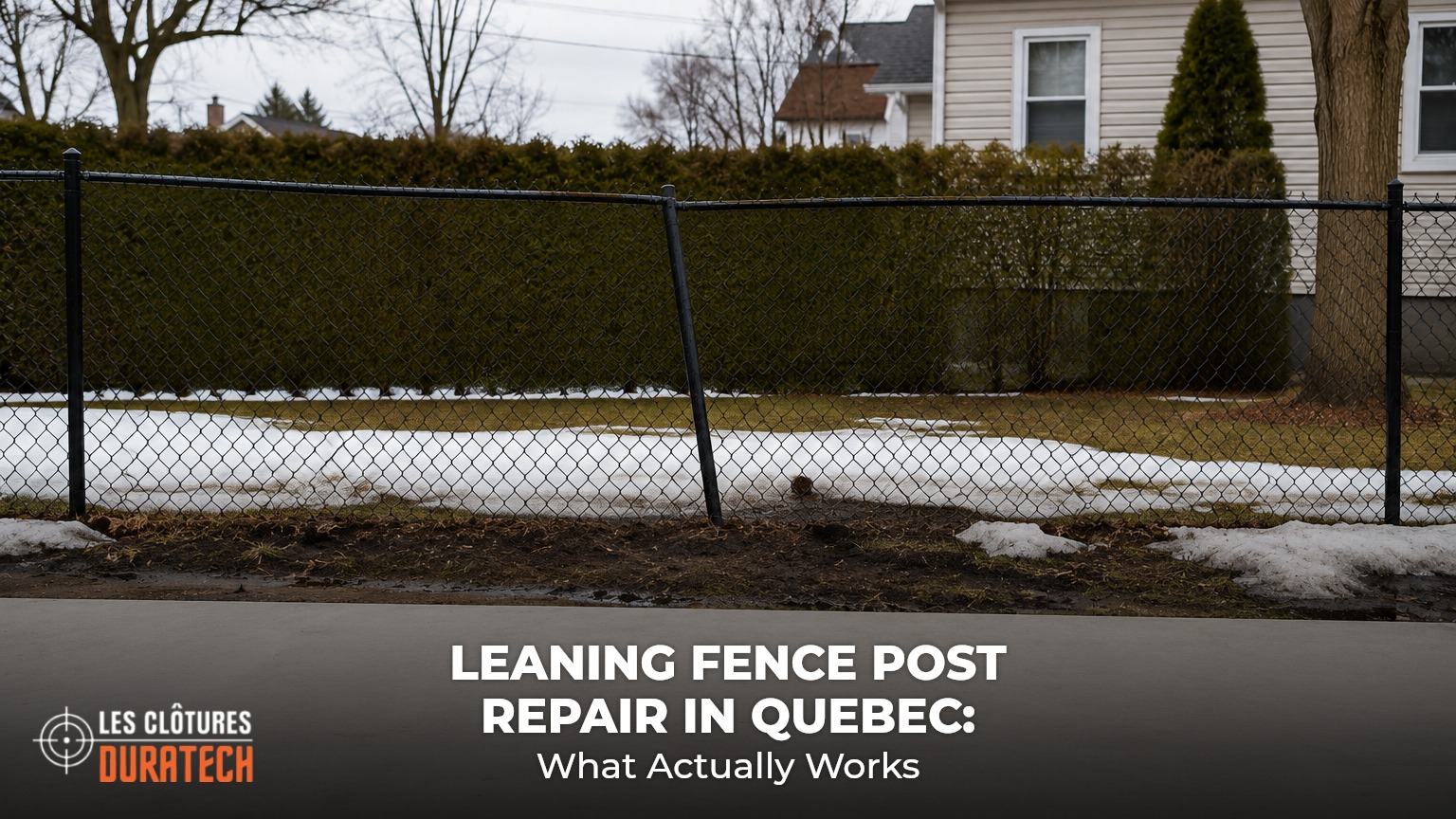
One post is leaning while the rest of the fence line stands straight. That’s usually not a sign the whole fence is failing — it’s a sign of what’s happening underground at that one spot, and in Quebec, what’s happening underground very often comes back to frost.
At Duratech, we get this call every fall and every spring: one post out of a dozen has tipped, a gate won’t latch anymore, or a section of chain-link is visibly pushed out of line. Before deciding between a quick fence post repair and pulling the whole fence, it helps to understand why Quebec posts lean in the first place — because that’s what determines which repair holds.
We already cover the broader repair-or-replace decision in our guide to fence repair vs. replacement. This article goes narrower: one leaning, rotten, or heaved post — why it happens here specifically, and which fixes last through a second winter.
Why Fence Posts Lean in a Quebec Winter
Frost heave is the most common reason behind the leaning posts we see. When the ground freezes, ice crystals form inside the soil — not just at the surface, but as deep as the frost line reaches that winter. In clay or silt soils with access to groundwater, those crystals form lenses that physically lift whatever sits above them.
For context, building foundations in Quebec are treated much more strictly than fence posts. For buildings on clay or poorly defined soil, the Quebec Construction Code refers to minimum foundation depth such as 1.2 m (table 9.12.2.2), and in some cases down to the frost penetration depth if that goes deeper. A fence post is not governed by that building-foundation table, but the same frost-heave physics still matter: if the post footing stops in the layer that freezes, the soil can lift or shift it.
In practice, footings around Montreal are typically placed 1.2 to 1.8 metres deep, and a technical column from APCHQ, Quebec’s residential construction association, cites a frost depth of 2.35 metres recorded at a downtown Montreal intersection, as reported by La Presse. That number should not be treated as a standard fence-post depth. It is a localized example showing how deep frost can reach in some conditions, which is why the actual repair depth has to be decided on site according to soil, drainage, exposure, and the failed post’s existing footing. A fence isn’t held to that table, so many posts end up set shallower than the frost goes — and that gap is exactly where heave gets its grip.
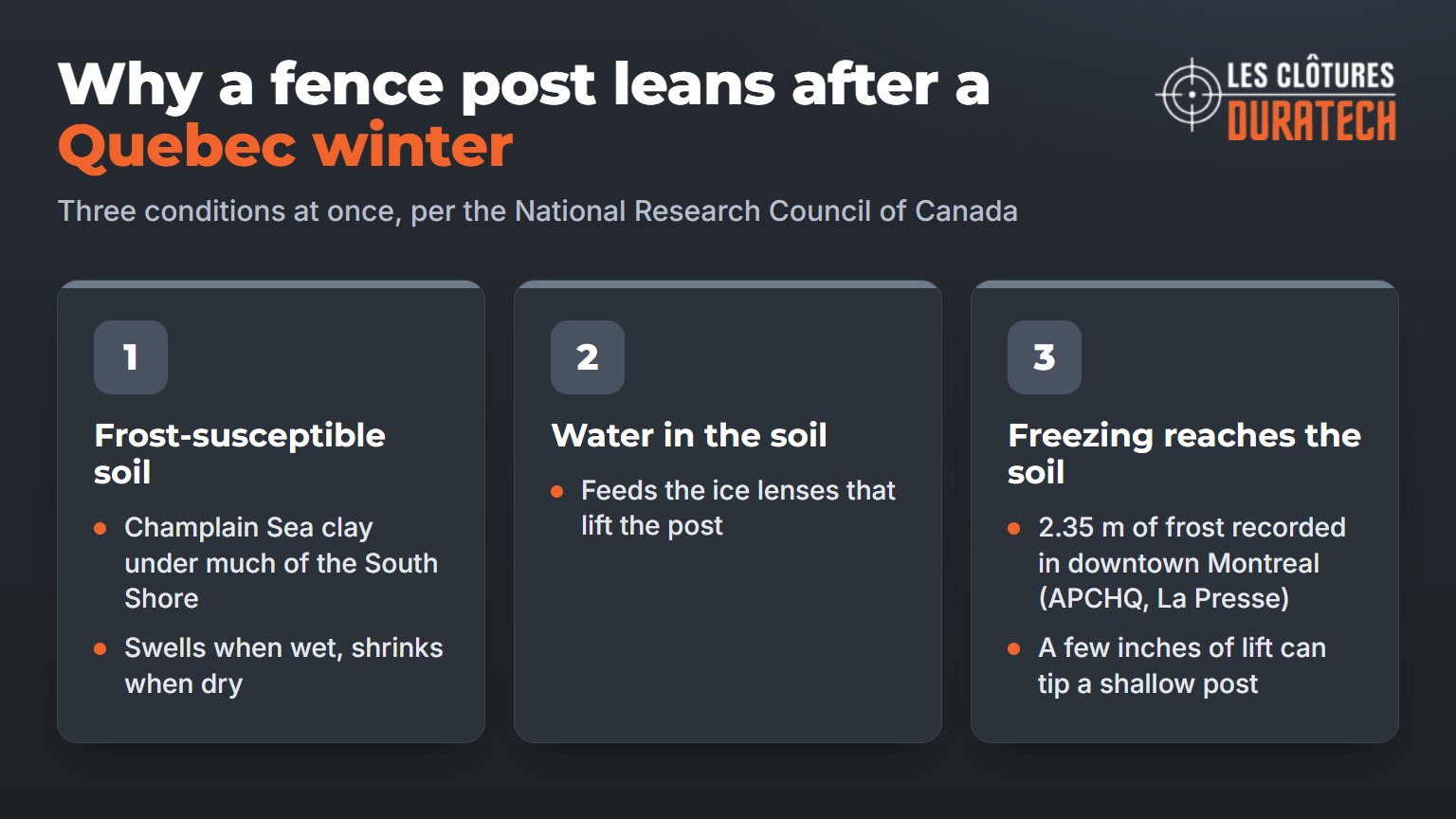
The National Research Council of Canada lists three basic conditions for frost heave: the soil must be frost-susceptible, water must be available in sufficient quantities, and the cold must actually freeze that soil and water. Where all three line up, even a few inches of lift — the kind APCHQ describes on heaved balconies — is enough to tip a post that isn’t anchored below the frost line.
The first condition — fine-grained, frost-susceptible soil such as clay — is common on the South Shore. Clay and other frost-susceptible soils are common across parts of the South Shore, including many areas around Longueuil and neighbouring municipalities.A local foundation contractor describes several South Shore sectors as being affected by heavy clay left by the Champlain Sea. Because soil can vary from one lot to another, the useful conclusion for a fence repair is not to assume one fixed depth from a map, but to inspect the failed post and set the new footing according to the actual site. That clay swells when wet and shrinks when dry, adding lateral pressure on top of the seasonal lift — part of why posts in these areas lean even when the rest of the fence line looks fine.
Frost isn’t the only thing that tips a post. Contact from a vehicle or a snowplough, a tree root working against the footing, or a solid-panel section catching wind can all push a post out of line — but each leaves its own evidence: fresh damage above ground, a root at the base, or a lean that appears outside the freeze-thaw season. A post that leans a little more every spring almost always points to a footing that stops above the frost line.
Is It the Post, or the Whole Fence? How to Tell
If your posts are wood, a simple test tells you a lot: press a screwdriver into the wood at the base of the post, right where it meets the ground. If the wood crumbles or the screwdriver sinks in with no resistance, the post is rotten at exactly the spot that takes the most stress.
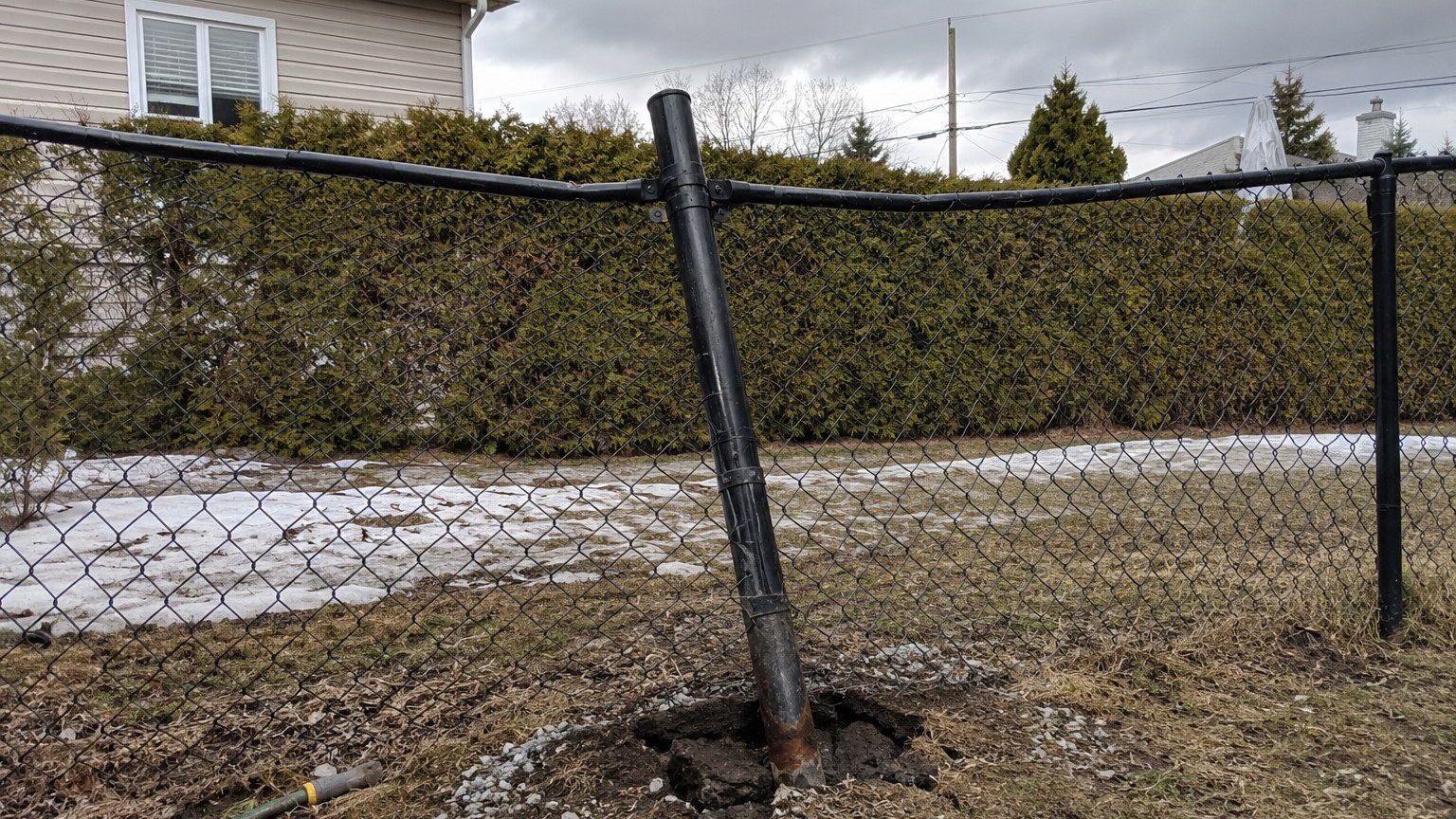
Steel posts — the kind that carry a chain-link fence, known here as a Frost fence — fail differently. There’s nothing to crumble, so you’re looking instead for corrosion at the ground line, and for movement: a post you can rock by hand usually means the concrete around it never went deep enough, or never really set.
Count how many posts are affected. One leaning post out of a run usually points to a localized footing problem — poor backfill, no concrete, or a footing set above the frost line. Several leaning posts along the same section more often point to a soil or drainage issue affecting the whole run, which changes the repair math.
Age matters too, relative to the material. Our own fence lifespan guide puts residential Frost fence at 20 to 30 years, ornamental aluminum at 25 to 35-plus, ornamental steel at 20 to 30, and the wood components of hybrid fences at 10 to 20. A post failing well inside that window usually points to an installation issue, not the material wearing out.
The broader guide we linked above uses a rule of thumb worth repeating: damage affecting less than about 20 percent of a fence generally points to repair, while damage affecting more than about a third generally points to replacement. For a single post, the more useful version of that question is simpler — is this one footing problem, or several?
Can you fix only one leaning fence post?
Often, yes — if the rest of the fence line is straight, the mesh or panels are still sound, and the problem is limited to one failed footing. The repair needs to address the cause, not just the symptom. If the post moved because the footing stopped above the frost line, straightening it in the same hole will usually only reset the problem for the next winter.
Fence Post Repair Methods, Compared
Once you know it’s a footing problem, there are a few ways to fix it — and they don’t all hold up the same way against a Quebec winter.
| Method | What it does | Honest assessment |
| Driven spike / mender (wood posts) | Fast, inexpensive; drives a steel bracket or stake beside the rotten base | Sits above the frost line, so heave typically pushes it out of alignment; one Canadian repair company reports frequent failures within the first year |
| Gravel backfill or concrete topping around the old post | Surface-level stabilization | Doesn’t reach below the frost line, so it doesn’t address the underlying cause |
| Straightening the post and resetting it in the same hole with fresh concrete or post-setting foam | Straightens a sound post without pulling it | Only as good as the original footing depth: if the lean came from a footing above the frost line, the next freeze typically tips it again — foam or concrete makes no difference to depth |
| Sistering (bolting a new wood post alongside the old one) | Works when the post is only partially compromised | Bolted through both posts; doesn’t require digging out the old footing, but the new post only resists frost as well as its own depth allows |
| Full replacement, drilled below the frost line | Anchors the post below the layer of soil that freezes and heaves | Higher upfront cost, but the lifespan difference isn’t close |
The driven spike is the fastest and cheapest fix on the list, so it deserves a closer look.
A driven spike (sometimes sold as a mender or post spike) is a steel bracket or stake driven into the ground next to a rotten or broken wood post, then bolted to the sound wood above it. It’s fast, inexpensive, and needs no excavation, which is exactly why it’s appealing.
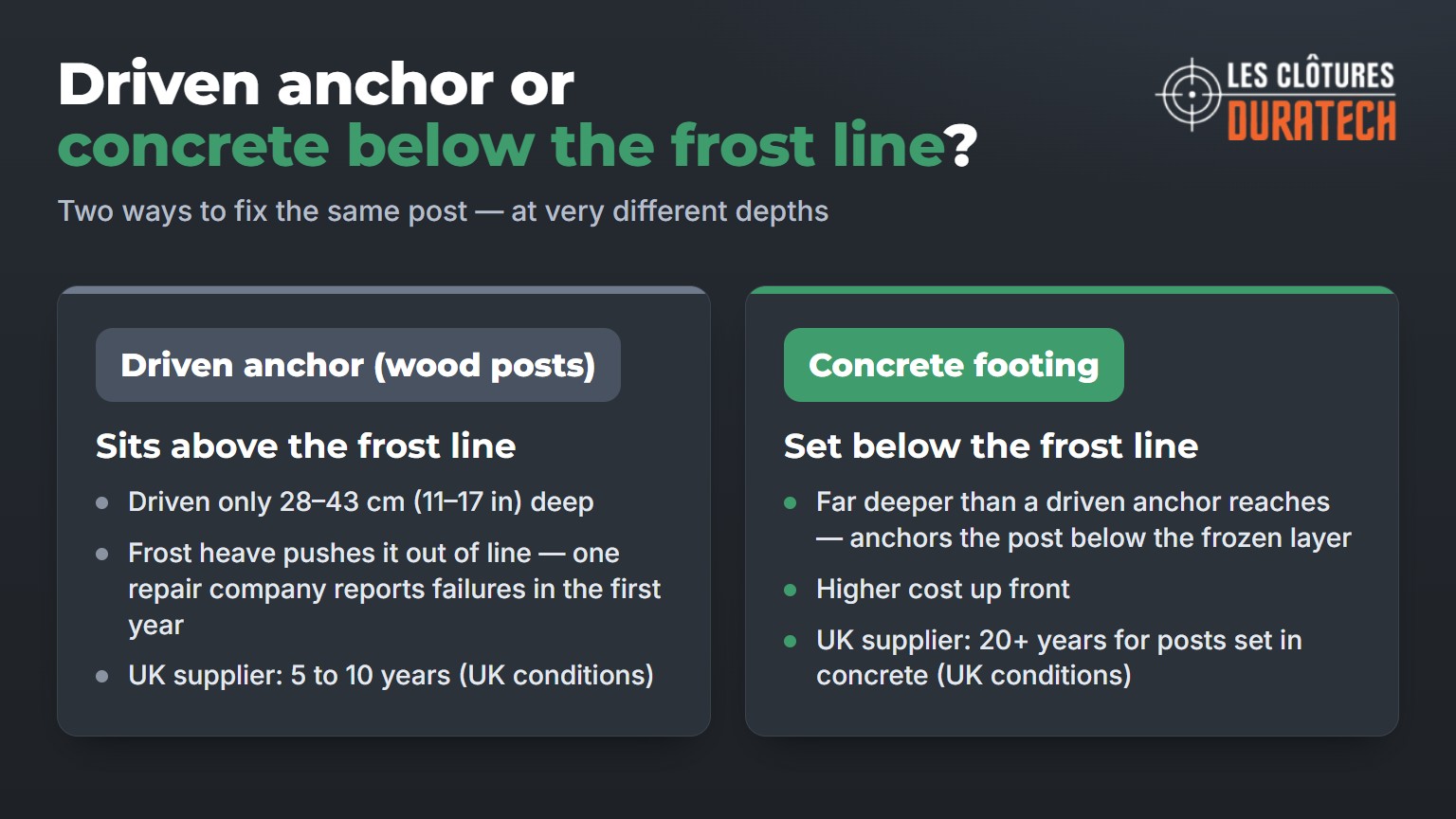
The problem is depth. According to a Canadian fence post repair company that sells its own alternative to spikes, typical spikes are driven only 11 to 17 inches into the ground and are roughly 0.105 inches thick. That’s well above where frost penetrates in a Montreal-area winter. Because the spike sits above the frost line, heave tends to push it out of alignment — and that same company reports those failures often show up in the first year.
Because that source sells its own alternative, we treat its lifespan claims cautiously. The point is not the exact failure timeline; the stronger support comes from the depth issue itself and from RONA’s own warning that metal spikes are not recommended for clay or compact soils and may shift with frost heave.
A UK-based fencing supplier’s comparison reaches a similar conclusion from a different angle. It’s a UK source, not a Quebec one, and in its case the ground movement comes from wet clay rather than deep frost. It gives spikes roughly 5 to 10 years in British conditions, against 20-plus years for a post set in concrete, and names clay specifically as the weak point, since clay expands and contracts with moisture and can work a metal anchor loose over time.
A Canadian retailer that sells these anchors says much the same. RONA’s fence foundation guide lists driven metal spikes as “not recommended for clay or compact soils” and warns that “posts may shift due to frost heave.”
None of that makes a spike useless. It’s a reasonable choice for a low or temporary fence section, or ground that’s genuinely dry and stable year-round. It’s not what we’d recommend for a wood post already leaning from frost heave on South Shore clay — that’s asking the same shallow anchor to fail the same way twice.
Before You Dig or Drive Anything Into the Ground
Every method in that table goes into the ground, and some buried cables sit shallower than a driven spike. Before you start, place a locate request with Info-Excavation. The request is free, and it should be made before digging or driving anything into the ground. Info-Excavation notes that some cables can sit very close to the surface, that fence installation is not treated as an emergency request, and that planned work generally requires a processing delay of 3 business days. The locate request covers underground infrastructure owned by Info-Excavation member companies; private lines or non-member infrastructure may require separate verification by the homeowner.
Build the wait into your timing: Info-Excavation asks you to expect 3 business days, not counting the day of the request, before starting planned work, and fence installation isn’t considered an emergency. In the fall, those three days come out of the short window before the ground freezes (more on that below).
How We Replace a Post Below the Frost Line
When a post needs full replacement, our process is built around not repeating the same failure.
Before anything gets dug, we locate underground utilities through Info-Excavation — we handle that request as part of the job. Private lines that wouldn’t show up in that locate, like a pool heater line or an irrigation system, are the homeowner’s to flag. Any permit or authorization your municipality requires is also the homeowner’s responsibility — permit rules vary by municipality. Longueuil’s simplified fence sheet indicates that a permit is generally not required for a standard residential fence, subject to applicable rules and exceptions. Other cities, including Brossard, should be checked directly before work begins. Pool fences follow their own rules.
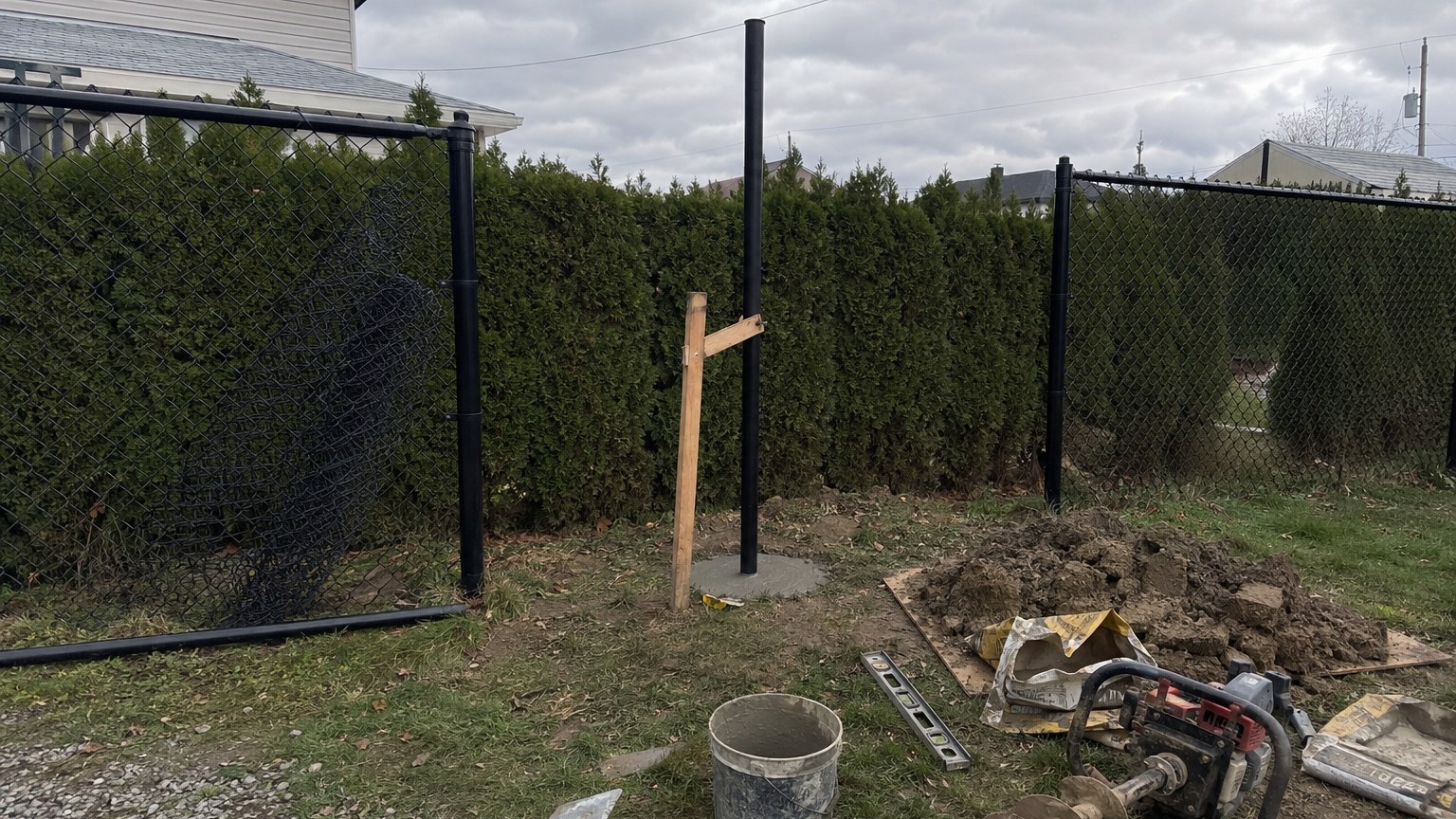
Once the lines are marked, we drill the new footing below the frost line rather than matching the shallow depth of the post that failed, and set it in concrete rather than gravel or loose backfill — the same footing standard we use on every Frost fence installation on the South Shore. That’s the piece that directly addresses what caused the lean in the first place. How deep that has to be isn’t a fixed number — it depends on the soil and the site, which is why we set it on site rather than from a price list; what matters is that the footing ends below the layer that freezes.
Depth isn’t the whole story, though: the same National Research Council of Canada digest notes that a hole backfilled with frost-susceptible soil can still lead to damage from adfreezing, when frozen soil grips the side of the footing — one more reason the hole gets concrete instead of the soil that came out of it.
Depth deals with frost; the top of the footing deals with water. The concrete should be shaped so water runs away from the post instead of pooling against it, as RONA’s foundation guide also recommends. Water is one of the three heave conditions, and it’s the one a homeowner can actually influence: keep downspouts and sprinkler spray off the fence line.
We also hold to a 14-day concrete cure before the repaired post is put back into service — for example, before reattaching gate hardware, tensioning mesh, or loading a panel section. That’s our own installation standard at Duratech, not a general construction requirement — we mention it because it’s the difference between a footing that’s fully set and one that’s asked to carry a gate or a wind-loaded panel before it’s ready.
What Fence Post Repair Costs in Quebec
Pricing for a single post repair is harder to pin down than pricing for a full new fence: there’s very little published Quebec-specific data on repair costs.
For a full Frost or chain-link installation, our own cost guide puts an installed price at $25 to $60 per linear foot, turnkey — with the caveat that quotes advertised around $25 per foot often exclude gates, corner posts, old-fence removal, and difficult access.
For broader context, a Quebec pricing aggregator’s installation price guide (updated late August 2026) lists new installed fencing at roughly $18 to $45 per linear foot for chain-link (Frost) fencing, $20 to $70 for wood, and $30 to $70 for ornamental iron.
| Repair item | Range listed in one Quebec quote-request guide (2024) |
| Mesh/chain-link section repair | $10–20 per linear foot |
| Single post (part) | $20–50 per post |
| Tension bar / hardware replacement | $5–15 per piece |
Those figures come from a 2024 guide on a Quebec quote-request site, and they match that guide’s own replacement-parts prices — so read them as parts-level references, not as the price of a new post drilled below the frost line and set in concrete. We haven’t found a second Quebec source to confirm them. The only way to get an accurate number for your fence is an on-site evaluation, which is what our own written quote process is built around.
The Fall Window: Why Timing Matters Before the Ground Freezes
Our installation season generally runs from April through November. Inside that window, timing still matters for a post repair specifically — the later in the fall you wait, the harder the ground gets to drill.
We can’t put a specific calendar date on when the ground becomes too frozen to work, because that varies by year, by location, and by how deep the frost has already gone in a given fall. What we do know is that the window closes from the top down: each week of the fall leaves more of the soil column frozen, and a lasting footing still has to be drilled through all of it. That’s why the useful move in October isn’t to wait and see whether the post gets worse — it’s to get the locate request in and the drilling done while the ground still cooperates.
The practical takeaway: a leaning post noticed in September or October is generally a straightforward drilled repair. The same post noticed in January typically has to wait for the ground to thaw, with the post braced or strapped to a sound neighbouring post until then.
Does Home Insurance Cover a Winter-Damaged Fence?
Homeowners often ask whether a fence damaged over the winter is covered by insurance — and the answer depends mostly on what caused the damage.
CAA-Québec notes that damage to things on your property — from the weight of snow, for instance — is generally covered if you hold an all-risk home insurance policy, and a crooked fence is one of the winter surprises it lists. Coverage still depends on the exact policy wording, exclusions, endorsements, deductible, and how the insurer classifies the cause of damage.
Frost heave is another matter: CAA-Québec adds that ground movements are not generally covered, and the Insurance Bureau of Canada lists damage from freezing outside the home, including heaving frost, among the perils home policies generally don’t cover. A post that leaned because the ground heaved is usually a repair to budget for.
What we’d suggest instead of guessing: confirm the details with your own broker before you file anything. It’s also worth knowing that an insurer can decline a claim if the damage is tied to a fence that was already deteriorating before the winter in question — so keep a couple of dated photos of the fence line each fall, in case you ever need to show what condition it was in.
2 Real Cases
A single leaning post in Saint-Hubert. After a hard winter, a homeowner noticed one gate post in an otherwise straight chain-link fence had tipped enough that the gate no longer latched. The steel post itself was in good shape, with no corrosion at the ground line — it could simply be rocked by hand, because it had been set shallow, above the frost line, with very little concrete around it.
We located utilities through Info-Excavation, drilled a new footing below the frost line, set the post in concrete, and held our 14-day cure before reattaching the gate hardware. The rest of the fence run needed nothing.
A run of rotten posts in Longueuil. A different call came in for a wood privacy fence where three posts along one section were visibly leaning, and a screwdriver test found soft, crumbling wood at the base of two of them. Given the age of the fence, the number of affected posts, and the clay soil on that lot, sistering or a spot repair wasn’t going to hold for long.
Replacing that section, including new footings below the frost line, made more sense than repairing posts that were already past the point where a patch would last.
Frequently Asked Questions
1. How much does fence post repair cost in Quebec?
There’s little published Quebec-specific pricing for a single post: the ranges we found — $20–50 per post, $10–20 per linear foot of mesh — are parts prices, not the cost of a footing drilled below the frost line and set in concrete. What actually moves the price is whether the old footing has to come out, how deep the new one has to go, and how easily a drill can reach that part of the fence line. That’s why the number comes from an on-site evaluation rather than a price list.
2. Will a fence post repair spike actually hold in a Quebec winter?
Sometimes, but not reliably where frost heave is a factor. A spike only works with wood posts, and it stops well above the depth frost reaches around Montreal — RONA, which sells them, advises against them in clay or compact soils for exactly that reason. The test to apply is the ground, not the product: if that post has already moved once with the seasons, a shallower anchor will move too. Spikes earn their place on a low or temporary fence, or on soil that stays dry and stable year-round — but if a spike is already in place and the post has moved again, adding a second one repeats the same mistake; the fix is a footing below the frost line.
3. Can a leaning fence post be repaired in winter?
Generally not once the ground is frozen. Drilling a proper footing below the frost line requires ground that can still be worked, and that gets progressively harder as fall goes on. If the lean shows up mid-winter, hold the post where it is until the thaw and book the footing for spring — bracing buys time, it doesn’t fix what’s underground.
4. At what point does repairing a post stop making sense?
When more than one or two posts along a run are affected, or when the wood is soft well above the ground line rather than just at the base. A single sound post that’s simply shifted is usually a repair. Several rotten posts on an aging fence more often point to replacing that section instead.
5. What should a warranty on a fence post repair cover?
Get it in writing. When you compare quotes, ask how the workmanship (footing depth, concrete, alignment) and the materials are each covered, what exactly is included — the post, the new footing, or the fence section around it — and for how long.
Ask too what happens if the repaired post moves after its first winter — that’s when this kind of work is really tested. A repair that reuses an existing footing is unlikely to be covered the same way as a new footing drilled below the frost line, since the part most likely to fail again is the one that wasn’t replaced.
Disclaimer: The prices and repair estimates in this article are general market ranges, not a quote for your property — your final price depends on an on-site evaluation of the post, the soil, and site access. Municipal rules on permits and excavation vary from one municipality to the next; check current requirements with your own city before starting work. This article is for general informational purposes only and does not constitute engineering, legal, or insurance advice specific to your property.
A leaning post rarely gets better on its own, and the closer we get to the ground freezing, the fewer weeks are left to fix it properly. If a post on your fence is leaning, rotten at the base, or just doesn’t look right anymore, send us photos of the base at ground level, the length of the run, and your city. We’ll tell you whether you’re looking at one footing or a section, then come see it on site and prepare a clear written quote before the ground freezes.
Phone: (438) 830-3436
Email: lescloturesduratech@gmail.com
Website: lescloturesduratech.com
We serve homeowners across the South Shore and Montérégie, in English and French.