

By late September, two things happen on the same to-do list. Homeowners pick up a roll of orange or wood-slat snow fencing at the hardware store to protect the shrubs. And homeowners who’ve been meaning to replace a leaning fence start asking whether there’s still time to get it done before the ground freezes.
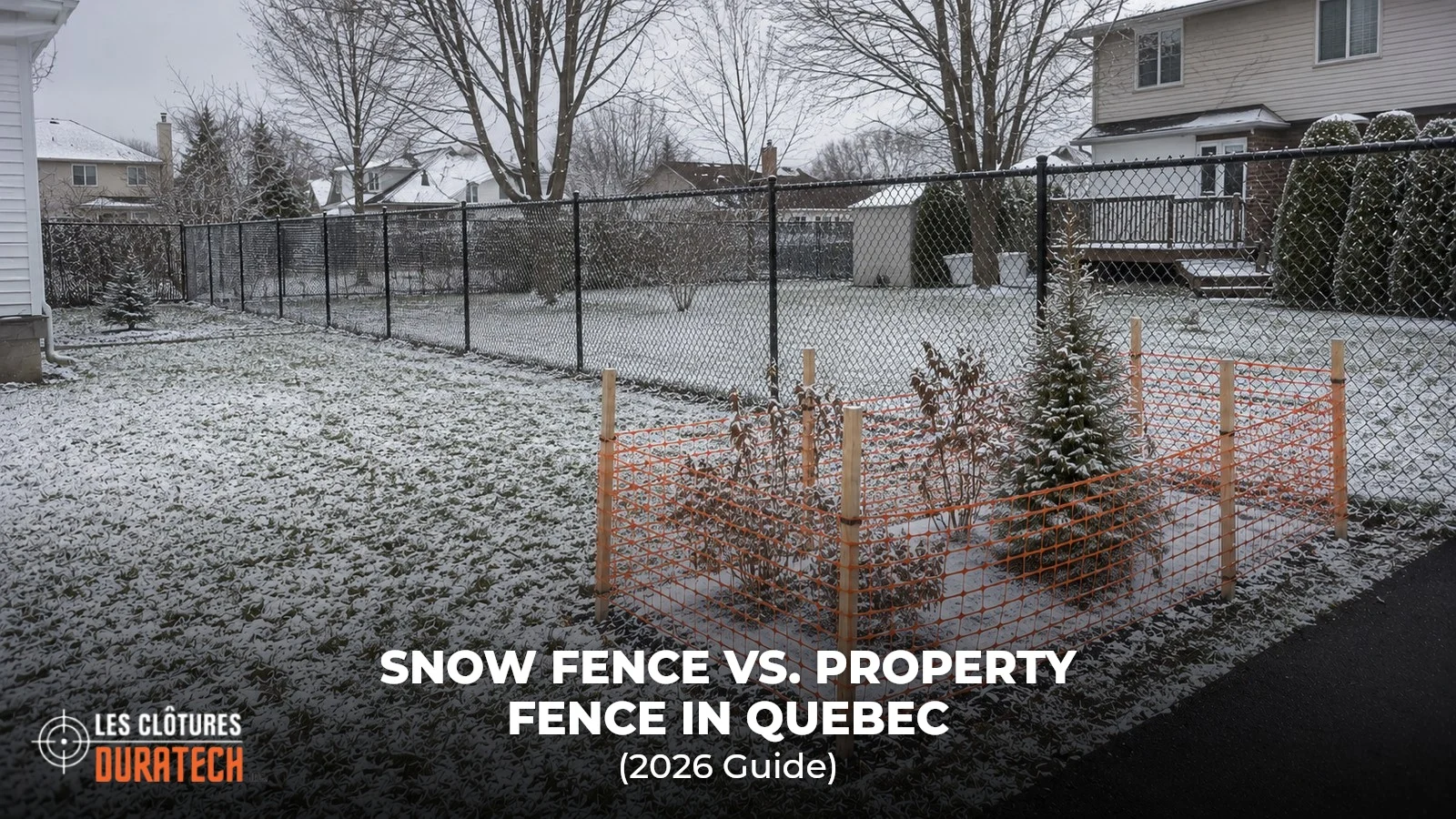
Those two projects get mixed up more than you’d think. A snow fence and a property fence look similar enough — posts, mesh, a line along the yard — that people assume one can stand in for the other, or that the rules for one apply to the other.
They don’t. At least one Quebec municipality writes that distinction into its bylaw in plain terms, and it’s worth knowing before you decide to leave that orange roll up past spring.
At Duratech, we install property fences across the South Shore through the whole build season, and every fall we field the same two questions: is my snow fence actually legal where it’s standing, and is it too late to get a real fence in before winter. This guide answers both.
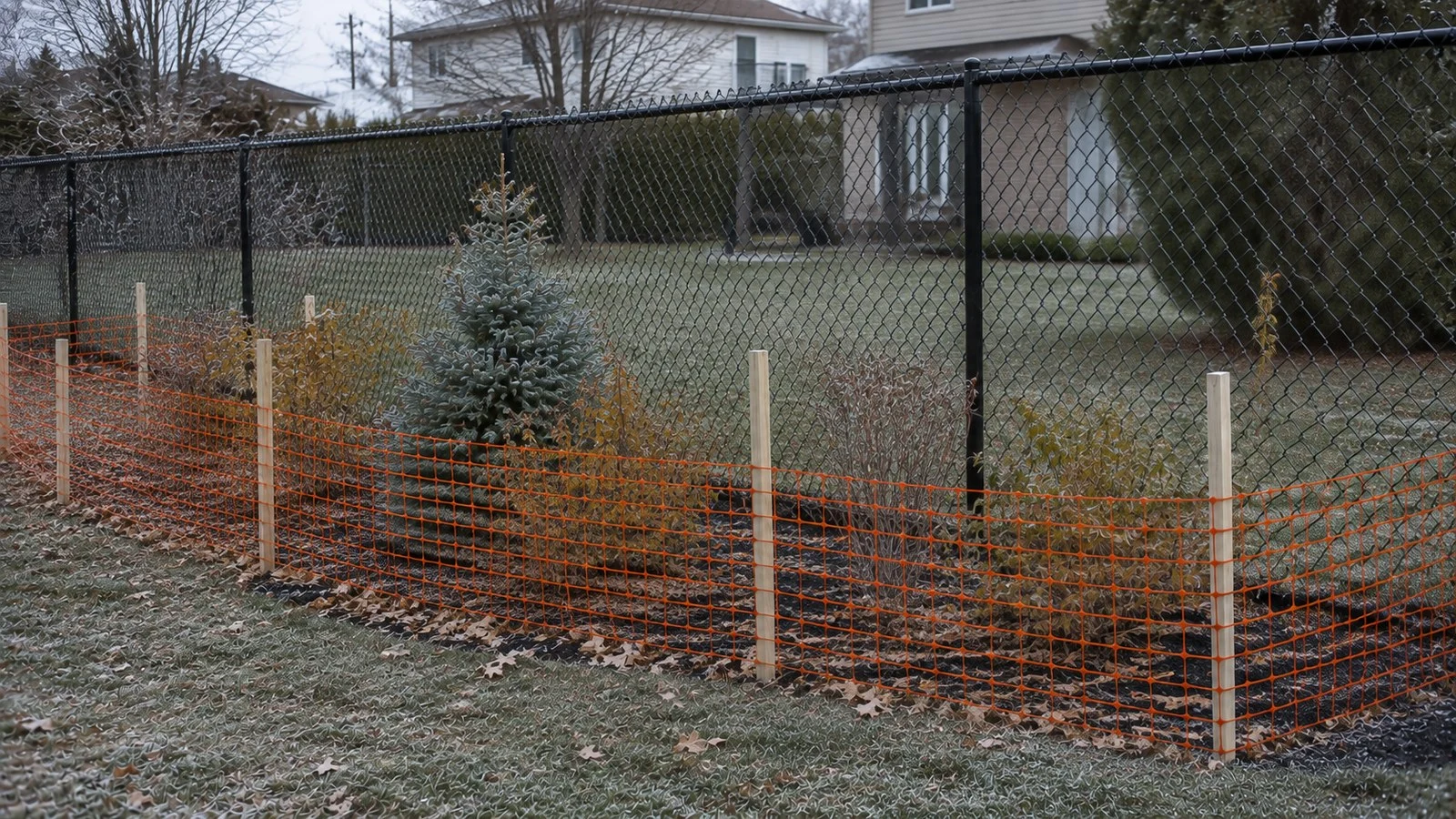
A Snow Fence Isn’t a Property Fence — Here’s What One City’s Rules Say
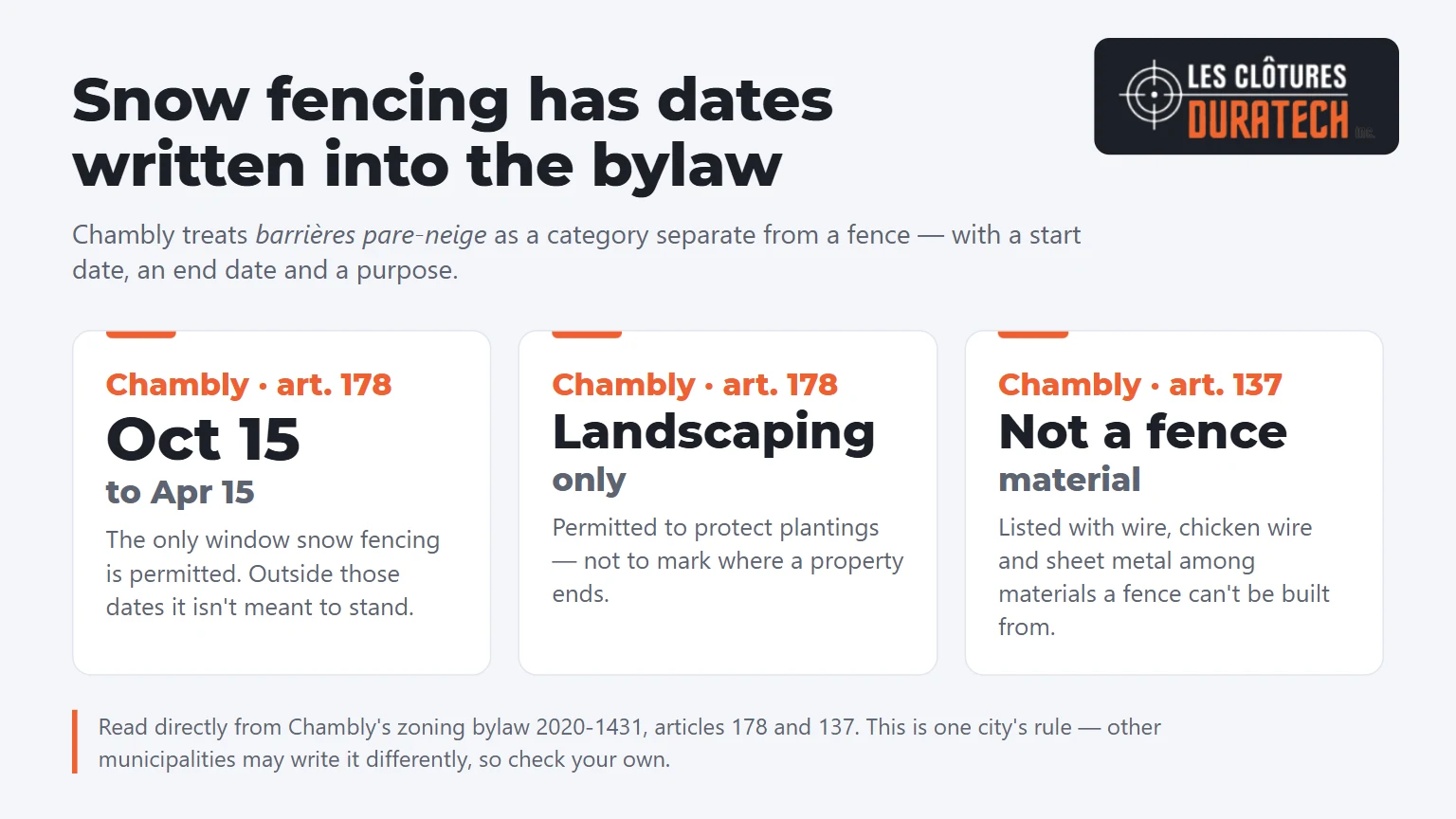
Chambly’s zoning bylaw (règlement 2020-1431) treats snow fencing — barrières pare-neige — as a separate category from a fence, not a type of fence. Article 178 permits them only “for the protection of landscaping,” and only from October 15 of one year to April 15 of the next.
Article 137 goes further. It lists barrières pare-neige among the materials a fence in Chambly is not allowed to be built from — grouped with wire, chicken wire, sheet metal, corrugated plastic, particleboard, and concrete block.
Put together, that’s a clear position: a snow fence is seasonal protection for plants, not a legal fence, and it isn’t supposed to stand year-round doing a fence’s job.
We want to be precise about what this proves and what it doesn’t. This is one city’s bylaw, read directly from the full Chambly zoning regulation. We haven’t checked whether every South Shore municipality writes the same rule the same way, and we won’t guess. If a snow fence has been marking your property line for a few winters, checking your own city’s bylaw before another season is a five-minute call worth making.
None of this means snow fencing is a bad product — it does a real job, just not the job of a property fence. A pare-neige barrier keeps thrown and drifting snow off young shrubs and hedges near a driveway, and it manages where snow piles up along a walkway. Put it up around plantings in mid-October, anchor the stakes so wind doesn’t walk it sideways, and take it down once the risk of heavy snow has passed — in Chambly’s case, that’s the April 15 marker written into the bylaw itself.
And if you’re re-staking the same run every October to screen a sightline or mark where the yard ends, the roll is quietly doing a permanent fence’s job. That’s usually the point where pricing the permanent version makes more sense than buying another roll.
What Actually Damages a Fence in Winter
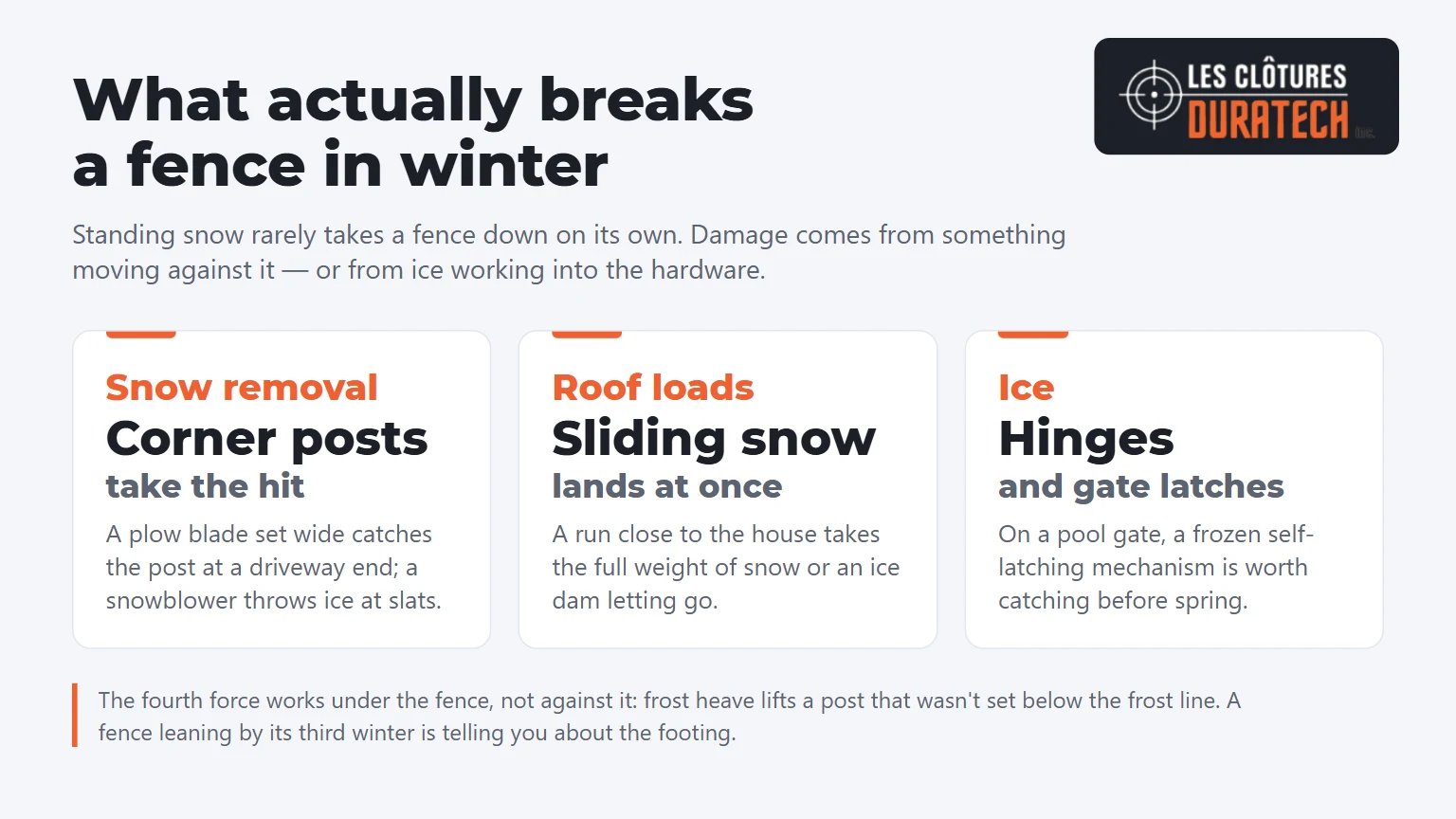
In our experience, standing snow rarely takes a fence down by itself. Most winter damage comes from something moving against the fence — and, on solid panels, from the weight that builds up over a wet winter.
Snow removal equipment is the most common cause we see. A plow blade set slightly wide catches a corner post at the end of a driveway. A snowblower chute throws chunks of ice and gravel at slats or panels from a few feet away, hard enough to crack rigid PVC that would have shrugged off a summer impact.
Roofs are a second source of damage homeowners often don’t see coming. A section of fence running close to the house can take the full weight of sliding snow or an ice dam letting go all at once — a load the fence was never designed to carry.
Solid infill panels — composite, wood, PVC — hold wet, heavy snow that would pass straight through an open mesh fence; the same logic that makes a solid panel catch more wind in a storm applies to snow settling against it after a heavy, wet storm. Ice is the third quiet problem: it works its way into hinges and gate latches, and on a pool enclosure, a frozen self-latching mechanism is worth catching before spring, not after.
The other winter force works under the fence rather than against it. Water in the soil freezes and expands, and that push — frost heave — lifts a post that wasn’t set deep enough. Much of the Rive-Sud sits on clay, which holds water and moves more through freeze-thaw cycles than sandy ground does. That’s why we drill below the frost line and set posts in concrete footings: a fence leaning by its third winter is almost always telling you about the footing, not the panel.
What to Prep Before Snow, by Fence Type
Not every fence needs the same attention going into winter. What’s actually exposed depends on the structure underneath.
| Fence type | What’s vulnerable in winter | What to do before snow |
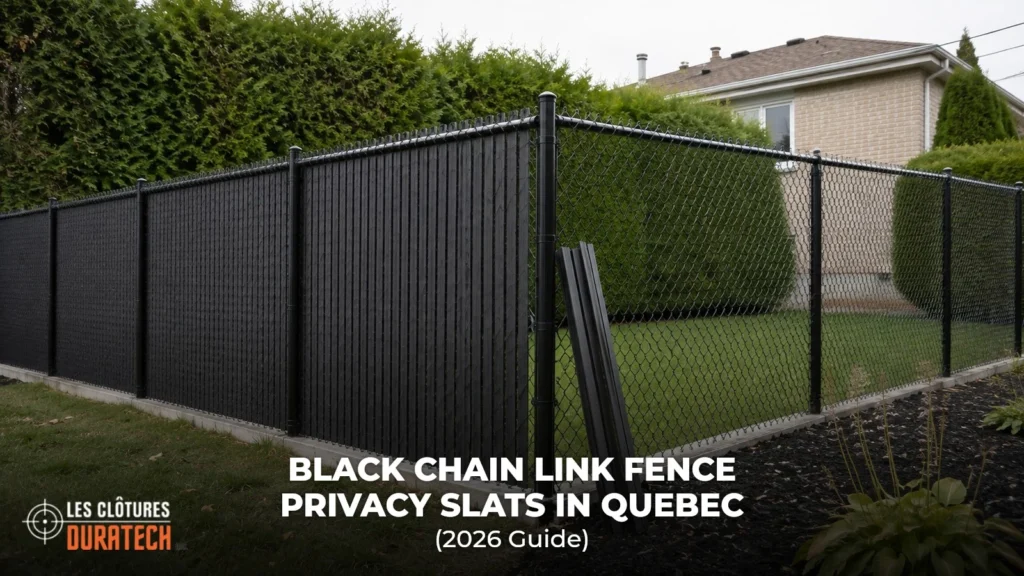
| Chain-link / Frost fence with privacy slats | Slats turn open mesh into a closed surface — that’s the wind load we build the structure around, and it holds more snow than bare mesh; PVC gets more brittle in deep cold | Keep snow-clearing equipment a few feet off the fence line; check that mesh tension hasn’t loosened |
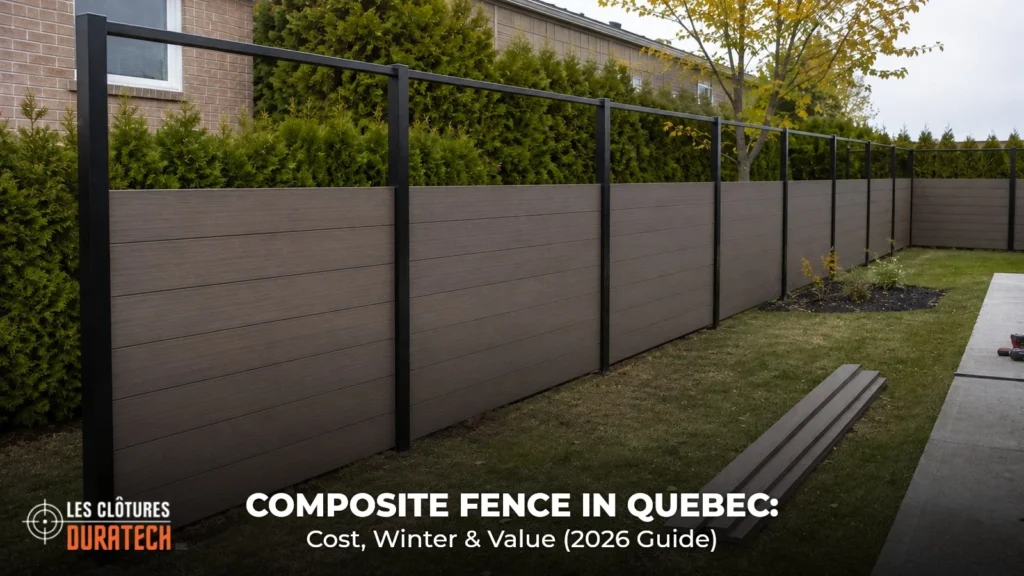
| Hybrid composite or wood on a steel frame | Solid boards catch heavy wet snow; board gaps were set for a specific install temperature | Clear equipment access along the run; walk the line and flag any board that has crept tight against its neighbour or pulled loose at the end |
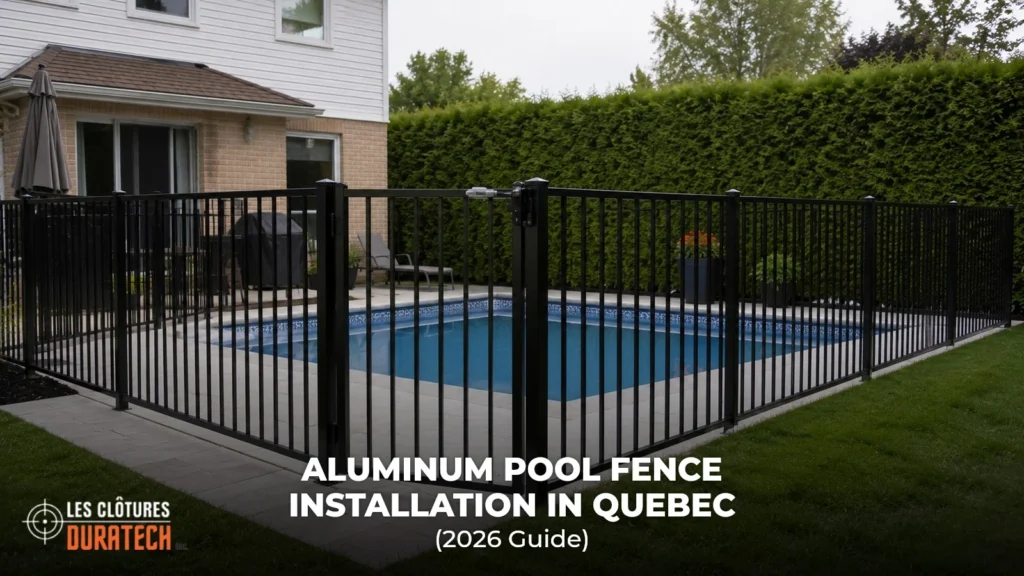
| Ornamental steel or aluminum, pool gates | Hinges and self-latching hardware can freeze or stiffen with ice | Test the gate swing and latch before the first hard freeze; clear ice regularly through winter |
| Classic wood | Snow load against the boards; posts at grade are already the weak point | Keep snow piled away from post bases; inspect for existing lean before winter adds weight |
Each of those structures is covered in more depth elsewhere on the site — the Frost fencing page, our Hybrid Wood & Composite line, and our Ornamental Steel & Aluminum page go into how each structure is built; this table is about what to check on the fence you already have, not how to build one from scratch.
The Fall Installation Window: Temperature Decides, Not the Month
We get asked whether fall is a good time to install a fence, and the honest answer is that “fall” isn’t really the variable that matters. Temperature is.
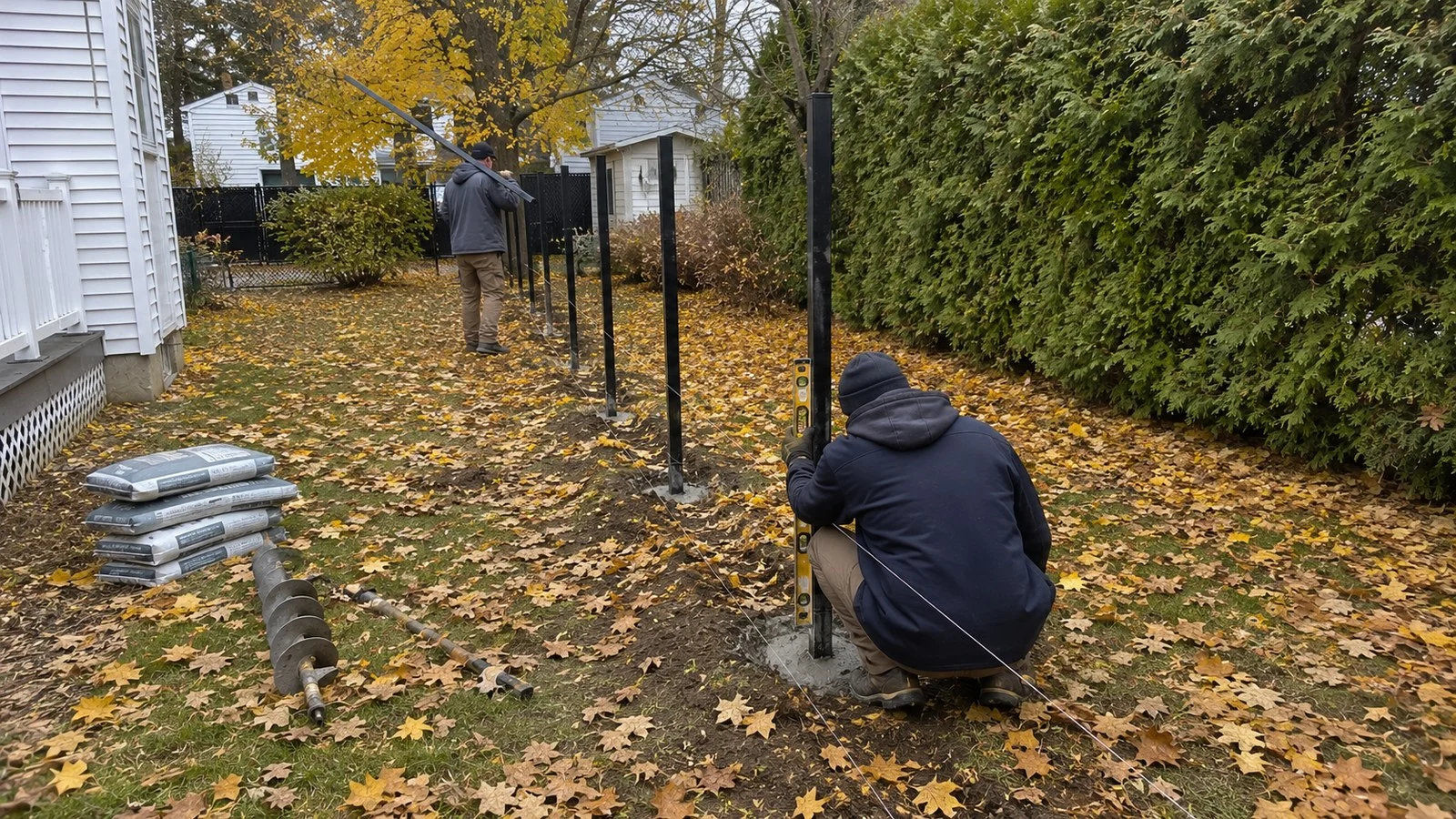
Our standard is a 14-day concrete cure before we hang panels, mesh, or slats — this is our own practice, not a building code requirement, but it’s non-negotiable on our jobs. That means the real question for a fall project isn’t “is it October,” it’s whether there’s enough mild weather left after we pour concrete for those 14 days to finish before the ground locks up hard.
Composite boards add a second temperature-dependent step: the gap left between board ends depends on the air temperature at install. Trex’s installation instructions for its decking and railing line, for example, call for a tighter end gap at 4.4°C and above, and a wider one below that. The figure that applies to your fence comes from the guide for the specific board going in — not from one number that covers every product on the market.
If what you’re weighing is whether the existing fence is worth another winter at all, our repair vs. replacement guide sets out the warning signs that decide it, and our fence lifespan guide covers how each material ages in this climate.
One scheduling item people forget: the construction permit is yours to pull, and your city’s processing time is part of the fall calendar. On our side, we submit the Info-Excavation locate request before any drilling starts.
So we plan fall projects around your dates and the forecast: a mild early November can still work, and a cold snap in late September can close the window sooner than the calendar suggests.
Pre-Winter Checklist
Before the first real snowfall, walk your fence line and check:
- No visible lean at any post, especially ones near a driveway or walkway
- Nothing climbable sits against a pool enclosure. Quebec’s 1-metre clearance names fixed structures — a play module, a retaining wall, a shed; movable things like patio furniture aren’t covered by it, but they give the same foothold, so move them anyway
- Snow isn’t piled against the pool fence: packed snow raises the ground the barrier is measured from, and gives a child a foothold the fence was never meant to offer
- Snow-clearing routes are marked or agreed on with whoever plows, so equipment stays a few feet off the fence line
- Any section that already looked shaky in October gets flagged now, not after the first big snow
What Not to Do in Winter
A few habits cause more damage than the winter itself does.
Don’t pile shoveled or plowed snow directly against a fence line — the weight and the meltwater-refreeze cycle both work against the structure over a season.
Don’t leave a snow fence up as a stand-in property marker once its season has passed — see the FAQ below for what Chambly’s bylaw says about that, and check your own city.
Don’t chip ice off a PVC panel or privacy slat with a shovel or ice pick — cold plastic has less give, and a tool that would just scuff it in July can crack it in January.
Don’t prop a pool gate open “just for winter” because nobody’s swimming — the self-closing, self-latching hardware needs to keep working through every season, not just the one where the pool is in use.
2 Real Cases:
Sainte-Julie — a plow clipped a corner post at the driveway. A homeowner’s Frost fence ran along a driveway that the municipal plow route passed close to every storm. Two winters in, a corner post near the driveway edge had been nudged out of alignment, likely from repeated contact with the plow blade. We reset the post in fresh concrete and suggested setting that end section back a foot from the driveway edge — well inside the property line — where plows routinely swing wide. A small layout change that solved the recurring problem instead of just fixing it once.
Saint-Basile-le-Grand — an October install that made the cure window with days to spare. A homeowner called us in early October wanting a Hybrid Composite fence before winter. We drilled and poured concrete in the first week, which gave us a comfortable 14-day cure before the first stretch of steady cold. Because the boards went in while daytime temperatures were still above the manufacturer’s threshold, we built to the tighter gap spec — no adjustment needed once the cold really set in.
Frequently Asked Questions
1. Can I still install a fence in the fall in Quebec, and how late is too late?
Often yes, but it depends on the weeks left before hard frost, not the date on the calendar. We need enough mild weather after pouring concrete for our 14-day cure to finish properly. Call early rather than late — a project booked in September has more schedule flexibility than one booked the week before the first snow.
2. My fence looked worse coming out of last winter — repair or replace?
It depends on where the problem is. Damage to a panel, a slat, or a rail is usually a repair; a post that has shifted or leaned is a foundation question, and patching the panel above it just postpones the same conversation. Our repair vs. replacement guide walks through the warning signs, and we can tell you which one you’re looking at on site.
3. Does snow removal actually break fences, and who’s responsible if it does?
Plow blades and snowblower chutes are a common source of winter fence damage in our experience, particularly at corners near a driveway. If a municipal or private contractor’s equipment causes the damage, that’s a conversation with the contractor or the municipality, not something covered under our installation work — we can assess and repair the damage either way.
4. Do I need to take my snow fence down in spring?
Check your municipality’s bylaw before assuming. In Chambly, the answer is yes — snow fencing is permitted only from October 15 to April 15 under article 178, and it’s separately listed as a material a permanent fence can’t be built from. Other cities may set different dates or none at all; ask before leaving it up.
5. What happens to a pool gate’s self-latching hardware in winter?
Ice and moisture can jam a latch or stiffen a self-closing hinge over a cold snap. Test the gate before the season starts and again after any thaw-refreeze cycle. A gate that doesn’t close and lock on its own isn’t doing its job, whether the pool is open or covered for winter.
6. Is a fence cheaper to install in the fall?
Not automatically — price is driven by length, height, gates, corners, slope, and access, not by the month on the calendar. What fall changes is scheduling: fewer weeks of workable weather leave less room to move a start date, and that’s the part worth planning around. We give a firm written quote after walking the property, whatever the season.
Disclaimer: This article doesn’t quote prices; any figure for your project comes after an on-site evaluation of slope, access, and existing conditions. Municipal rules on snow fencing and permanent fences — including the dates and materials referenced from Chambly’s bylaw — vary by city and can change over time; confirm current requirements with your own municipality before relying on them, and obtain any required permit before starting a project. Installation timelines depend on weather and site conditions and can shift from what’s outlined here. This article is for general informational purposes only and does not constitute engineering or legal advice specific to your property.
Thinking about getting a fence in before winter, or want a section checked before the snow flies? We’ll walk your property, tell you honestly whether the season still works, and give you a clear, written quote.
Phone: (438) 830-3436
Email: lescloturesduratech@gmail.com
Website: lescloturesduratech.com
We serve homeowners across the South Shore and Montérégie, in English and French.