

In this article
- Types of Bollards, and What Each One Actually Does
- Crash Ratings: ASTM F3016 vs. ASTM F2656
- Commercial Fencing: Built for a Different Job Than a Backyard Fence
- What You Can’t Block: Fire Lanes, Hydrants, and Accessible Routes
- Info-Excavation: Why We Call Before Anything Goes in the Ground
- Winter: What a Snow Plow Does to a Bollard
- What Bollards and Commercial Fencing Cost
- 2 Real Cases
- Frequently Asked Questions
A car backing into a storefront, a delivery truck clipping a gas meter, a pickup rolling through a parking stop and into a patio railing — none of these show up on a maintenance schedule. They show up as a smashed window, a shut-down day, an insurance claim, and a conversation with a landlord or a tenant about who’s responsible for what happened.
“We’ll put in a couple of bollards” is a reasonable instinct. But a bollard bolted to a slab and a bollard engineered to stop a vehicle are not the same product, and product listings don’t always make clear which one you’re getting.
This guide is about making that decision with your eyes open — what each type of bollard and commercial fence actually does, what the industry testing standards mean, and where the real gaps are (fire access, utility locates, winter) that a good installer plans around instead of discovering later. We install bollards and commercial fencing on the South Shore and across Montérégie, and we’d rather walk you through the real trade-offs than sell you a fixed price over the phone.
The short answer: for most storefronts and parking lots on the South Shore, a row of deep-set steel bollards in their own concrete footings stops the everyday slow-speed mistake — but it’s a deterrent, not a certified barrier. If you need a tested rating, ask for an assembly (post and footing together) certified to ASTM F3016, and plan the layout around fire access and buried utilities before anything is poured.
Types of Bollards, and What Each One Actually Does
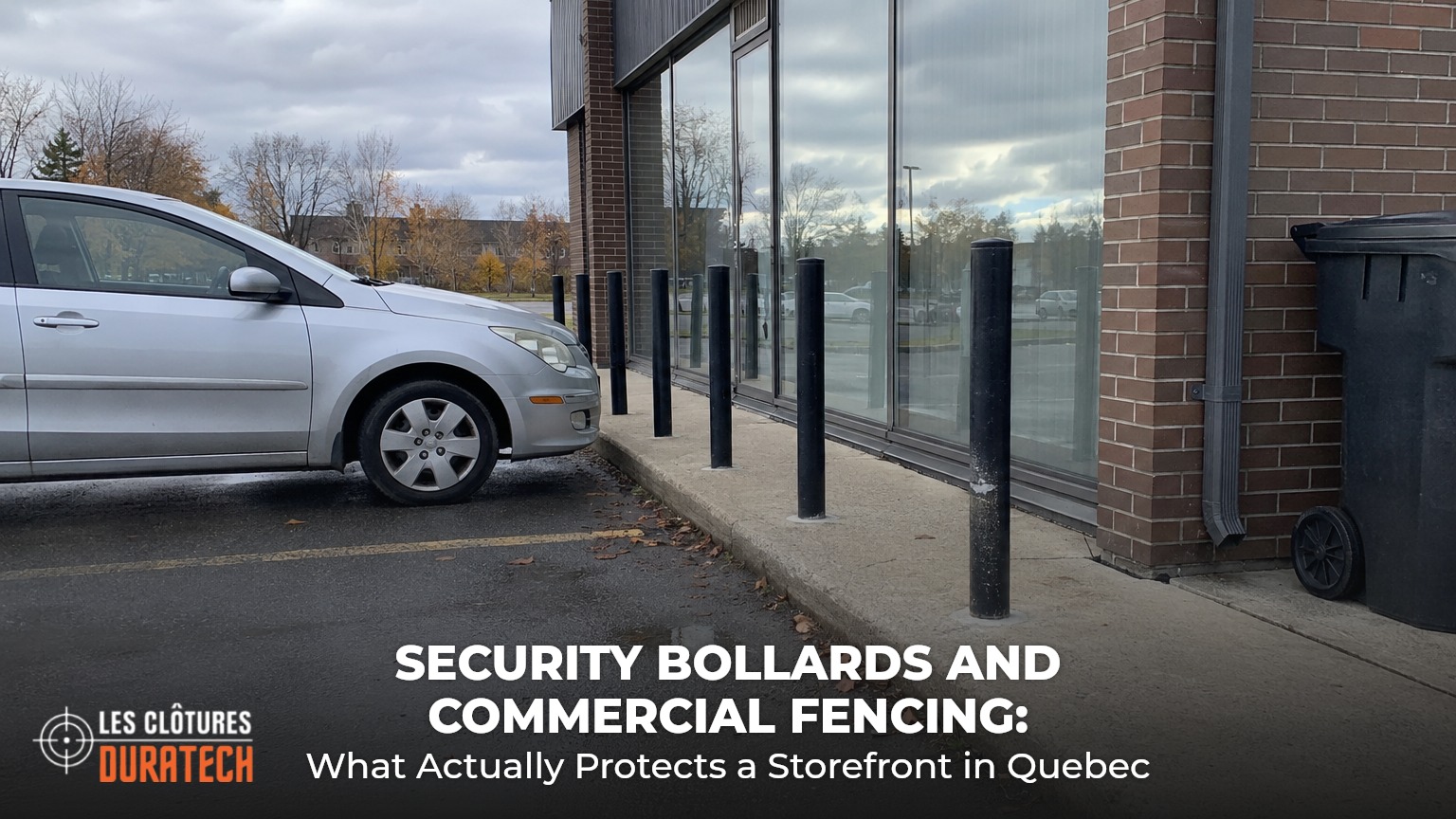
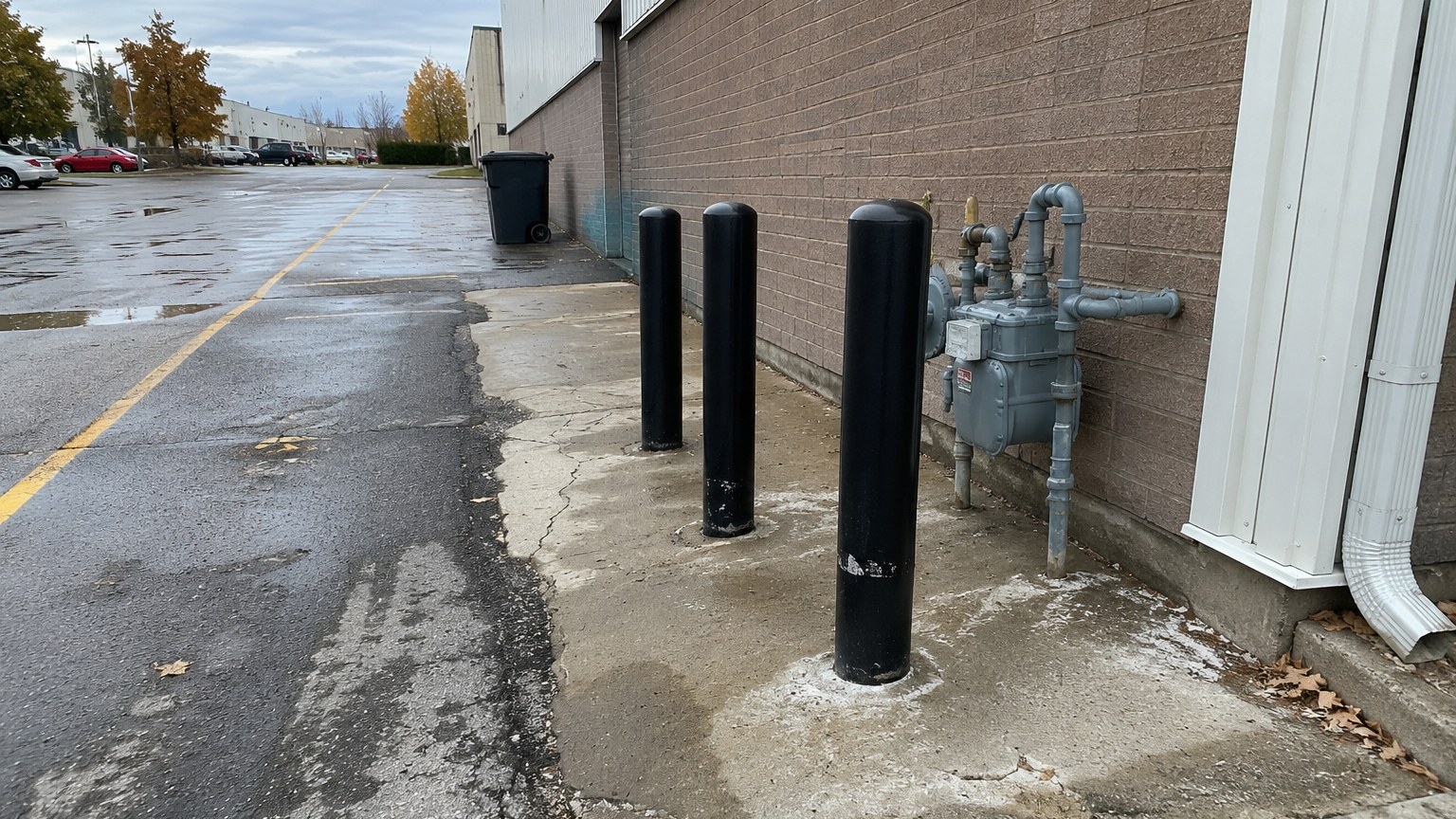
Fixed bollards are set permanently into a concrete footing. They’re the right call for a spot that never needs a vehicle through it — the sidewalk in front of a storefront window, the corner of a building next to a drive aisle, the perimeter around a piece of fixed equipment.
Removable bollards unlock and lift out of a ground sleeve so the opening can take a vehicle when it needs to — a fire lane, a loading dock during deliveries, an event space that’s a driveway the rest of the year. They give you protection most of the time and full access when you need it, without cutting a hole in your fence line.
Retractable and folding bollards drop below grade or fold flat instead of coming out entirely, which is useful where the opening gets used daily — a gated driveway with regular deliveries is the common case. They’re a specialty order rather than a stock item, and not every installer carries them. Before you plan a layout around one, ask who supplies the mechanism, what the lead time is, and how it’s built for a Quebec winter — a below-grade housing that fills with meltwater and refreezes is the failure mode to ask about by name.
Decorative sleeves dress up a plain steel pipe for a more finished look in a lobby entrance or storefront frontage. They’re a cosmetic layer, not a structural one — what’s actually stopping a vehicle is whatever is underneath the sleeve, and that’s worth confirming before you assume the sleeve adds strength it doesn’t have. What a sleeve does add is visibility: yellow is the usual choice where drivers need to spot the post at night or in a snowstorm, black where the frontage matters more.
Surface-mounted (bolt-down) vs. in-ground (deep-set) is the other axis that matters. A surface-mounted bollard bolts to an existing slab and functions mainly as a visual deterrent — it marks a boundary and discourages a slow-speed mistake, but unless that specific bolt-down assembly has been crash-tested, it isn’t built to absorb a real impact. A deep-set bollard, poured into its own footing below grade, is the stronger option of the two and the one you’d want anywhere an actual hit is a realistic risk.
An existing sidewalk or concrete pad doesn’t have to be torn up to get a set-in bollard. We use a diamond core drill to cut a clean, precise hole through the slab, set the post and fill it with concrete — a neater job than breaking out a section, and a stronger one than bolting a plate on top.
Bollard, or Wheel Stop? They’re Not the Same Thing
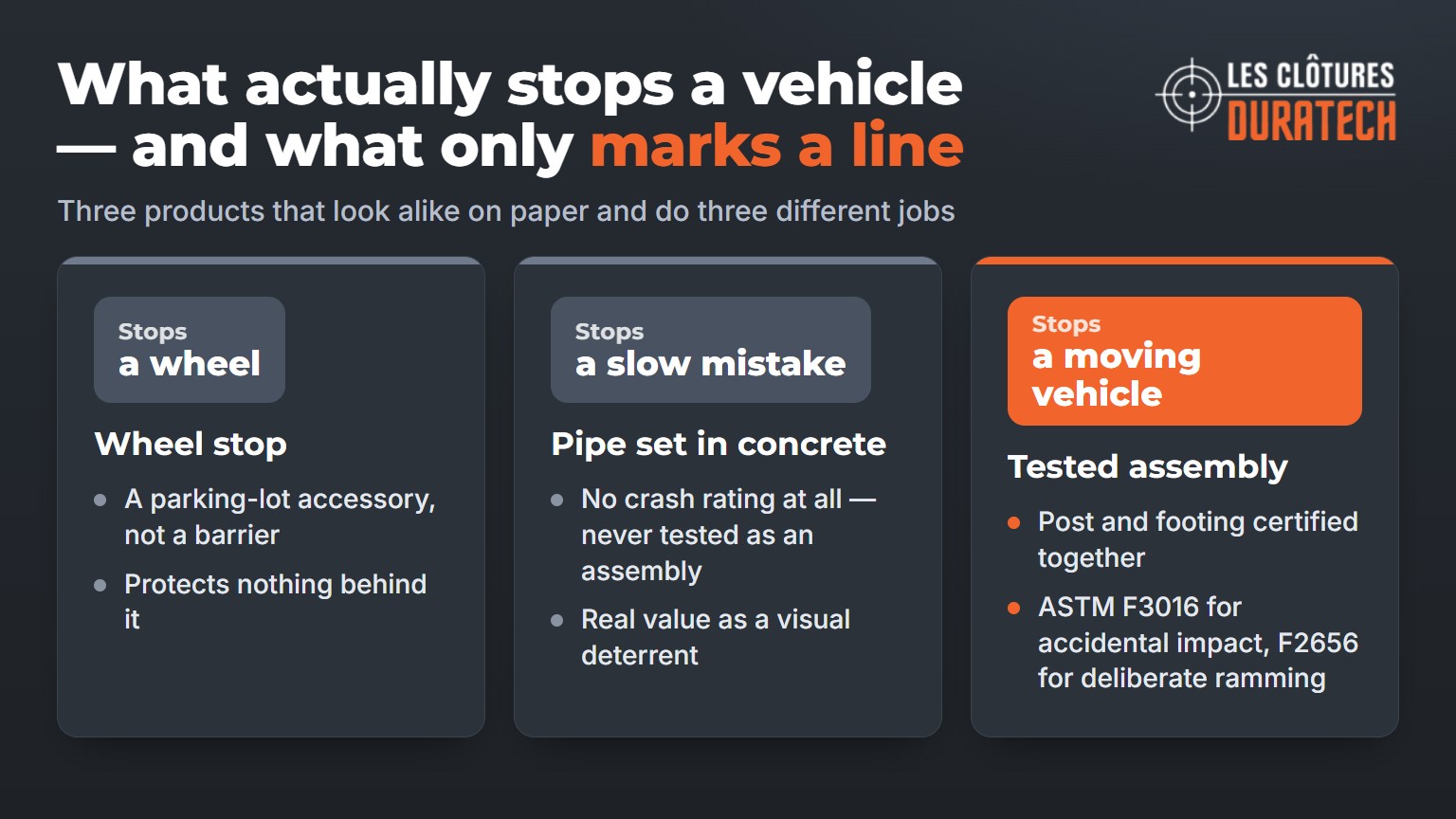
One mix-up we see constantly, including from other suppliers: a wheel stop (sometimes sold as a “parking curb”) is the low block at the end of a parking space that stops a tire from rolling forward. A bollard is a vertical post meant to take a hit from the body of the vehicle.
A wheel stop does nothing to protect a wall, a meter, or a pedestrian standing past it — it’s a parking-lot accessory, not a barrier. If a quote calls something a bollard and it’s really a wheel stop, ask what it’s rated to stop.
Crash Ratings: ASTM F3016 vs. ASTM F2656
Two testing standards get thrown around in bollard marketing, and they answer different questions. Knowing which one applies to your situation changes what you should be buying.
| Comparison | ASTM F3016 | ASTM F2656 |
| Covers | Low-speed vehicle impact protective devices | Crash testing of vehicle security barriers |
| Typical scenario | Accidental impact — a storefront, a parking lot, a patio, a school drop-off zone | Deliberate, high-speed ramming — security and anti-terrorism applications |
| Test vehicle | 5,000 lb. (roughly a full-size pickup) | Ranges from a 2,430 lb. car up to a 65,000 lb. heavy truck |
| Speed classes | S10 (9–18.9 mph), S20 (19–27.4 mph), S30 (27.5–32.5 mph) | M30 / M40 / M50 (a 15,000 lb. truck at 30, 40 and 50 mph) — the current names for the older K4 / K8 / K12 ratings |
| Penetration allowed | P1 (≤1 ft), P2 (≤4 ft) | P1 (≤3.3 ft), P2 (≤23 ft), P3 (≤98.4 ft); beyond that the test is a failure |
| Foundation required | Smaller, lower-cost footing | Heavy, engineered footing |
Sources: rating tables of ASTM F3016 and ASTM F2656.
For most commercial properties on the South Shore — a storefront, a strip-mall parking lot, a delivery driveway — F3016 is the relevant standard: it’s built around exactly that kind of accidental, low-speed impact. F2656 belongs to a different world, the deliberate-ramming scenario you’d see specified for a government building or a high-security site, not a typical retail frontage.
Why “Crash-Rated” Means the Whole System, Not a Thick Pipe
Here’s the point most bollard listings skip entirely: a bollard doesn’t earn a crash rating on its own. Under ASTM F3016, a device can be tested under a specific set of installation conditions, and its rating is then only valid if those same conditions are met when it’s installed in the field.
That’s because the foundation is where the force goes. As bollard maker Reliance Foundry puts it, the energy of an impact is “transferred through the subsurface foundation into the ground,” and “an improperly reinforced footing can lead to bollard failure even if the above-ground post is strong.” Change the footing, the anchoring or the soil from what was tested, and you can’t assume the rating still applies.
The practical takeaway follows directly from that: a plain steel pipe set in a bag of concrete has no crash rating at all, because it was never tested as part of a rated assembly. That’s not a knock on the product: a visual deterrent has real value — it stops the slow-speed mistake and marks a boundary clearly. It just isn’t the same thing as a tested, crash-rated barrier, and the honest move is to call it what it is rather than sell “protection” it can’t deliver.
If crash protection is what you actually need — a gas meter, a transformer, a high-traffic entrance — the question to ask any installer isn’t “is this bollard strong?” It’s “is this specific assembly, post and footing together, tested and certified to a named ASTM class?” If the answer is vague, you’re looking at a visual deterrent priced like something more.
Around gas meters and regulators specifically, the utility decides where its meter goes and requires that access to it stay clear, and the gas code adds its own installation rules. Call the utility with your proposed layout before anything gets set in concrete next to one — and any damage to a meter, regulator or line has to be reported to the utility, even if nothing is leaking.
Commercial Fencing: Built for a Different Job Than a Backyard Fence
A commercial fence isn’t a taller residential fence — it’s specified for a different set of problems: higher foot and vehicle traffic, liability exposure, and a perimeter that has to hold up to years of daily use rather than the occasional dog testing a gate.
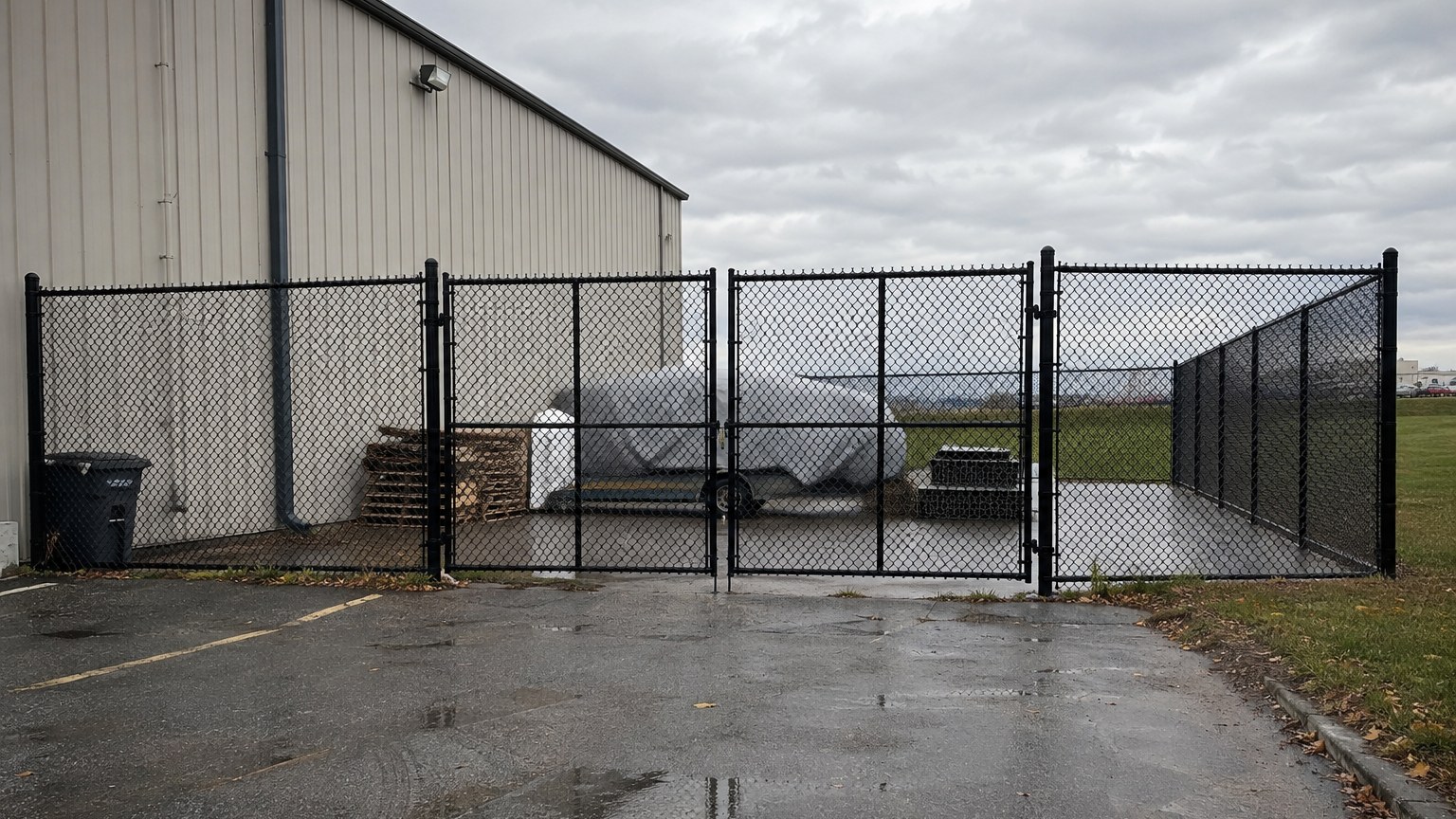
Height typically runs 6 to 8 feet for commercial perimeter fencing, with custom runs from 4 up to 10-plus feet depending on what’s inside — a storage yard, a rooftop mechanical enclosure, and a retail parking lot all call for different heights. Mesh is heavier-gauge galvanized than what goes on a residential lot, built to take repeated contact rather than occasional wind load.
For a more finished frontage, ornamental steel or aluminum fencing gives a commercial property a professional look at the entrance while still holding a real perimeter behind it. Privacy slats woven into chain-link block sightlines into a storage or loading area — useful anywhere the goal is discretion as much as security.
Where climb resistance matters — a storage yard, a compound, anywhere the perimeter is the main line of defence — angled barbed-wire arms carrying three strands at the top of the fence are the usual anti-climb upgrade, and they read as a clear deterrent from the street as well. Whether you can have them depends on your municipality and the zone your lot is in, so we check the local bylaw before they go into the quote.
Gates split into two practical categories. Cantilever (rolling) gates slide along the fence line on rollers instead of swinging on hinges — the standard choice for a loading dock or truck yard, since there’s no arc of swing to keep clear and no gate to catch in a snowbank. Swing gates work fine for a lower-traffic entrance where space isn’t tight. Either way, a pedestrian gate built into or beside the main gate keeps foot traffic from having to open the full vehicle gate for every delivery driver or staff member.
As with our residential installs, commercial fence posts get our 14-day concrete cure before we stretch the mesh and hang the gates. For heavy commercial gates, that wait isn’t negotiable: the posts have to carry the gate’s weight, and a run with privacy slats catches far more wind than open mesh — the footing has to be fully set before it takes either load.
Permits sit with the property owner. A commercial fence almost always needs a municipal permit, and bollards often do too — especially near a public street or sidewalk. You (or your landlord) apply for it; we supply the drawings and specifications the application needs. Height is part of the same check: 6 to 8 feet is typical, but your municipality’s zoning bylaw sets what’s allowed on your lot.
What You Can’t Block: Fire Lanes, Hydrants, and Accessible Routes
Before any bollard or gate goes in, there’s a hard limit that overrides the security plan: the fire access route has to stay clear for fire trucks at all times.
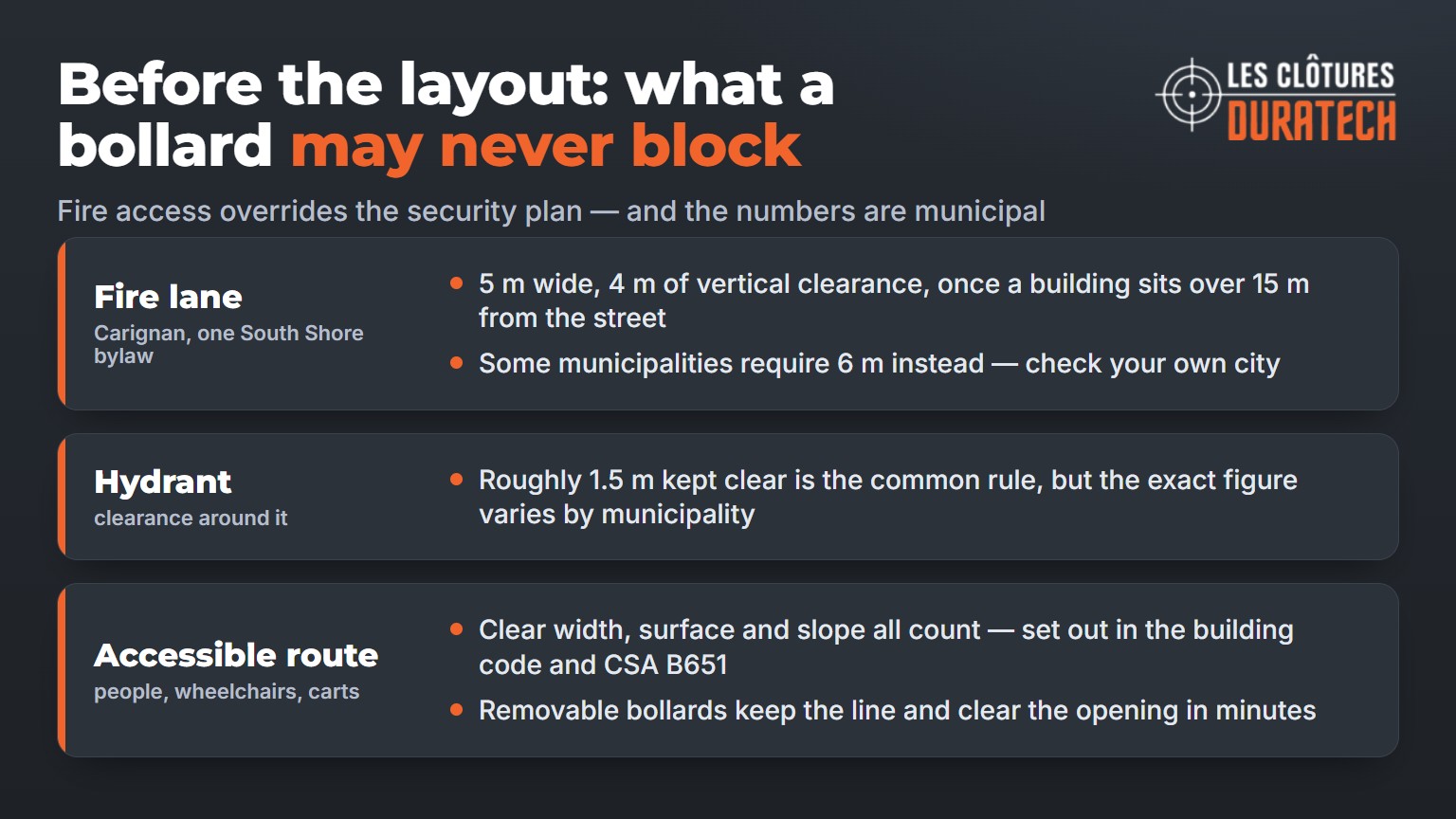
Municipal fire-access bylaws in Quebec are built on the National Fire Code. Carignan’s bylaw, to take one South Shore example, requires an access route once a building sits more than 15 metres from the street: at least 5 metres wide with 4 metres of clearance height, kept clear at all times, with curves of at least 7.6 metres on the inside edge and 15.2 metres on the outside. The same bylaw allows a barrier on that route only if it sits at least 3 metres back from the public right-of-way and doesn’t open outward. Other municipalities set the width higher: in Richelieu, access lanes in an integrated development need at least 6 metres of drivable width.
Those are local numbers, not a provincial standard — there is no single fire-lane width that applies everywhere in Quebec. Municipalities follow the National Fire Code as a baseline but, per the Régie du bâtiment du Québec (RBQ), can adopt stricter requirements for buildings on their own territory. Read your own city’s fire-access bylaw before bollard placement is finalized — that check is part of the job, not a formality.
Clearance around a fire hydrant follows the same pattern. Montréal’s fire department and Québec City both call for 1.5 metres kept clear around a hydrant, while Carignan’s bylaw sets 1 metre in every direction — so we treat 1.5 metres as a starting point and confirm the local figure before designing around it. Some bylaws go further: Cowansville’s requires a hydrant in a parking area to be protected against damage from cars.
Accessible routes matter just as much. A path used by pedestrians, wheelchairs, or delivery carts has to stay genuinely usable — clear width, surface, and slope all count, not just enough space to satisfy a fire-lane minimum on paper. Those requirements sit in the building code’s barrier-free provisions and in CSA B651, the Canadian accessible-design standard, and they’re why we lay out bollard spacing on site rather than off a floor plan.
This is where removable bollards earn their keep. A fixed line of posts across a driveway solves the security problem and creates the access problem in the same move. A removable or retractable line solves both — locked down day to day, and clear in minutes when a fire truck, a delivery, or an event needs the opening.
Info-Excavation: Why We Call Before Anything Goes in the Ground
Every deep-set bollard and every fence post footing means digging, and digging on the South Shore means checking what’s already buried there first — the step we walk through in our guide to Info-Excavation before a fence install.
We submit the request through Info-Excavation at least 4 business days before the planned dig — the lead time the RBQ sets out for licensed contractors. Info-Excavation asks you to allow at least 3 business days for utility owners to respond, not counting the day the request is filed; in our experience it takes 3 to 10. Per the RBQ, the request stays valid until the end-of-work date written on it, up to 180 days. The service is free and available 24/7.
It covers the networks of Info-Excavation’s member companies only — a private line, such as parking-lot lighting or a feed to an outbuilding, has to be located separately. That part is on the property owner, so point out any private lines before we dig.
The Régie du bâtiment du Québec lists checking for buried infrastructure before starting excavation work among a licensed contractor’s responsibilities. Skip that step and hit something, and the contractor is on the hook for the damage — with a mark on the licence file and possible sanctions to go with it.
One thing worth being straight about: Quebec has no dedicated locate law like the one Ontario has had since 2012, and Info-Excavation itself says a request isn’t mandatory for everyone. On a construction site, though, checking isn’t optional: Quebec’s construction safety code (section 3.15.1) requires the employer to check for underground lines before digging and mark their exact location. In practice, it doesn’t change how we work: we file the request as a standard part of every job, and it’s one less thing you have to track before a footing goes in.
Winter: What a Snow Plow Does to a Bollard
A bollard rated to survive a car at parking-lot speed isn’t necessarily rated to survive a plow blade, and that distinction matters on any property that gets cleared through the winter.
Flexible bollards — the polyurethane posts you see in drive-throughs and on traffic islands — are built to absorb a hit from a vehicle at legal, low speed and spring back into shape. A snow plow hits differently — more force, at a different angle, often repeatedly over a season — and bollard maker Reliance Foundry is direct about it: flexible bollards “cannot withstand a snow plow” and “can be sheared off by a snowplow.” In any zone your own crew or a contractor clears with equipment, we generally recommend a removable bollard in a flush ground sleeve over a fixed post standing above grade all winter.
Pulling the posts for the season does leave that opening unprotected, so this suits lanes and docks; in front of a storefront, we’d rather keep a fixed post and make sure the plow crew can see it.
Repeated freeze-thaw cycles also put real stress on any concrete footing over the years, fixed or removable. It’s one more reason the foundation under a bollard has to be built to spec the first time, rather than treated as the part of the job that’s easy to shortcut.
The same conversation applies to a fence line. We ask on every commercial site where the snow will be pushed, because a windrow banked against mesh and slats leaves steady lateral load on the posts all winter, and a swing gate needs a cleared arc that a cantilever gate doesn’t. Deciding that in October is cheaper than repairing it in April.
What Bollards and Commercial Fencing Cost
We’ll say this plainly: there’s no reliable Quebec-specific pricing for bollards on the market right now, and we’re not going to invent numbers to fill that gap.
What we can offer is order-of-magnitude context from other markets, clearly labelled as such. One Toronto contractor’s 2026 cost guide puts a basic fixed bollard, installed, at $400–900 per unit, with impact-rated, automatic or retractable units starting around $1,500 and up. That’s a single Toronto source, not a Quebec market rate — treat it as a reference point, not a quote.
On the U.S. side, one Oregon installer’s 2026 price guide puts a crash-rated bollard, before installation, at roughly $1,500–3,000 for K4/M30, $2,500–5,000 for K8/M40 and $4,500–10,000 for K12/M50 (U.S. dollars), with the foundation adding roughly $1,200–3,000 per post at K4 and up to $4,000–8,000 at K12. American figures, quoted here only to show the shape of the range.
For contrast, the same Toronto contractor’s guide notes retail multi-packs of posts at $250–600 for light residential use — rarely crash-rated or engineered for impact, and with no footing, no locate and no installation included. That gap between an off-the-shelf post and a tested system is the whole point of this section.
That spread — from a few hundred dollars to five figures per point of protection — comes down to four things: whether the foundation is engineered or basic, whether the assembly is actually crash-rated or a visual deterrent, how difficult the site is to access, and how many points need protecting.
There’s no reliable published benchmark for commercial chain-link on the Montreal South Shore either. Our own published range for Frost chain-link — $25–60 per linear foot installed — is a figure for a 6-foot residential fence. A commercial run is specified differently: heavier gauge, greater height, cantilever or double gates, often slats or barbed-wire arms where the zone allows them. It gets quoted on its own rather than read off the residential range.
None of those figures is a quote. Run length, ground conditions, and how a truck reaches the fence line move the number more than the material does — as does the level of protection the location actually calls for, and that one only gets settled standing on the site.
In a leased building, settle one question before the quote: who is ordering the bollards — the landlord or the tenant — and who will own and maintain them afterwards. They’re set in the property’s concrete and they stay with it, so it’s worth having that in writing with the lease rather than sorting it out after the first incident.
2 Real Cases
A storefront on a strip-mall parking lot in Brossard. The tenant’s glass frontage sat directly in line with three angled parking stalls, and a slow-speed backing incident the year before had already cracked one panel. We installed a row of fixed, deep-set steel bollards along the sidewalk edge, spaced to stop a vehicle without blocking the entrance, and checked the layout against the property’s fire-access requirements before finalizing it.
The landlord asked directly whether the bollards were crash-rated. We were straight with him: they were not tested to an ASTM class, and a rated assembly would have meant a heavier foundation and a different budget. He chose the deterrent option knowing what it does and what it doesn’t.
A distribution warehouse near Chambly. The drive aisle serving the building’s single loading dock was also its designated fire lane, so a fixed barrier was off the table no matter how much protection the owner wanted at that opening. We set removable bollards in flush ground sleeves at the dock, and ran heavy-gauge galvanized mesh with a cantilever gate around the rest of the yard — with a pedestrian gate beside it, so nobody was opening the vehicle gate for every driver.
We filed the Info-Excavation request before drilling the sleeve footings and scheduled the work around deliveries, so the dock lost only part of one day. The posts went back into the sleeves once the footings had cured: a bollard is only as good as the concrete under it, and that part doesn’t get rushed.
Frequently Asked Questions
1. How much do bollards and commercial fencing cost installed?
There’s no reliable Quebec figure for bollards — price swings with foundation type, whether the assembly is crash-rated, and site access. As a rough sense of scale from other markets, basic fixed units run in the hundreds of dollars, and crash-rated systems with engineered foundations run into four and even five figures per point. For fencing, our own published residential range for installed chain-link is roughly $25 to $60 per linear foot; a commercial run — heavier gauge, added height, coating, slats, more gates — is quoted on its own. Either way, the number that counts comes after we’ve seen the site.
2. Will a regular steel pipe set in concrete protect my building?
It will stop a slow, glancing impact and act as a clear visual boundary — that has real value. But unless the specific bollard-and-foundation assembly has been tested and certified to an ASTM standard like F3016 or F2656, it has no official crash rating, and it isn’t built to reliably stop a real impact from a moving vehicle. We’ll tell you plainly which one you’re getting before you commit to it.
3. Can a bollard or gate block a fire lane?
Not in a way that stops a fire truck. Fire-access requirements override the security plan: municipal bylaws set minimum widths, clearances and turning radii, and the route has to stay clear at all times. Some bylaws allow a barrier on the route under conditions — Carignan’s requires it to sit at least 3 metres back from the public right-of-way and not open outward — so check your own city’s rules. A removable bollard system is often the right answer here — it holds the line day to day and clears in minutes when fire access is needed. A retractable system does the same job but is a special order, worth confirming before you plan around one.
4. Will a snow plow damage my bollards?
It can, especially a fixed post standing above grade in a zone your own crew or a contractor clears with equipment. Flexible bollards are generally built to take a hit from a vehicle at low speed, not a plow blade. In any area that gets plowed regularly, a removable bollard with a flush base is usually the more durable choice for winter. The exception is a storefront: pulling the posts there leaves the glass unprotected all winter, so we keep a fixed post and make sure the plow crew can see it.
5. How long does installation take, including the utility locate?
The locate comes first, and it sets the floor: the request goes in at least 4 business days ahead, and Info-Excavation asks you to allow at least 3 business days for utility owners to respond — in our experience, 3 to 10. Plan on one to two weeks between approving the work and a drill going into the ground. The request stays valid until the end-of-work date written on it, up to 180 days, so it can be filed ahead of the install.
After that, the job tracks the number of footings, not the calendar, and the footings have to cure before the posts take a load — for fence posts that carry mesh and gates, that’s our standard 14 days. Plan that into the date the barrier needs to be in service. We date the schedule once we’ve walked the site.
6. How much maintenance do bollards and commercial fencing need?
Less than a residential fence, but not none. Freeze-thaw cycles work on every footing over the years, so after each winter it’s worth walking the line: a post that leans, rocks or has a cracked collar of concrete at grade is telling you something about its footing. Removable bollards need their sleeves kept clear of sand, salt and ice so the posts still come out when you need them. On a fence line, check where the snow was banked against mesh or slats and whether the gates still close and latch squarely — that’s where winter load shows up first.
Disclaimer: Prices here are reference figures from other markets and our own published residential range, not a quote — a final price depends on an on-site evaluation of the layout, access, and foundation. We don’t advertise ASTM crash ratings on our standard bollard installations; if your project requires a certified crash-rated assembly, say so before we quote, so we can confirm in writing what can be supplied and to which tested class. Fire-access requirements, hydrant clearances, and other municipal bylaws vary by municipality and change over time — confirm current rules with your city. This article is general information only and is not engineering or legal advice for your property.
Not sure whether your property needs a fixed barrier, a removable system, or a full commercial fence line — or which one actually solves the problem you’re worried about? We’ll walk the site with you and put together a clear written quote built around what your building and your access requirements actually need. You can also see the range of what we install on our pages for security bollards and commercial and industrial fencing.
Phone: (438) 830-3436
Email: lescloturesduratech@gmail.com
Website: lescloturesduratech.com
We serve commercial properties across the South Shore and Montérégie, in English and French.