

In this article
- Pooling Water: Two Different Problems
- What Quebec’s Code Actually Requires
- Grading or French Drain: How to Tell Which One You Need
- Mistakes That Make It Worse
- How We Grade a Yard
- When You Actually Need a French Drain Specialist
- What Affects the Price
- Best Time of Year to Fix It
- 2 Real Cases
- Frequently Asked Questions
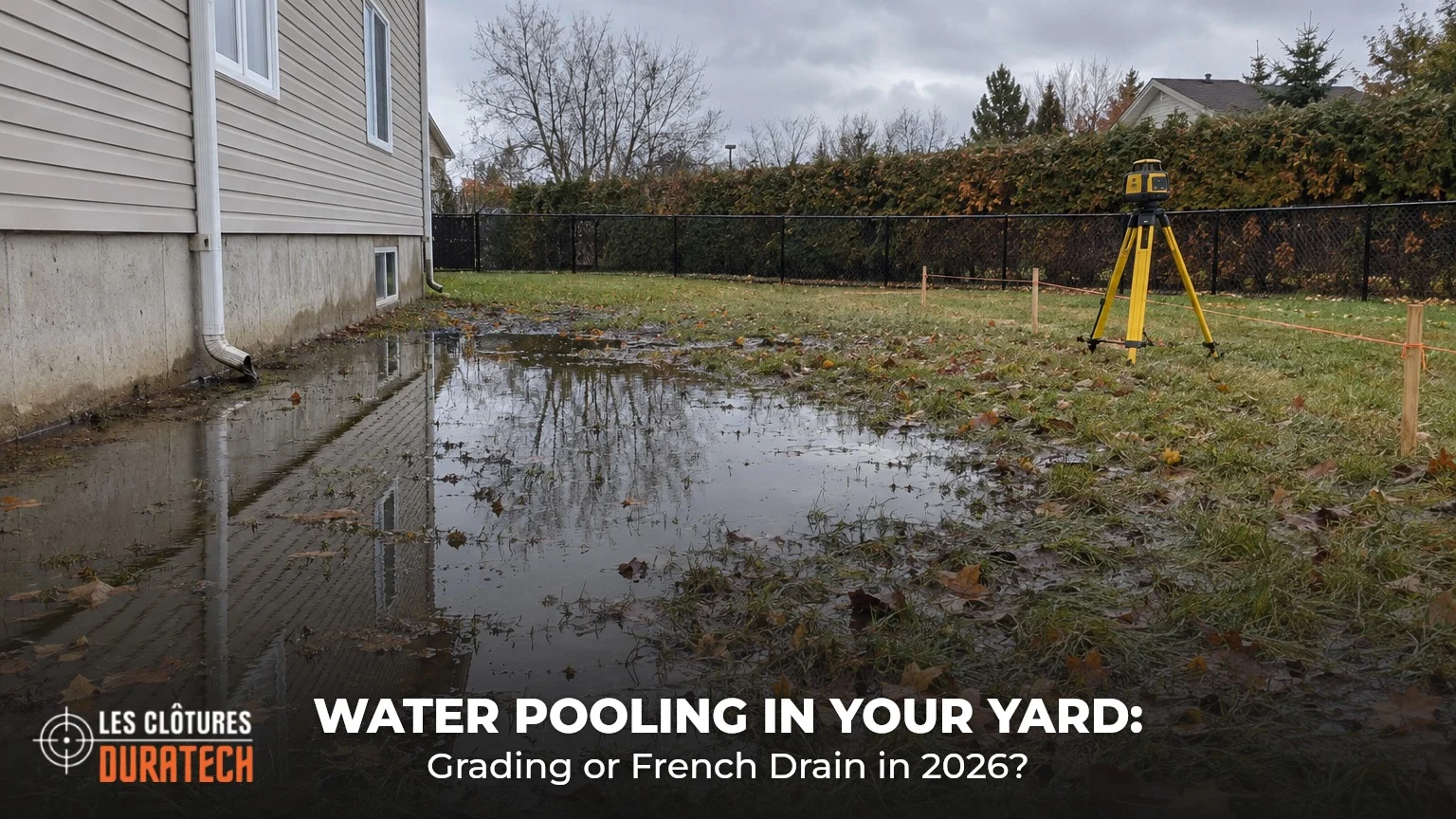
Water sitting in the lawn after every rain, a soggy strip along the foundation, a corner of the yard that never quite dries out — the question we often hear is whether that needs yard grading or a French drain. The honest answer is that it depends on where the water actually is, and that’s the part worth sorting out before anyone starts digging.
We at Duratech handle the surface side of this: yard grading, the slope that moves water away from your foundation before it becomes a problem. We don’t install or repair French drains. This guide helps you tell which problem you have, because treating the wrong one wastes money and leaves the real issue in place.
Pooling Water: Two Different Problems
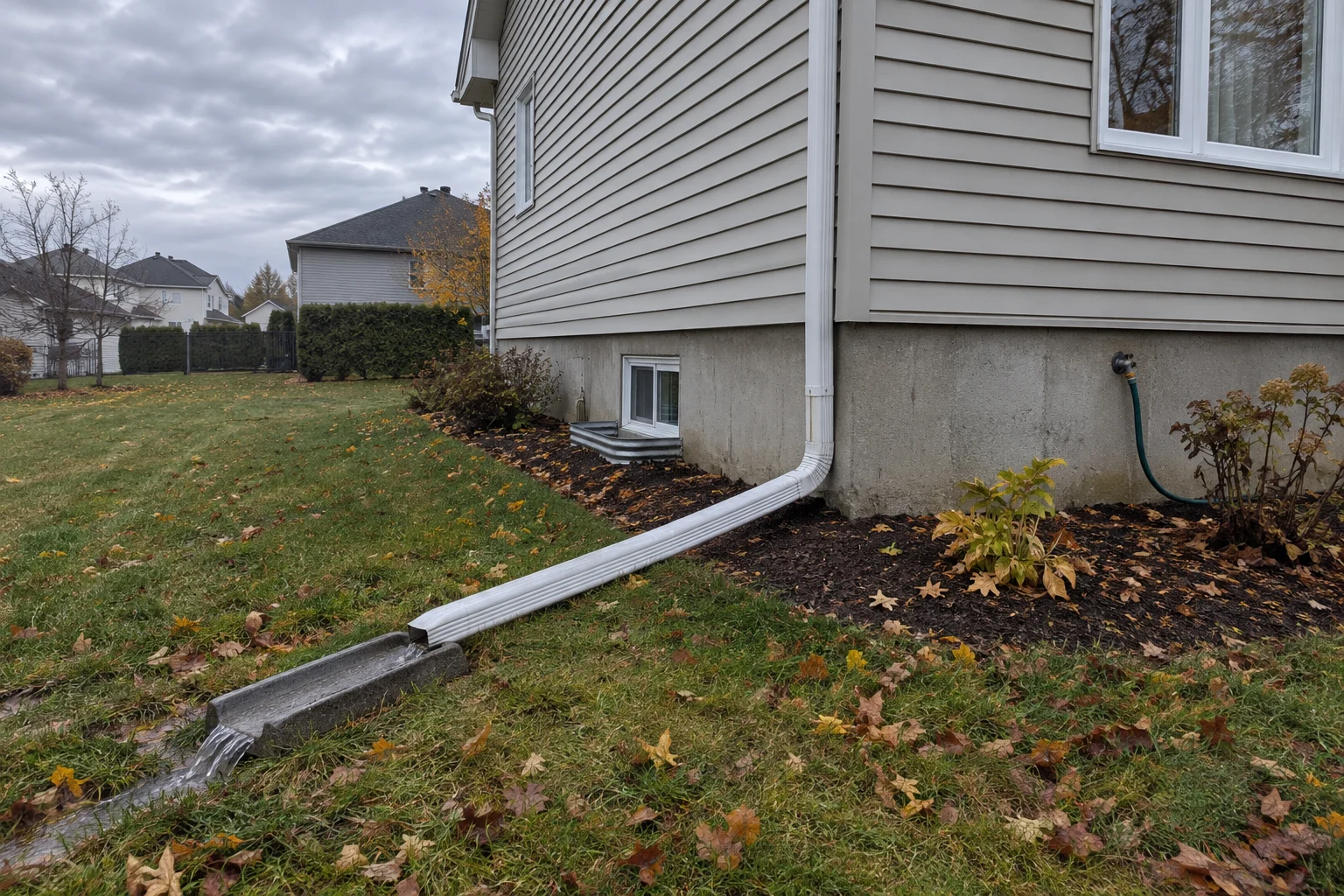
Standing water in a yard and water inside a basement can look related, but they’re usually solved by two completely different trades. Yard grading reshapes the surface of your lot so rain runs away from the house instead of sitting against it.
A French drain — also called a foundation drain, drain de fondation, or weeping tile — is a buried, perforated pipe that collects groundwater pressing against the foundation wall and carries it away before it reaches your basement. That’s a foundation-drainage specialist’s job, not ours.
One note on terms: in English, “French drain” is also used for a gravel trench drain dug across a lawn for yard drainage. In Quebec, drain français almost always means the foundation drain, and that’s the meaning this guide uses. A lawn trench drain is a separate solution from both — and not one we install either.
The confusion is understandable: both problems show up as “water near the house,” and both get worse in the same wet seasons. But a yard that drains perfectly on the surface can still have a failing foundation drain underneath it, and vice versa.
What Quebec’s Code Actually Requires
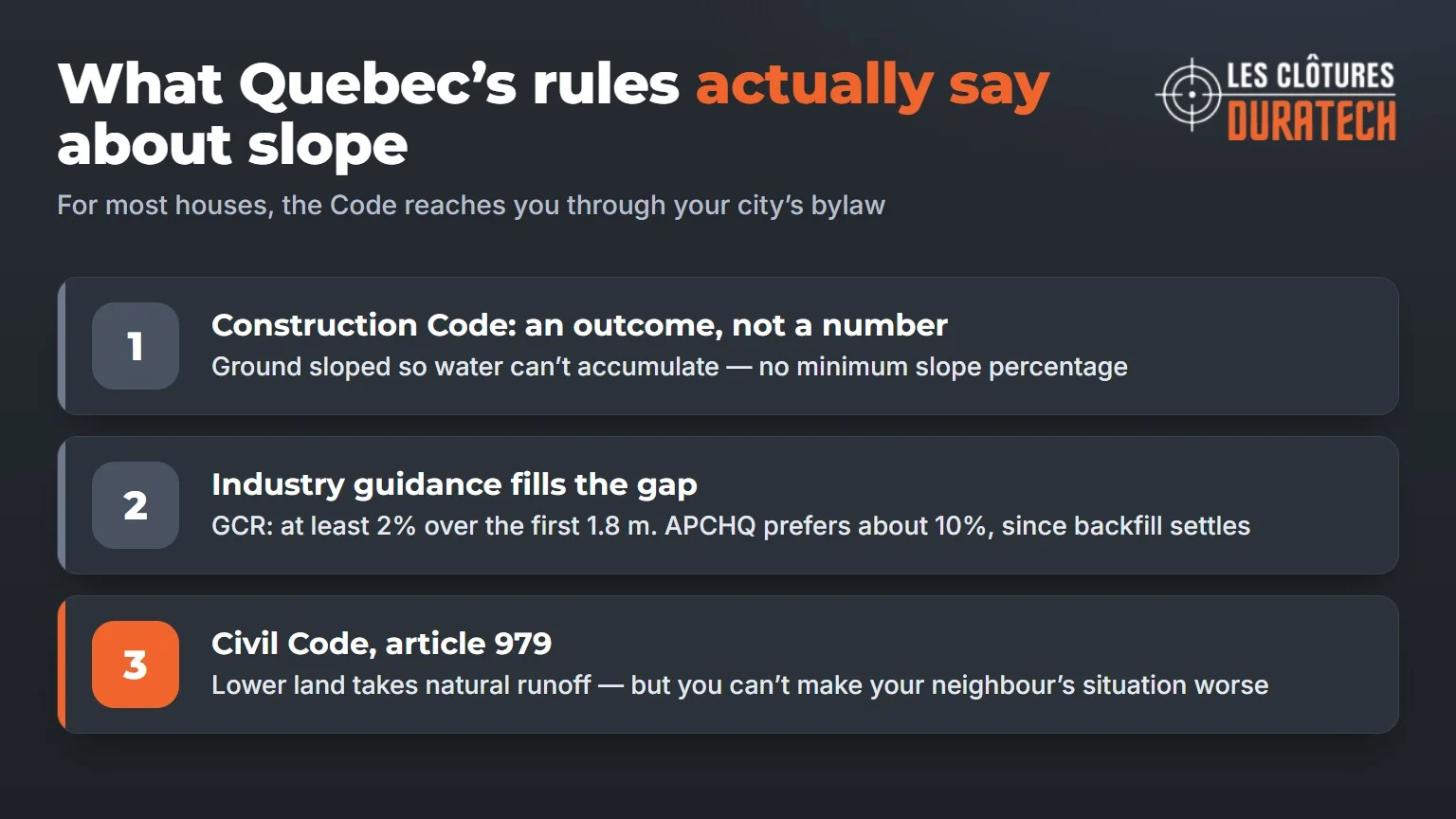
Quebec’s Construction Code — currently based on the 2020 National Building Code, with Quebec amendments — addresses this, though not with a number you can simply go measure against. For most single-family homes, the Code itself doesn’t apply directly to the property; it reaches you through your municipality’s construction by-law, which typically carries the same rules forward.
The principle behind articles 9.14.6.1 and 9.12.3.2 (numbered as in the 2015 edition, which the technical guidance of GCR — the body that administers Quebec’s mandatory new-home warranty — still references) is straightforward: if a building’s location could let surface water accumulate nearby, the ground must be sloped to prevent that, and backfill around a foundation must be graded so that, once it settles, water doesn’t flow toward the foundation.
Neither article specifies a minimum slope percentage — the requirement is the outcome (no water accumulating), not a fixed angle. That’s where industry guidance fills the gap, and the numbers genuinely differ: GCR’s technical guidance suggests at least 2% away from the foundation over the first 1.8 metres; a 2008 National Research Council of Canada technical update recommended 5% for the first 1.5 metres, tapering to 1.5% across the rest of the lot.
APCHQ, Quebec’s residential builders’ association, considers 2% a workable baseline but prefers roughly 10% on that first 1.8 metres, because backfill often settles over time. None of these numbers is “the code” — they’re professional recommendations, and the right one for your lot depends on soil, grade, and what’s already there.
The Civil Code of Québec adds a separate rule that matters once water leaves your property. Under article 979, lower land must accept water that naturally drains onto it from higher land — but the owner of the higher land has no right to make the lower land’s situation worse. In plain terms: you can’t regrade your yard in a way that pushes more water onto your neighbour’s property than used to flow there naturally. Québec.ca’s summary of this rule also notes that water, snow, or ice from your roof has to land on your own property, not your neighbour’s.
Grading or French Drain: How to Tell Which One You Need
Here’s a general comparison. Your actual situation should still get a look in person — soil, slope, and the house itself all affect which side of the table you’re on.
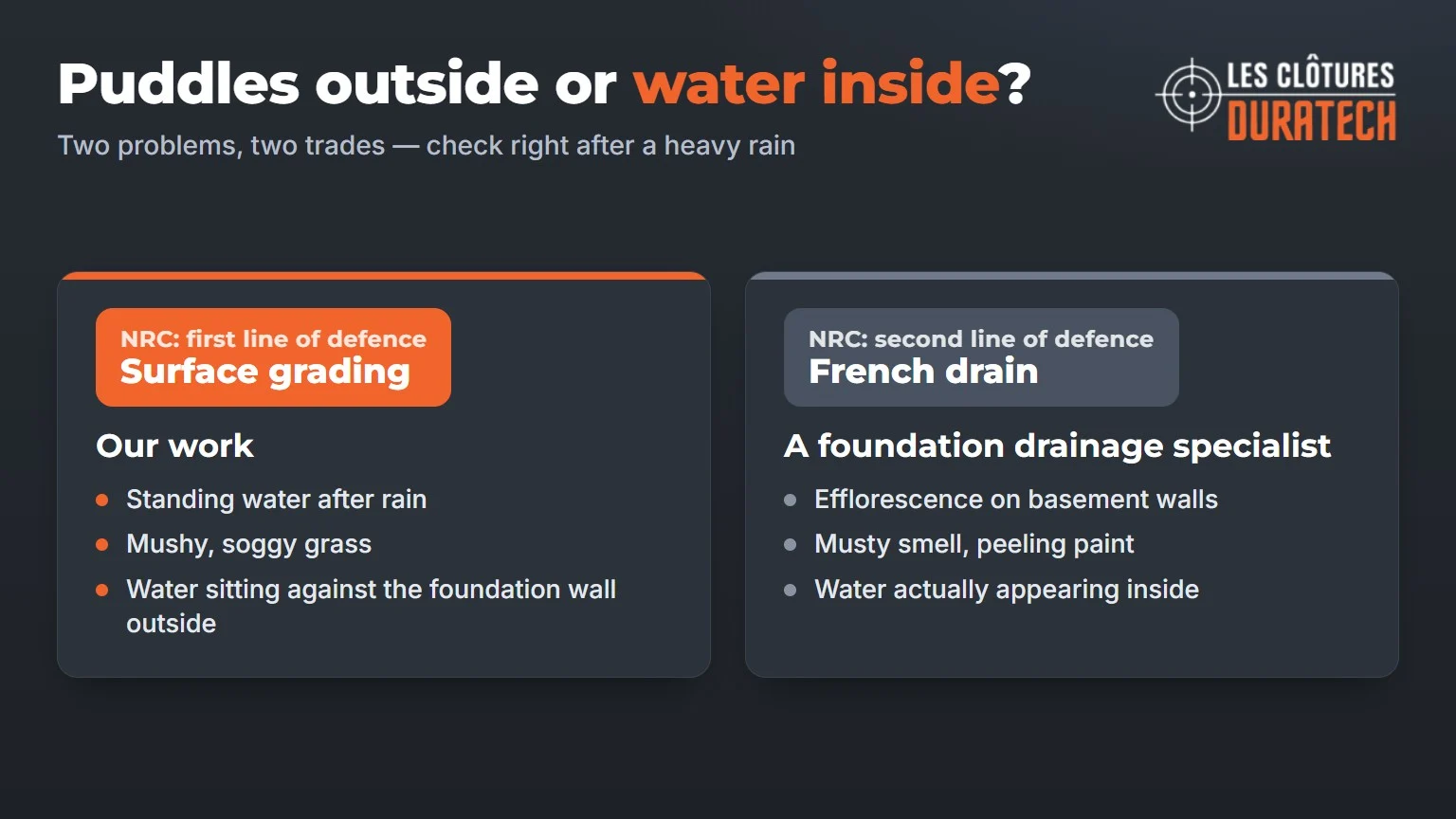
| Surface grading (our work) | French drain / foundation drainage (specialist) | |
| What it fixes | Puddles, soggy low spots, water sheeting toward the house on the surface | Water or dampness getting into the basement or crawlspace |
| Typical warning signs | Standing water after rain, mushy grass, water visibly sitting against the foundation wall outside | Efflorescence on basement walls, a musty smell, peeling paint, water actually appearing inside |
| What’s involved | Laser-level survey, Info-Excavation request, reshaping the slope, usually 1 to 2 days | Excavation around (or sometimes inside) the foundation, perforated pipe, gravel, filter fabric, often a sump pump |
| Who does it | Us (Duratech) | A foundation drainage or waterproofing contractor |
The National Research Council of Canada frames the relationship well: site grading is the “first line of defence” against water reaching a foundation, and foundation drainage — the French drain system — is the “second line of defence” for whatever gets past the first. They work together. Good grading reduces how much water a French drain ever has to handle; it doesn’t replace one that’s already failing.
You can measure the slope yourself on a dry day. Drive one stake against the foundation and a second about 2 metres straight out. Tie a string to the house stake at ground level, run it to the outer stake, level it with a line level, then measure from the string down to the ground at the outer stake.
A 4 cm drop over those 2 metres is 2%, 10 cm is 5%, and 20 cm is 10% — the range the guidance above covers. Less than 4 cm of drop — or ground that rises away from the house — means the slope is working against you. Check several spots, especially under downspouts. If one small low spot fails, topping it up with soil by hand is often a reasonable DIY fix; if most readings fail, or the yard slopes toward the house on several sides, that’s a job for equipment and a laser survey.
A quick self-check after the next heavy rain:
- Outside: does water sit against the foundation wall, or run away from it?
- The lawn: where do puddles form, and are they still there a day later?
- Downspouts: do they discharge onto the ground, well away from the house?
- The basement, same day: any dampness, a musty smell, or fresh white deposits (efflorescence) on the walls?
Water outside with a dry basement usually points to grading. A wet basement with a yard that drains fine points below the surface — the foundation drain, a crack, or the waterproofing — which is a specialist’s diagnosis. If you see both, fix the surface first, since it’s the first line of defence, and have the drain checked too.
Mistakes That Make It Worse
A few things we see homeowners (and sometimes other contractors) do that turn a small problem into a bigger one.
Sending more water toward a neighbour’s yard than flowed there naturally. Even accidentally, this runs against article 979 of the Civil Code — and it tends to start a dispute with whoever’s downhill, on top of not solving your drainage problem.
Connecting a downspout to a foundation drain. This is explicitly prohibited in at least two Montérégie municipalities. Longueuil’s by-law requires roof water carried by gutters and downspouts to be discharged on the surface, and bans connecting those downspouts to the foundation drain or the municipal sewer. Chambly’s sewer-connection by-law goes further, banning direct or indirect connections. Rules like this vary by municipality — confirm yours before changing anything.
Skipping backfill grading after other work. Any time soil gets disturbed near the house — a pool install, a new fence post, a deck footing — that backfill needs to be graded so it doesn’t settle into a channel pointing at the foundation. It’s the same principle behind article 9.12.3.2, and it’s easy to forget once the main project is “done.”
Ignoring a drainage problem because the lawn looks fine. A foundation drain can clog or fail underground — ferrous ochre is one known cause, covered below — with nothing visible on the surface. If your basement shows signs of water intrusion but your yard drains fine on the surface, that points below the surface — often the drain itself — not to the grading.
How We Grade a Yard
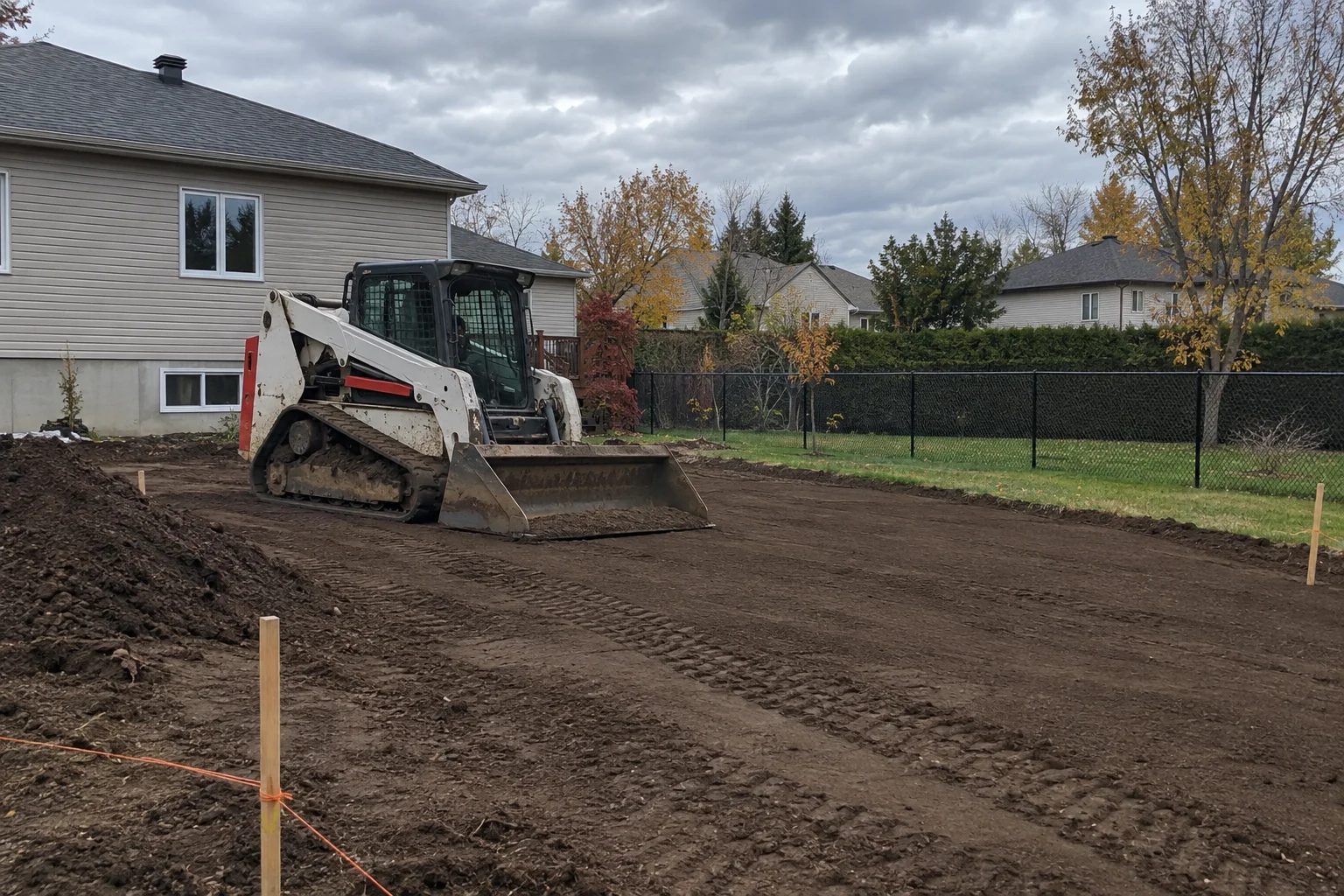
Our process starts with a laser-level survey of your lot to map the actual high and low points — not a guess, a measurement. From there, we submit an Info-Excavation request before any equipment touches the ground, the same step we take before any fence installation. That request covers lines owned by Info-Excavation’s member companies; private lines, such as a buried cable to a garage or an irrigation line, aren’t included, so let us know where yours run.
Rough grading with compact equipment reshapes the problem areas, followed by fine grading to smooth the final slope. Most residential grading projects wrap up in 1 to 2 days, depending on the size of the yard and how much access our equipment has.
Whether your municipality requires a permit for regrading depends on the city and the scope of the work; where one is needed, getting it is the homeowner’s responsibility, and we design the grading plan around your city’s drainage requirements. If you’re also planning sod or landscaping afterward, fine grading is the step that prepares the surface — our sod installation page covers that next step.
One more detail worth knowing: Longueuil requires homeowners to notify the city if they’re changing their lot’s grade, so the city can readjust the water service valve and its curb box — at the owner’s expense (by-law CO-2021-1141, art. 47). Other South Shore municipalities may handle grade changes differently, so check with yours.
When You Actually Need a French Drain Specialist
If water is getting into your basement, or you’re seeing efflorescence, a musty smell, or deteriorating materials near the foundation wall, that’s a foundation drainage problem — not something surface grading alone will fix. A French drain is typically a perforated pipe, at least 100 mm in diameter (the minimum both APCHQ and Longueuil’s by-law specify), wrapped in filter fabric and surrounded by clear crushed stone, installed around the foundation’s perimeter to intercept groundwater before it reaches the wall.
In parts of Quebec — notably the northern crown of the Montreal area — ferrous ochre in the soil is a well-documented cause of these drains clogging over time, which is one reason a drain that worked for years can suddenly start failing. Diagnosing and repairing that is specialized work: excavation, pipe condition, slope of the buried pipe, and sometimes interior waterproofing all come into play.
We don’t do this work, and we won’t pretend otherwise. If what we see on a site visit points to a foundation drainage issue rather than a surface one, we’ll tell you plainly and suggest you bring in a foundation drainage or waterproofing contractor for that part.
What Affects the Price
We don’t publish a flat price for yard grading, because the job changes too much from one lot to the next. What moves the number:
- Size of the area being regraded, and how much soil needs to be moved, added, or trucked away
- Severity of the slope problem — one low spot near a patio is a different job than a yard that slopes toward the house on three sides
- Soil type — clay-heavy soil drains slowly, so the slope has to do more of the work, and soil can vary from one lot to the next
- Access for equipment — a narrow side yard or a gate too narrow for compact equipment adds time compared to open drive-up access
- Existing landscaping that needs protecting or removing before grading starts
- What Info-Excavation finds underground before we can plan the final grade
- Municipal drainage requirements specific to your city
A French drain is priced entirely separately by whichever specialist installs it, and the range is wide — it depends on depth, whether work is done from outside or inside the foundation, and local excavation access. We’re not going to put a number on that work since it’s not ours; ask a foundation drainage contractor for a site-specific quote.
Best Time of Year to Fix It
Fall is generally the more forgiving window for grading work on the South Shore. According to the Regroupement des organismes de bassins versants du Québec, spring soils are typically saturated, which limits how well water can infiltrate — exactly the condition that makes a wet lawn worse and heavy equipment harder to work with.
That said, there’s no fixed calendar date when it becomes too late. It depends on how early the ground freezes in a given year and how deep. A low spot noticed in September or October is usually a straightforward regrading job before the ground closes up; the same issue noticed in January generally has to wait for spring, by which point another thaw-and-freeze cycle may have made it worse.
2 Real Cases
Standing water by a patio in Brossard. A homeowner called after noticing water pooling against their patio slab after every rain, with the soil visibly flat — almost sloping back toward the house — along that side of the yard. There was no sign of anything inside the basement.
Our laser-level survey confirmed the grade had flattened over the years, likely from settled backfill near an older addition. We regraded that section to carry water away from the patio and the foundation, finishing in one day. No drainage work was needed because the problem never reached below the surface.
A case we referred out, in Saint-Hubert. A homeowner asked us to regrade a yard where the lawn itself drained reasonably well, but they mentioned a musty smell and some paint peeling on an interior basement wall. On site, the exterior slope looked fine — nothing pointed to a surface problem.
Those interior signs — a musty smell and peeling paint — point to moisture coming from the foundation side, not from the grading, so we told the homeowner this likely needed a foundation drainage specialist rather than a yard regrade. We didn’t take the job, because surface grading wasn’t going to fix what was happening at the foundation wall.
Frequently Asked Questions
1. What does yard grading cost in Quebec?
It depends on lot size, slope severity, access, and what Info-Excavation finds before we start. We don’t publish a flat rate because those variables change the job too much from one property to the next — the reliable number comes from an on-site evaluation.
2. Do I need a permit to regrade my yard?
It depends on your municipality and on the scope of the work, so check with your city before work starts. Where a permit is required, it’s the homeowner’s responsibility; we design our grading plan around your municipality’s drainage requirements. Some cities add their own steps — Longueuil, for example, requires owners to notify the city before changing the lot’s grade.
3. Can grading fix a wet basement?
Sometimes, but only if the water was getting in from the surface in the first place — a slope that was sending rainwater against the foundation wall. If water is coming through the wall itself, through cracks, or up from under the slab, that points to the foundation — drainage or waterproofing — which grading alone won’t resolve.
4. What’s the real difference between grading and a French drain?
Grading reshapes the surface of your lot so water drains away instead of pooling near the house. A French drain is a buried pipe system that intercepts groundwater pressing against the foundation below ground. They’re handled by different trades, and a working French drain doesn’t make up for a yard that slopes toward the house.
5. Can I direct water toward my neighbour’s yard if it solves my problem?
Not beyond what already flows there naturally. Article 979 of the Civil Code of Québec requires lower land to accept natural runoff from higher land and prohibits the higher owner from making the lower land’s situation worse — work that simply helps water follow its natural slope isn’t presumed to do that. A grading plan that adds to that flow can create a legal dispute on top of not being good practice.
6. Is fall or spring the better time to regrade a yard?
Fall is usually the more workable window — spring soils tend to be saturated, which limits drainage and makes equipment access harder. There’s no fixed cutoff date each year; it depends on how early and how deep the ground freezes that particular fall.
7. Does a regraded yard need maintenance?
A little. Soil near the house can settle over time, especially fresh backfill, and later projects — a pool, a deck, new plantings — can disturb the slope. Walk the yard after a heavy rain each spring and fall, and keep downspouts discharging onto the ground away from the house. If a low spot starts forming against the foundation again, a small touch-up is usually a much smaller job than letting it grow.
Disclaimer: This article doesn’t quote prices, and any grading scope described here is general, not a quote for your property — your final price depends on an on-site evaluation of your lot, soil, access, and existing drainage. Municipal rules on permits, downspout connections, grade changes, and drainage by-laws vary by city; confirm current requirements with your own municipality before starting work. This article is for general informational purposes only and does not constitute an engineering, legal, or insurance assessment of your property’s drainage.
If water keeps showing up in the same spot in your yard, request a grading quote or email a few photos taken after the next rain to lescloturesduratech@gmail.com, along with your city and where on the lot it’s pooling. We’ll let you know whether it looks like a grading fix we can put in a written quote, or a sign you should be calling a foundation drainage specialist instead.
Phone: (438) 830-3436
Email: lescloturesduratech@gmail.com
Website: lescloturesduratech.com
We serve homeowners across the South Shore and Montérégie, in English and French.