

A sloped yard presents installation challenges that go far beyond aesthetics. In Quebec, proper fencing on uneven ground must address drainage, soil stability, frost heave, gate function, and long-term structural alignment.
For homeowners in Montérégie, including Chambly and Marieville, fencing uneven ground requires a fundamentally different approach than building on a flat lot. The best method balances the severity of the slope with your choice of material, privacy needs, pet security, and budget.
This guide covers key techniques, common mistakes, and essential 2026 considerations for Quebec properties, helping you decide on the right approach for sloped terrain.
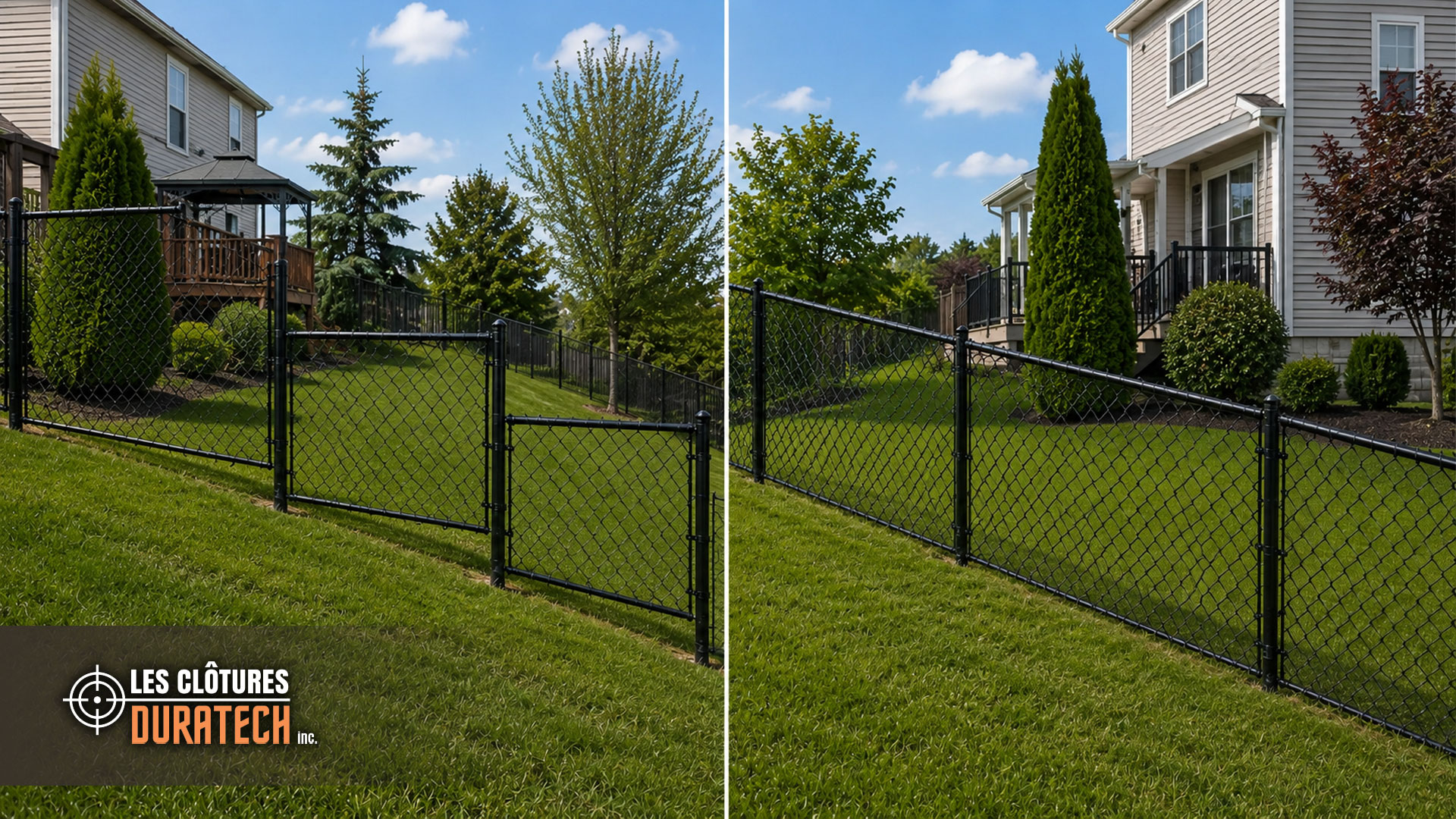
Installing a Fence on Sloped Terrain
Successful sloped yard fences require designs that complement the terrain rather than fight it. Professional contractors typically choose between two primary methods: stepped or racked installation.
Homeowners increasingly seek fences with clean lines and minimal ground gaps – crucial for pets, pool safety, and privacy. On slopes, these needs often conflict, making professional planning essential.
Stepped Installation on Slopes
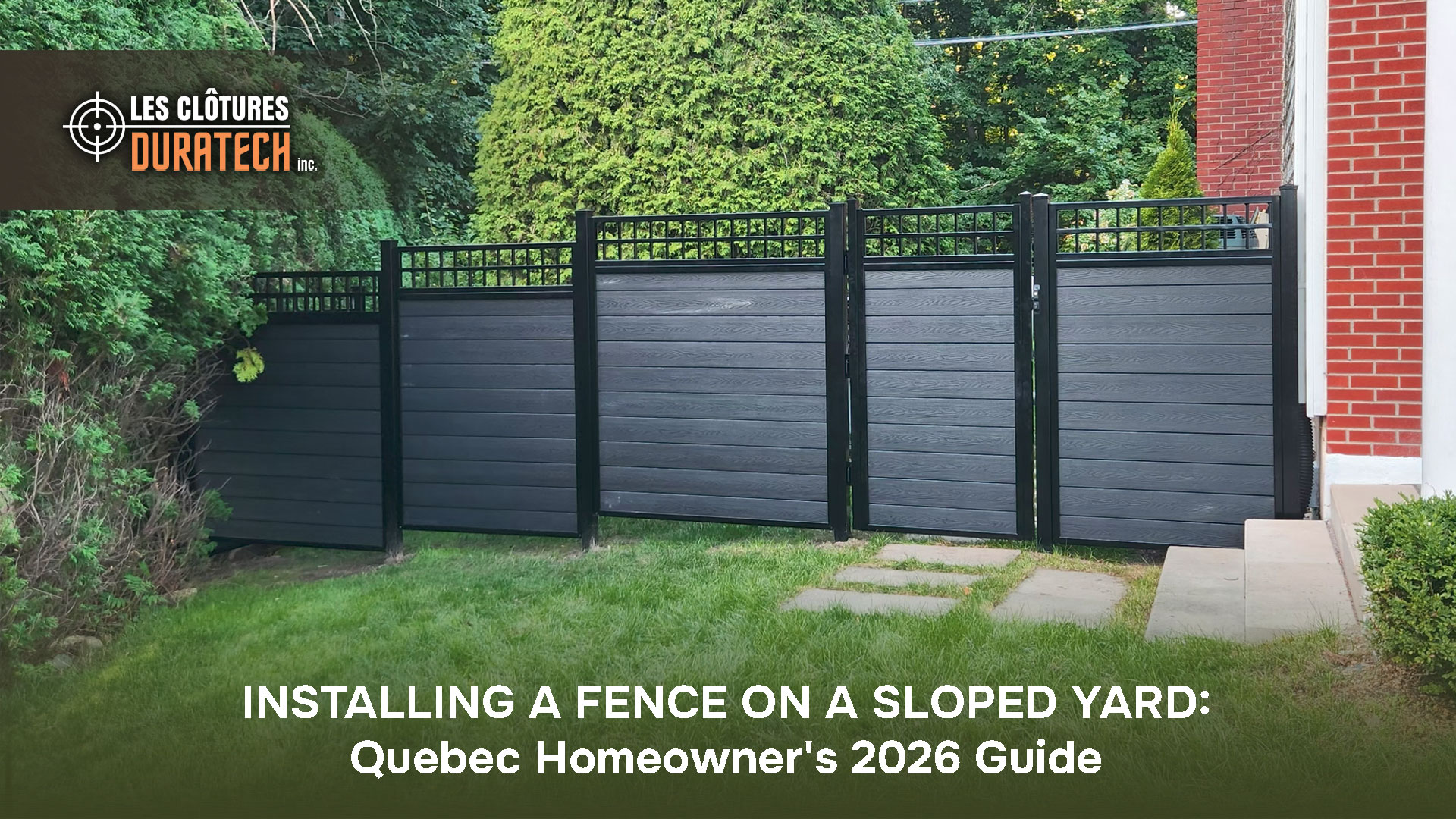
A stepped fence follows the slope in level sections. Each panel remains perfectly horizontal, then drops at the next post, creating a stair-step effect.
This method suits:
- Ornamental aluminum or steel fences.
- Rigid wood or hybrid privacy panels.
- Yards with sharp, sudden grade changes.
- Projects prioritizing architectural and visual symmetry.
Note: Stepped fences naturally leave triangular gaps under the panels on the downhill side.
Racked Installation on Slopes
A racked fence (also called contoured or biased) gradually adjusts to the slope. The panel or mesh follows the angle of the terrain continuously, rather than in distinct steps, keeping the bottom rail parallel to the ground.
This method is often preferred for:
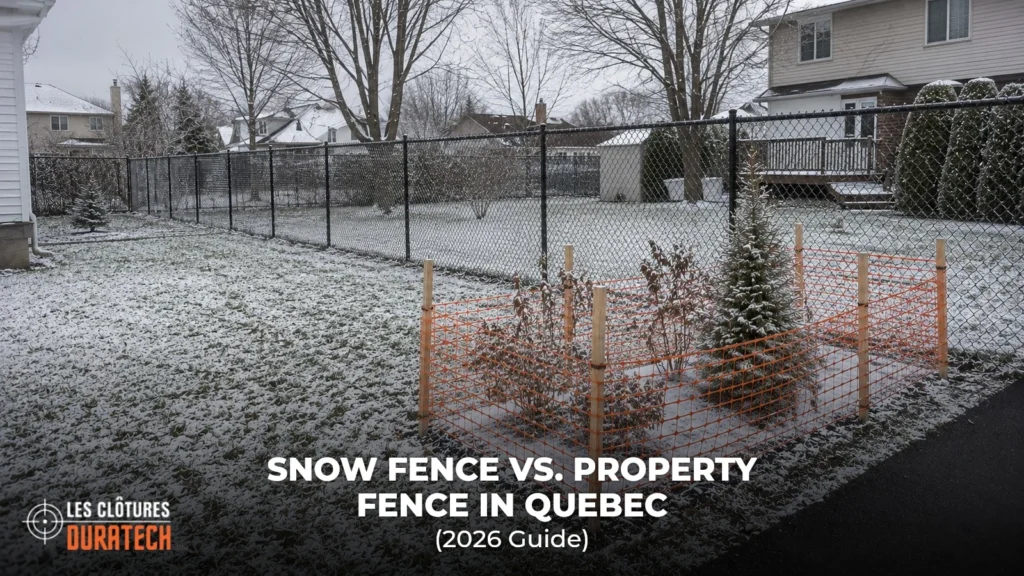
- Frost fence projects in Quebec (vinyl-coated chain-link).
- Certain rackable ornamental systems.
- Properties with pets, as it minimizes ground gaps.
- Yards with mild, rolling grades.
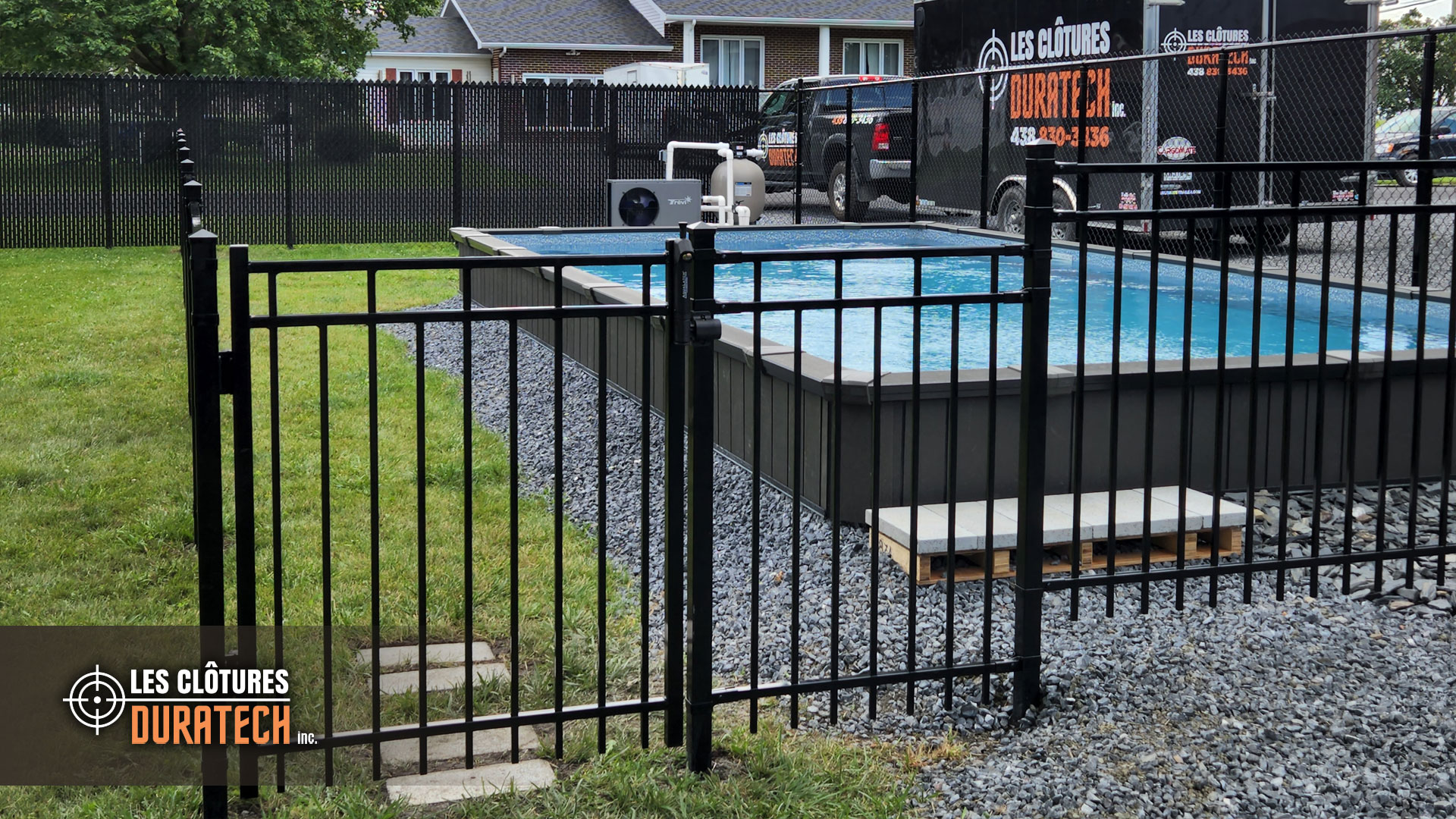
Planning for a Fence on Uneven Ground
Fence installation on uneven ground must begin with a thorough site evaluation. Before any drilling occurs, a contractor must assess grade changes, soil conditions, drainage paths, and potential gate locations.
In Quebec, this initial assessment prevents disastrous future issues. Montérégie’s clay soils are highly prone to freeze-thaw movement. Shallow posts are much more likely to be pushed upward by winter frost, permanently misaligning the fence line.
Les Clôtures Duratech ensures deep post drilling below the frost line and handles all public Info-Excavation clearances. This is vital for durable installations suited to our local climate.
Why Slope Changes Everything for Fence Projects
A sloped site directly impacts:
- Post spacing requirements and depth.
- Appropriate material and panel selection.
- Bottom clearance management (crucial for dog owners).
- Gate swing direction and latch alignment.
- Excavation and ground preparation needs.
Why On-Site Pricing is Crucial for Sloped Yards
Online fence calculators often overlook the realities of a Quebec yard:
- Sudden grade breaks or retaining edges.
- Buried obstacles (roots, rocks, old concrete).
- Drainage swales.
- Equipment access limitations.
On steep sites, additional earthwork, grading, or custom panel adjustments can add to labor time and material waste, which is why on‑site quotes are much more reliable than online estimates.
A transparent on-site evaluation identifies these obstacles upfront, leading to a much more accurate budget with no surprise fees on the final invoice.
| Slope Condition | Best-Fit Approach | Main Risk if Done Poorly |
| Mild, gradual slope | Racked installation | Uneven bottom line |
| Steeper, segmented slope | Stepped installation | Large gaps or awkward transitions |
| Clay soil with elevation change | Deep-drilled posts | Frost heave and leaning posts |
| Yard with pets | Custom ground fitting | Escape gaps under the fence |
How to choose between stepped and racked fences
- Choose racked (contoured) when the slope is mild to moderate and you want minimal gaps under the fence (ideal for pets and pool areas).
- Choose stepped when the slope is steep or segmented and you want clean, horizontal lines (common with ornamental and some privacy panels).
The final choice also depends on material, budget, and whether you need a fully non‑climbable enclosure.
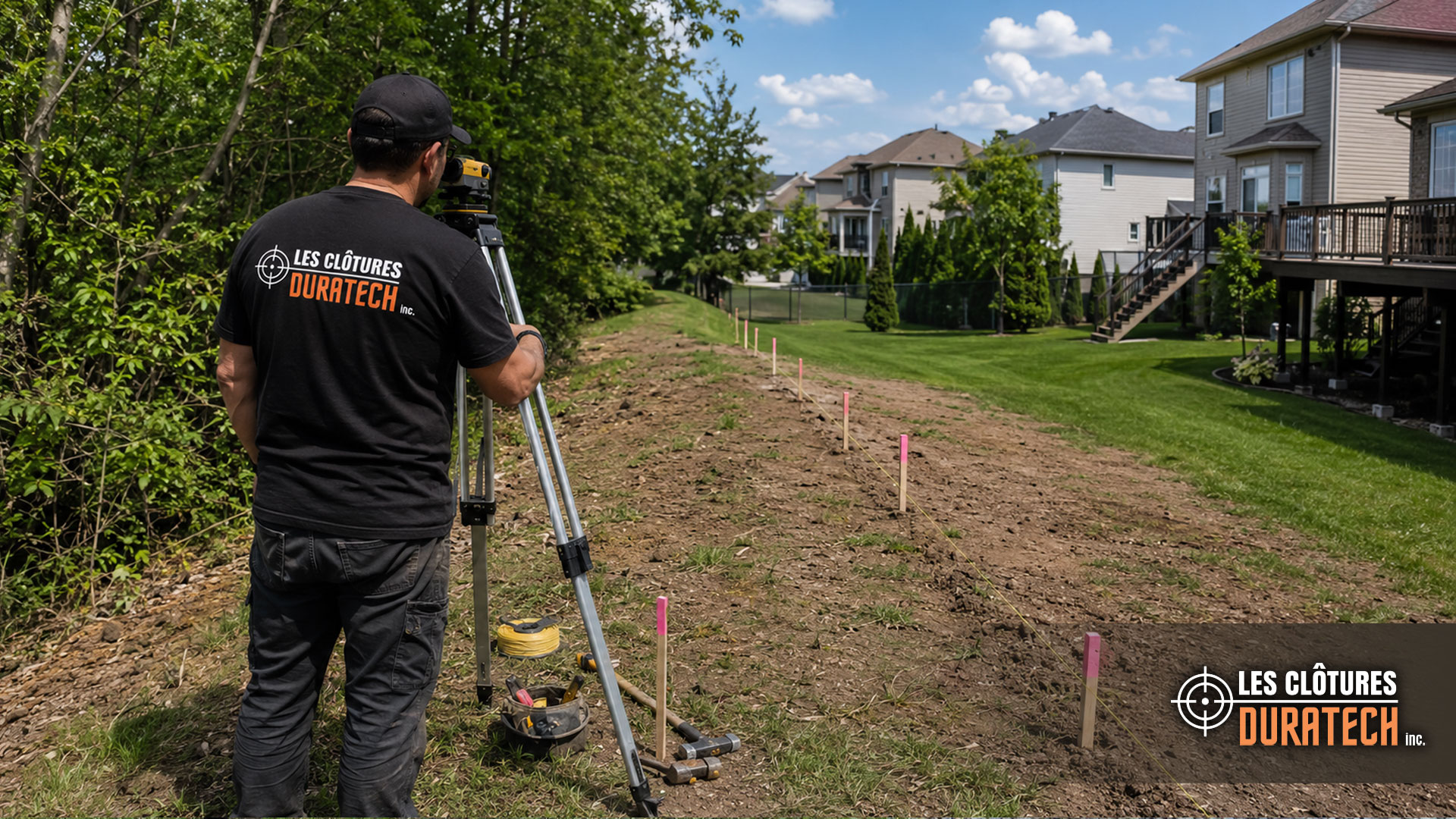
Chain-Link Fence Installation on Slopes in Quebec
Chain-link fencing adapts exceptionally well to uneven terrain and is highly cost-effective. Quebec residential projects overwhelmingly use the “Frost fence”. In Quebec, a Frost fence is a common local term for a permanent, vinyl‑coated chain‑link fence, typically black.
For sloped yards, Frost fencing offers superior flexibility. The mesh can adjust more easily to grade changes than rigid wood or ornamental panels. It provides good visibility, durability, and excellent long-term value.
At Duratech, we custom-contour the mesh at ground level to follow the terrain, significantly reducing visible spaces. This is highly beneficial for properties with dogs.
The 14-Day Curing Difference
Many installations fail because the heavy wire mesh is stretched prematurely. At Duratech, we follow a 14‑day concrete curing standard before tensioning the fence wire.
This curing period prevents the soft posts from being pulled out of alignment. On slopes, where gravity and tension are already pulling unevenly, this step is absolutely crucial for long-term stability.
When Chain-Link is the Smartest Choice for Uneven Yards
A Frost fence is the ideal solution when you want:
- Good performance on irregular terrain: The mesh easily racks to follow rolling grades without awkward bottom gaps.
- Lower cost: Significantly more budget-friendly than custom-stepped ornamental fencing.
- Reliable pet containment: Custom ground-contouring prevents dogs from escaping under the fence.
- Clear property definition: Defines your boundaries cleanly without blocking airflow or natural light.
Installing Rigid Fence Panels on Slopes
Ornamental fence panels (aluminum or steel) can elevate a property’s curb appeal, but they require careful selection for slopes. Rigid panels vary greatly in their ability to rack (adapt to grade changes). Forcing standard rigid panels onto a slope creates structural stress, visual inconsistency, or unsafe openings.
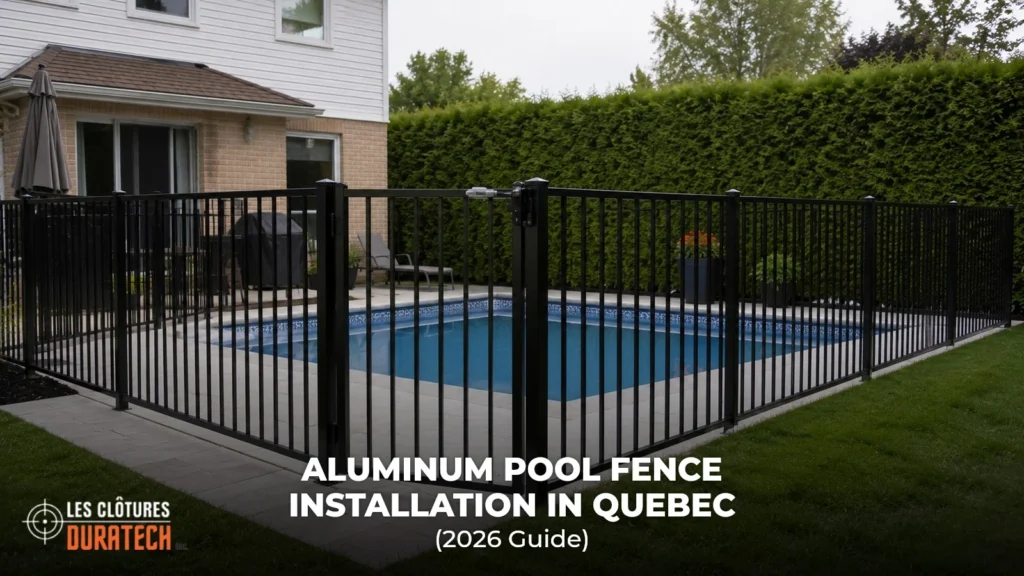
For aluminum or steel ornamental fences on steeper grades, stepped layouts are often the cleanest, most professional solution. This approach provides a highly structured appearance suitable for front yards, public spaces, and pool enclosures.
Best Uses for Rigid Fence Panels
Stepped panel systems are highly beneficial when prioritizing:
- A premium architectural look: Adds high-end curb appeal that chain-link cannot match.
- Defined lines along landscaping: Creates a beautiful, staircase-like structure alongside sloped gardens.
- Pool enclosure compliance: Rigid panels are naturally non-climbable and easy to integrate with compliant gates.
- Low-maintenance finishes: Powder-coated aluminum and steel require zero painting or rust-treatment.
Pool Safety Enclosures on Sloped Yards
Slope does not exempt pool enclosures from provincial regulations. In Quebec, outdoor residential pools whose water depth may be equal to or greater than 60 cm must be secured in accordance with the Residential Swimming Pool Safety Regulation. Pools installed before November 1, 2010 now have until September 30, 2027 to be brought into compliance, while pools installed on or after November 1, 2010 are already subject to the Regulation.
Key safety requirements include:
- Minimum height of 1.2 m at all points.
- Non-climbable design (no horizontal footholds).
- Self-closing, self-latching gates.
On sloped terrain, ensuring compliance at all points – especially avoiding large gaps under stepped panels or under gates – is a complex mathematical challenge. Experienced planning is critical to passing municipal inspection.
| Fence Type | Slope Adaptability | Typical Advantage |
| Frost fence | High | Flexible fit and value |
| Ornamental aluminum | Moderate | Clean curb appeal |
| Ornamental steel | Moderate | Strength and prestige |
| Hybrid with wood/composite | Variable | Privacy and custom look |
Fence Drainage and Long-Term Stability
Fence drainage issues on slopes are often overlooked during summer installations but become glaringly apparent after the spring thaw. Water pooling along a fence line can erode soil, undermine footings, and create sinkholes.
Quebec’s freeze-thaw cycle exacerbates this. Saturated ground expands violently in winter and softens in spring. Posts sitting in poorly drained water paths will heave faster than those on dry ground.
What professional installers evaluate:
- Surface runoff direction.
- Low spots and pooling zones.
- The need for minor grading before installation.
- Risks near retaining walls.
Installing Fence Gates on Slopes
Fence gates on slopes are the most challenging aspect of the entire project. Even with a perfectly installed fence line, a poorly planned gate can drag on the ground, bind on the hinges, leave excessive clearance underneath, or fail to latch correctly after winter.
Gate locations should be chosen based on the grade, not just convenience. Relocating a gate just a few feet to a more stable, level area can prevent years of ongoing maintenance issues.
On steep grades, a single heavy gate is more likely to sag or drag; splitting the opening into two narrower leaves often improves long‑term operation.
Common Gate Mistakes to Avoid:
- Installing a gate at the steepest point of the yard.
- Ignoring swing clearance needs (the gate hits the rising slope when opened).
- Using rigid gates on abrupt grade transitions.
Smarter Solutions:
- Relocating the gate opening to a flat zone.
- Installing a double gate (using shorter leaves that require less swing clearance).
- Performing minor grading adjustments specifically for the gate path.
2 Real Cases: Duratech Experience with Sloped Fencing
Case 1: Residential Frost fence in Chambly
A homeowner had a backyard with a steady rear slope and active dogs. Their previous wood fence had large gaps underneath the stepped panels, and the posts leaned more each spring. Duratech installed a new black Frost fence with deep-drilled posts, a strict 14-day concrete curing period, and custom mesh contouring. The result was a laser-straight fence, improved pet security, and virtually zero ground openings.
Case 2: Ornamental pool enclosure on the South Shore
A South Shore family required a compliant pool fence on a yard with significant elevation changes. They needed to meet the 2027 safety rules without creating an unsightly, disjointed enclosure. Duratech designed a stepped ornamental aluminum layout with precisely placed self-closing, self-latching gates on the flattest sections of the yard. The installation addressed the grade transitions beautifully, meeting strict safety requirements while maintaining the yard’s premium aesthetic.
FAQ
How do you install a fence on a sloped yard?
Installation typically involves either a stepped (staircase effect) or racked (following the ground angle) layout. The choice depends on the fence material, the steepness of the slope, and desired ground clearance.
What is the best fence for uneven ground in Quebec?
For many properties, Frost fence is ideal due to its adaptability to grade changes and value. Ornamental aluminum can also perform well with proper slope planning.
Will frost heave damage a fence on a slope?
Yes, especially if the posts are shallow or if water drains poorly around them. Quebec’s freeze-thaw cycles can easily push posts upward. Deep drilling below the frost line is essential for stability.
Can a pool fence be installed on a sloped yard?
Yes, but it must meet Quebec regulations. By September 30, 2027, all residential pools require a compliant fence: minimum 1.2 m height, non-climbable design, and self-closing, self-latching gates.
How do you avoid gaps under a fence on a slope?
Methods vary by material. For chain-link, professional installers will custom-contour the bottom of the mesh to follow the terrain – a highly effective method for pet owners concerned about escape gaps.
Where is the best place to put a gate on a sloped fence?
Ideally on the flattest section of the yard, where the gate can swing freely without hitting the ground or leaving large gaps. Moving a gate just a few feet to a more level area can greatly improve long‑term operation.
Ready to Optimize Your Sloped Yard?
Free Consultation: Les Clôtures Duratech
A sloped yard doesn’t mean you have to settle for an uneven, gappy, or unstable fence. Les Clôtures Duratech evaluates complex grades, drills posts deep below the frost line, and uses installation methods specifically suited for Quebec terrain.
For fencing projects in Chambly, Marieville, the South Shore, or Montérégie, we provide transparent pricing that accounts for all obstacles upfront.
Request a free on-site consultation today for expert advice tailored to your terrain!
Disclaimer: This article is for general informational purposes only and does not constitute engineering or legal advice. Fence height limits and pool safety requirements vary strictly by municipality on the South Shore. Homeowners are responsible for securing applicable permits with their local urban planning department before installation begins.