

In this article
- What Sod Installation Costs in Quebec (Per Square Foot)
- Why Prep Work Decides the Final Price
- Can You Still Lay Sod in the Fall in Quebec?
- Sod vs Seed: Why the Calendar Decides in Quebec
- Watering New Sod: The First Two Weeks
- Watering Permits for New Sod on the South Shore
- 2 Real Cases
- Frequently Asked Questions
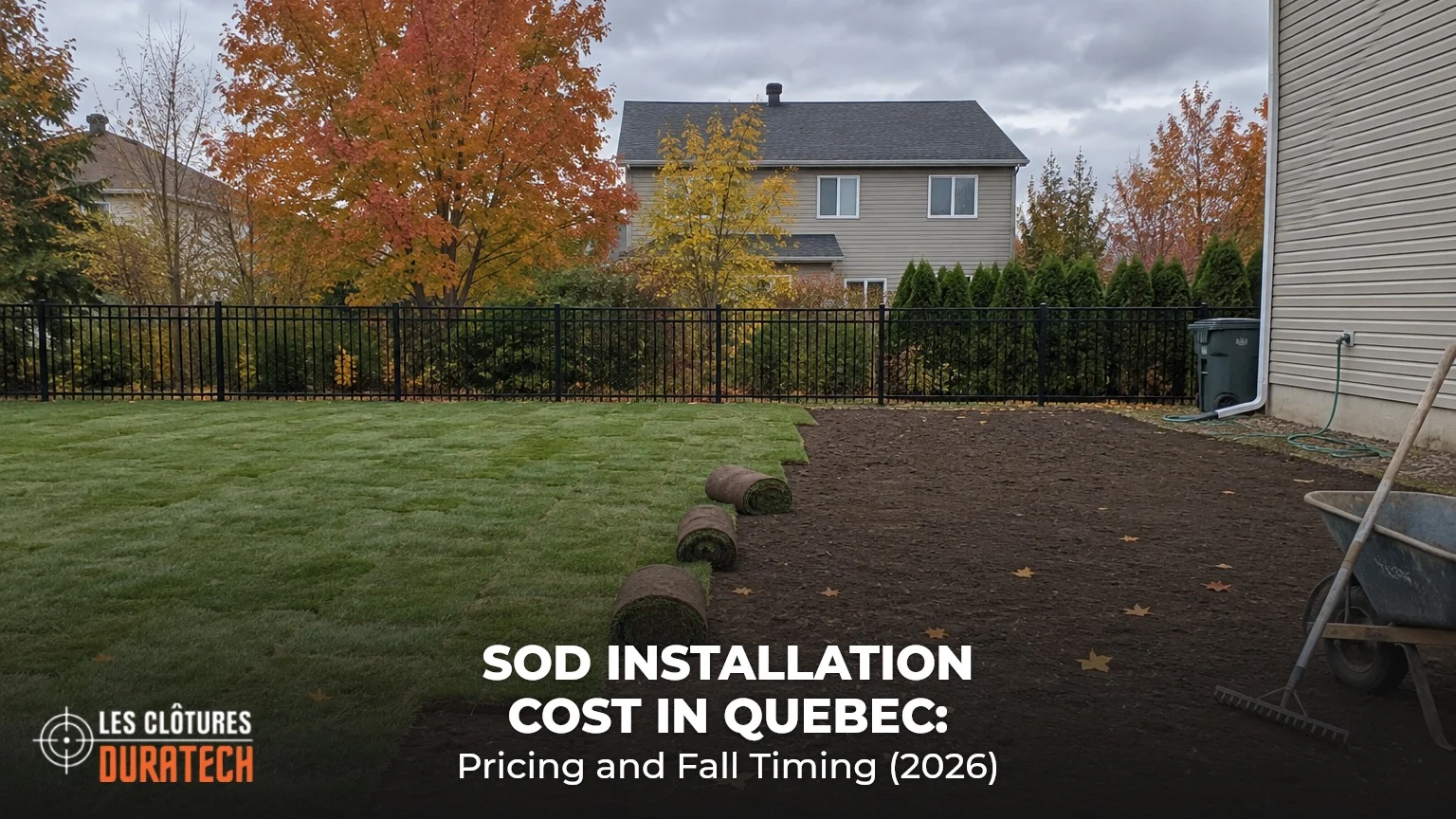
Published Quebec cost guides put new sod installation at roughly $1 to $4 per square foot once soil prep, material, and labour are counted together — and fall isn’t automatically too late to do it. The two questions almost always come together: what will it cost, and is there still time this season before the ground freezes.
We get both questions constantly at Duratech, often from the same homeowner in the same phone call. The honest answer to each depends on the yard, not on a single number we can quote without seeing it — but there’s enough public pricing data and enough known cutoffs for fall planting in Quebec to give a real answer instead of a shrug.
We’ve already covered the broader topic of restoring a lawn after fence work in our guide to natural sod after fence installation — this article goes narrower, into cost and timing specifically.
What Sod Installation Costs in Quebec (Per Square Foot)
We price sod — tourbe, the word you’ll see on Quebec supplier sites and in city bylaws — the way the Quebec market usually quotes it: per square foot, after seeing the yard. As our own sod installation page puts it plainly, the price “depends on the size of the yard and how much prep work (grading/soil adding) is needed.” There’s no fixed per-foot rate we can give over the phone, because two yards the same size can need very different amounts of work underneath.
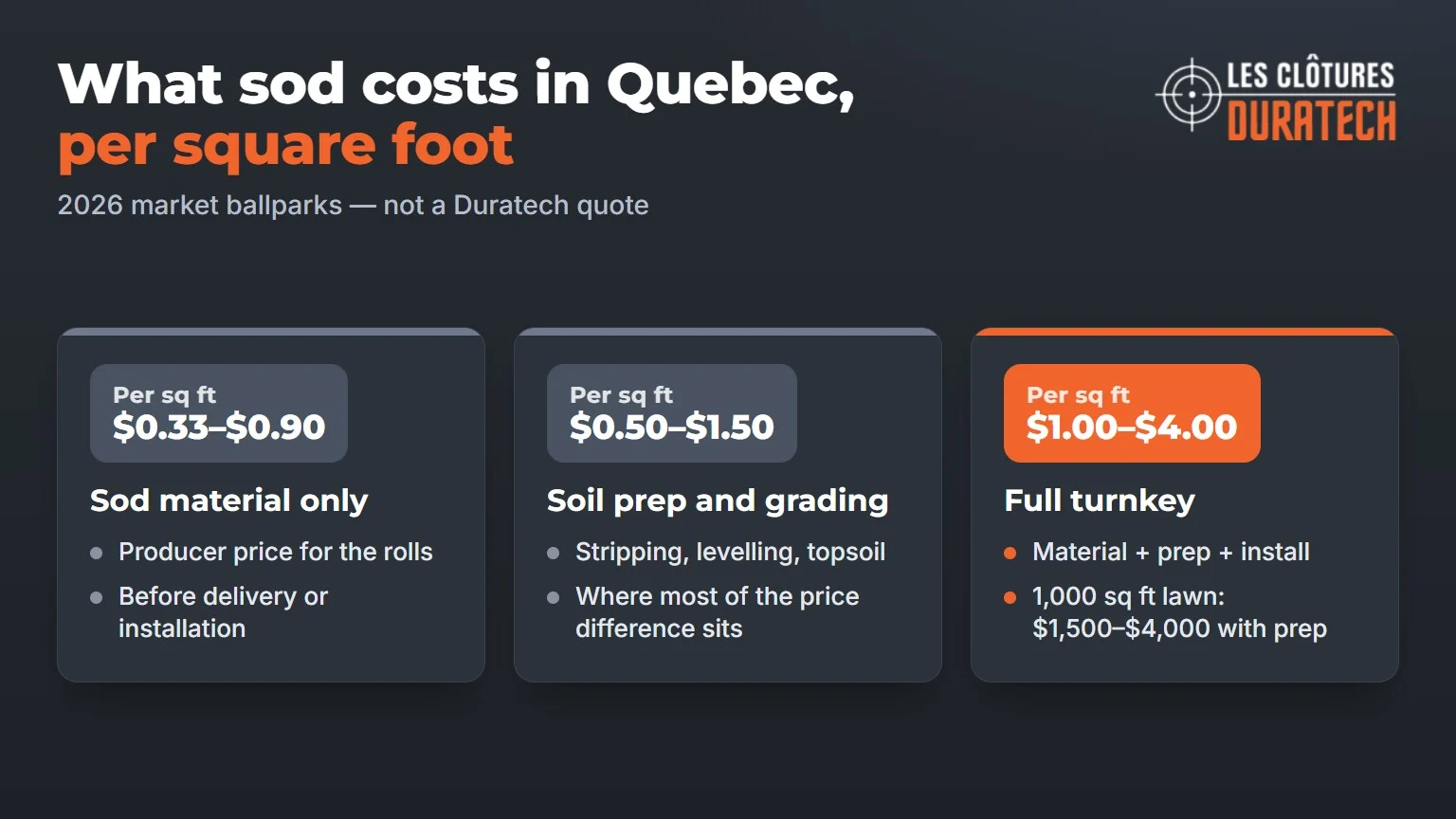
What we can share is where the market sits. A 2026 Montreal landscaping cost guide, a separate Quebec soumission-comparison site, and two Quebec sod suppliers give roughly these ranges — and the two guides don’t define “installation” the same way:
| What’s included | Typical range per sq ft (2026) |
| Sod material only (supplier price) | $0.33 – $0.90 |
| Soil preparation and grading | $0.50 – $1.50 |
| Topsoil, if needed (4–6 in. layer) | $0.50 – $1.00 |
| Installation labour (prep billed separately) | $0.30 – $0.80 |
| Installation quoted as one line (scope varies, may include prep) | $1.00 – $2.50 |
| Full turnkey (material + prep + install) | $1.00 – $4.00 |
Those figures are ballpark, not a quote. The soil-prep, topsoil, and labour lines above come from the Montreal cost guide, which bills them separately; the Quebec soumission site quotes installation as a single line whose scope varies by contractor and can include soil preparation, which likely explains why that range sits higher — we’ve kept both rather than splicing a single number out of two different compositions.
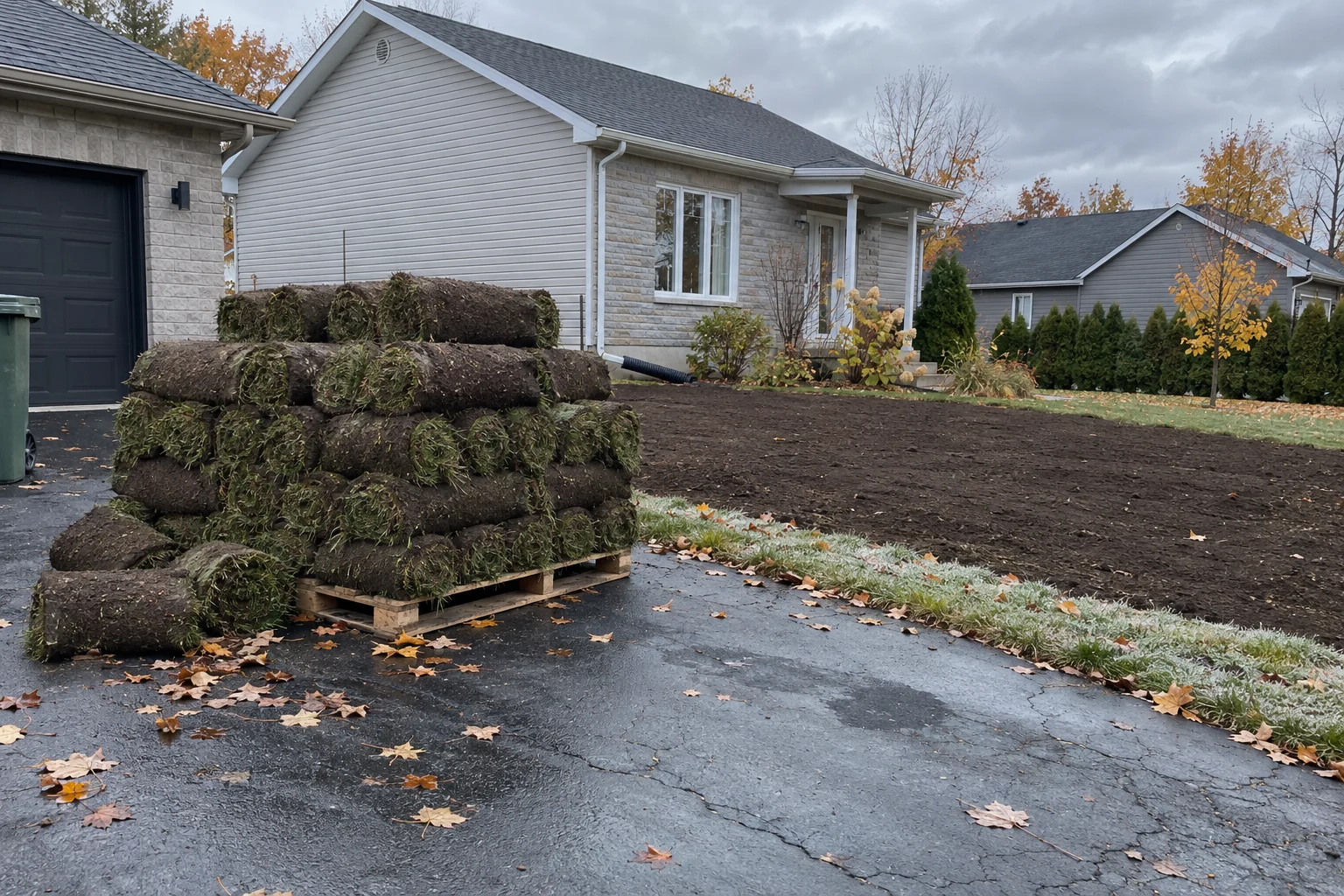
The two suppliers, a sod farm and a garden centre, sell rolls directly and price the bare material at $0.33 to roughly $0.90 per square foot, before any delivery or installation is added. Sod is sold by the roll, and a standard roll covers about 10 square feet: $3.30 a roll at the sod farm, $8.99 at the garden centre (its 2026 price). If you’re buying for a do-it-yourself job, delivery is a separate line, often priced per pallet (the same garden centre lists $275 for a pallet of 74 rolls, on top of the sod), so confirm it before you order — and it’s normal to order a few extra rolls for cuts along the edges.
For scale, the same Montreal guide puts a 1,000-square-foot lawn at $1,500 to $4,000 with soil preparation included. None of these numbers is what we charge; they’re a starting point for sizing up a quote when one arrives. When you compare quotes, check what each one actually includes — removing the old lawn, grading, topsoil, delivery, cleanup — because the scope of a “sod installation” price varies from one contractor to the next.
Why Prep Work Decides the Final Price
The reason a fixed price per square foot doesn’t work is that most of the cost difference between two jobs happens before the sod ever arrives. On our own page we say it directly: eighty percent of a lawn’s success happens underneath, not in the roll itself.
In practice that means stripping or tilling under whatever is already growing, correcting low or uneven spots, and adding fresh topsoil where the existing soil is thin or compacted. We don’t install sod over an old lawn — the buried grass rots underneath the new layer and kills the young roots above it, which is a shortcut that costs more to fix later than it saves up front.
If your yard also needs grading before any of that — low corners that pool water, a slope that needs reshaping — that’s a separate step covered on our land grading and yard leveling service page. As a general reference point, not a South Shore-specific rule, the City of Québec recommends 15 to 20 centimetres of good-quality topsoil under a lawn for proper root development — more than the 4–6 inches priced above for a typical top-up. Yard size, slope, access for equipment, and how much topsoil needs adding are the real variables behind any sod quote.
Can You Still Lay Sod in the Fall in Quebec?
Our installation season runs from May through November, and fall is one of the two seasons we consider ideal, alongside spring — cooler air and more rain mean less manual watering while the roots are establishing.
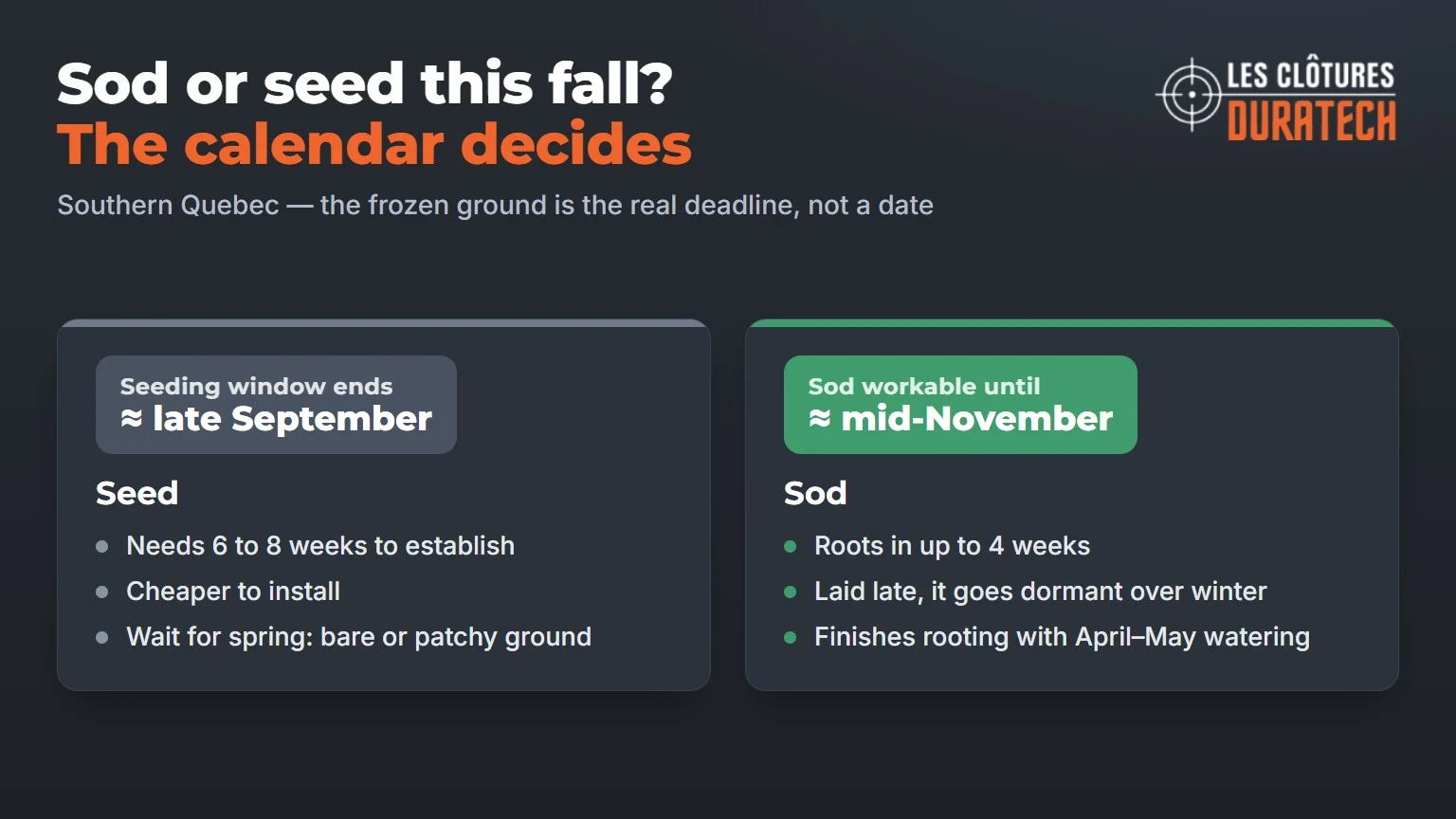
A Montérégie landscaping company that publishes seasonal guidance puts the practical cutoff at roughly mid-November in southern Quebec, with sod workable until the first snowfall or the first ground frost — a night around 5°C without snow on the ground, in their description, still doesn’t rule out laying sod in October or November. The same source explains that sod laid late in the season goes dormant for winter rather than fully rooting, then finishes establishing the following spring with ordinary April and May watering.
We won’t put one fixed calendar date on when it becomes too late, because that varies by year and by how deep frost has already reached a given lot — the ground, not the calendar, is the real deadline. If you’re weighing fall sod against waiting for next spring, the practical rule is simple: the earlier in the fall you decide, the more margin there is before the ground closes up.
Sod vs Seed: Why the Calendar Decides in Quebec
For a fall project specifically, sod and seed aren’t really competing on quality — they’re competing on how much time is left. A Quebec lawn-care company puts the seeding window in southern Quebec at roughly the end of September in a mild year, because new grass needs enough time to establish before hard frost arrives.
Seed is cheaper to install, generally $0.50 to $1.50 per square foot according to the same 2026 Montreal cost guide cited above, but it needs six to eight weeks to establish into something usable. General turfgrass research (Penn State Extension, describing cool-season grass broadly rather than Quebec conditions specifically) puts sod’s own rooting period at up to four weeks, depending on the site and weather.
That gap is the real argument for sod in October: a homeowner who waits to seed in spring spends a good part of the next season looking at bare or patchy ground while the seed establishes, while sod laid in fall can go dormant, sit through winter, and finish rooting with ordinary watering the following April and May.
Watering New Sod: The First Two Weeks
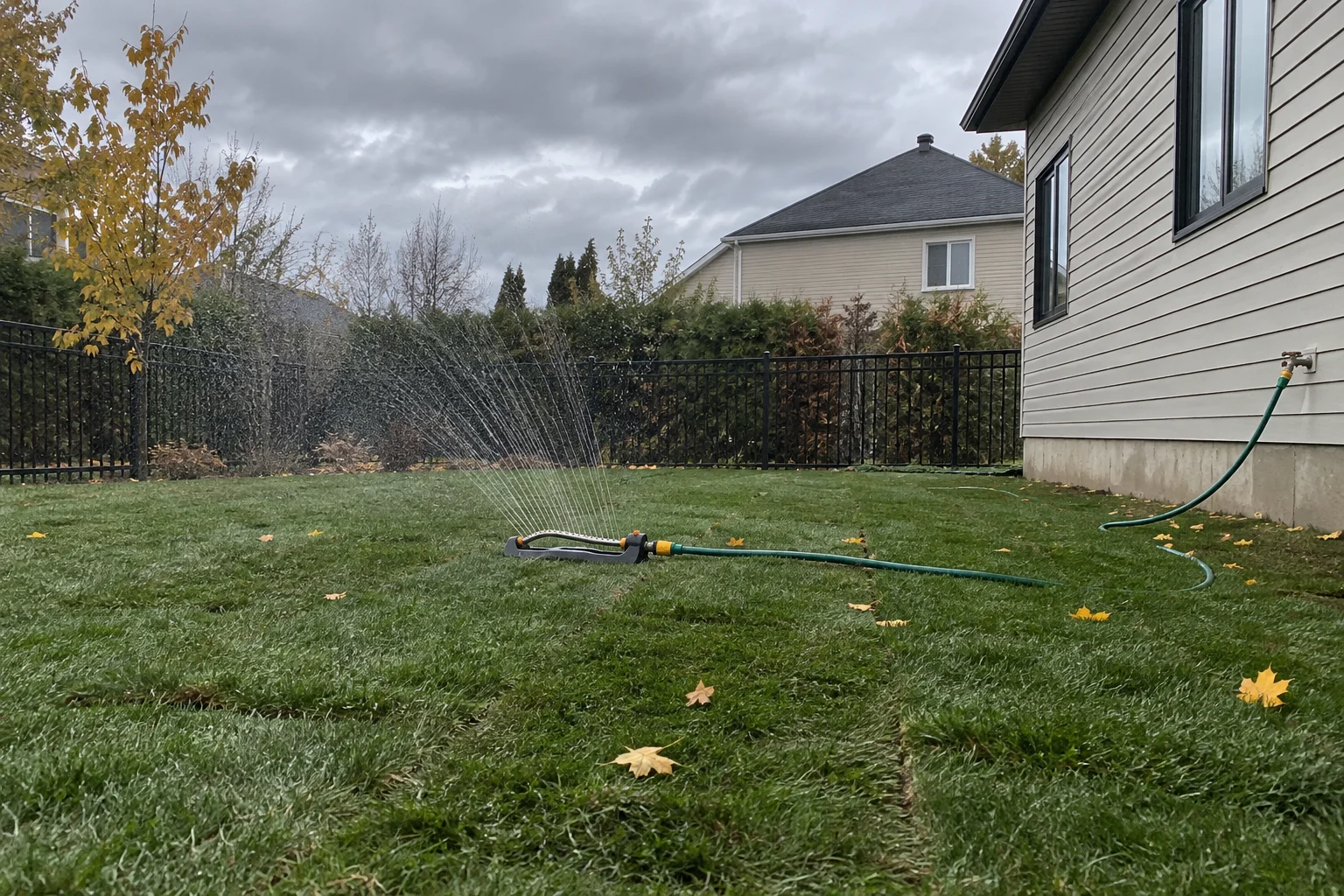
Once sod is down, the first two weeks decide whether it takes. Our own standard at Duratech is straightforward: keep the lawn moist for the first 14 days, watering daily, with morning watering as the better time of day. That’s our practice, not a universal rule — other installers run different schedules, and yours may vary with weather.
What catches people off guard is that daily watering a brand-new lawn can bump into a municipal watering restriction meant for established lawns — which is exactly why several South Shore cities issue a separate, temporary permit just for new sod.
Two practical caveats: most of the South Shore permits below only allow evening watering, and where that’s the case the permit hours take priority over our morning preference; and if your city’s permit is shorter than our 14-day routine, ask the city what schedule applies once it expires.
On the aftercare side, we also tell clients to keep pets and children off the new lawn for about two weeks, and to hold off on the first mow until the grass reaches three to four inches, usually around the two-to-three-week mark. None of that is complicated, but it’s easy to skip when a new lawn looks ready sooner than it actually is.
Watering Permits for New Sod on the South Shore
Many South Shore municipalities restrict lawn watering in the warm months to conserve water, and each city in the table below carves out an exception for sod or seed that’s just gone in — provided you get a short-term permit first. For fall sod, check the dates as well: Chambly’s bylaw, for example, only restricts lawn watering from May 1 to September 30, so a lawn laid there in October falls outside the restricted period. Other cities don’t always state their season the same way, so ask yours.
The rules differ enough by city that assuming your neighbour’s schedule applies to you is a mistake. In the Longueuil, Chambly, and Boucherville bylaws, the permit is issued to the property owner, so the application is yours, not your installer’s.
| Municipality | Permit length | Allowed watering hours |
| Brossard | 7 days for sod (14 for seed), free | Days 1–2 as needed; days 3–7, 9 p.m. to 1 a.m. |
| Saint-Jean-sur-Richelieu | Up to 15 days, permit from the Urbanisme department | Day of installation, any time; after that, 6–9 a.m. and 8 p.m.–midnight |
| Longueuil | 15 days, not renewable | 9 p.m. to 11 p.m. only |
| Chambly | 15 consecutive days, permit required (restriction applies May 1 – Sept. 30) | 8 p.m. to midnight; confirm with the city which days the permit covers |
| Boucherville | 15 days from the date the permit is issued; proof of sod purchase required; post it where it’s visible from the street | 6 p.m. to 11 p.m. daily |
These are the rules as published by each city at the time of writing, and municipalities update them without much notice. Confirm the current version and any fee with your own municipality before you count on a specific watering window — Brossard states its permit is free, while Longueuil and Boucherville set their fees through a separate municipal bylaw that isn’t published alongside the watering rule itself.
For comparison only, the island of Montreal — a different jurisdiction from the South Shore cities above — allows daily watering of a new lawn for 15 days after installation. It’s a useful reference point for how the logic works, not a rule that applies to Rive-Sud or Montérégie addresses.
2 Real Cases
A Brossard backyard with an old above-ground pool footprint. A homeowner in Brossard had removed an above-ground pool that summer, leaving a compacted, grassless circle of roughly 300 square feet in an otherwise decent lawn. We tilled and graded the area, added fresh topsoil to match the surrounding grade, and laid sod in early October.
The homeowner got the city’s free 7-day watering permit, kept to the 9 p.m.–1 a.m. window from day 3, then moved to Brossard’s regular three-evenings-a-week schedule for the rest of our two-week routine. By the time frost arrived, the patch had rooted into the surrounding lawn, and by the following spring the seam was hard to spot.
A new-construction yard in Saint-Jean-sur-Richelieu. A newly built home had a backyard of roughly 1,800 square feet left as compacted subsoil and construction debris after the builder finished grading. We cleared debris, added about six inches of fresh topsoil, and laid sod in late September — inside our fall window, with weeks of margin left before the ground would close up.
The homeowner applied through the Urbanisme department for the municipal watering permit and used the 6–9 a.m. and 8 p.m.–midnight slots for the full 15 days. The sod had started rooting before the first frost, went dormant for winter, and finished establishing the following spring with normal watering.
Frequently Asked Questions
1. How much does it cost to lay sod in Quebec?
Published Quebec guides put turnkey sod jobs at roughly $1 to $4 per square foot, depending on how much soil preparation and grading the yard needs. Bare sod material alone runs lower, around $0.33 to $0.90 per square foot from Quebec suppliers — about $3.30 to $8.99 for a roll of roughly 10 square feet. These are market ranges, not our quote — we set our own pricing per yard after an on-site look.
2. Can you lay sod in the fall in Quebec?
Yes, within limits. Our season runs May through November, and fall is one of two seasons we consider ideal because cooler, wetter conditions mean less manual watering. The practical cutoff is the ground freezing, not a fixed calendar date — commonly mid-November in southern Quebec, or whenever the first snowfall or ground frost comes first.
3. Do I need a permit to water new sod?
Often, yes — at least during the restricted season. The South Shore cities we checked limit general lawn watering but issue a separate, short-term permit for new sod or seed, usually for 7 to 15 days, and some (Chambly, for example) only apply the restriction from May to September. Hours and permit length vary by city — check the current rule with your own municipality before you assume a schedule.
4. Is sod better than seed in a Quebec fall?
For a fall project, sod has the clearer advantage. Seed needs roughly six to eight weeks to establish, and Quebec lawn-care guidance puts the seeding window in southern Quebec at around the end of September in a mild fall. Sod laid later than that can still go dormant for winter and finish rooting the following spring.
5. Can sod be installed over an existing lawn?
No. Laying sod directly over an existing lawn traps the old grass underneath, where it rots and can kill the new roots growing above it. The old lawn needs to be stripped or properly tilled under first — skipping that step puts the new lawn at risk in its very first season.
Disclaimer: The prices in this article are general market ranges from third-party sources, not a Duratech quote — your final price depends on an on-site evaluation of your yard’s size, slope, access, soil, and prep needs. Municipal watering permits, fees, and allowed hours vary by city and change without notice; confirm current requirements with your own municipality before applying for one or relying on a schedule described here. This article is for general informational purposes only and does not constitute professional landscaping, legal, or municipal advice specific to your property.
If you’re wondering whether there’s still time this year, or what your yard specifically needs before sod goes down, send us the approximate size of the area and your address through our landscaping quote form, and email a few photos of the current ground to the address below. We’ll tell you honestly whether fall still works and what we can put in a written quote.
Phone: (438) 830-3436
Email: lescloturesduratech@gmail.com
Website: lescloturesduratech.com
We serve homeowners across the South Shore and Montérégie, in English and French.