

In this article
- Aluminum, Steel, or “Wrought Iron”? Clearing Up the Terms
- Why One Rusts and the Other Doesn’t
- Aluminum vs Steel Ornamental Fence: Side by Side
- How High Can Your Ornamental Fence Be at the Front of the House?
- What We’d Steer You Away From
- How We Handle an Ornamental Quote
- What Drives the Price
- Winter, Salt, and When to Touch Things Up
- 2 Real Cases
- Frequently Asked Questions
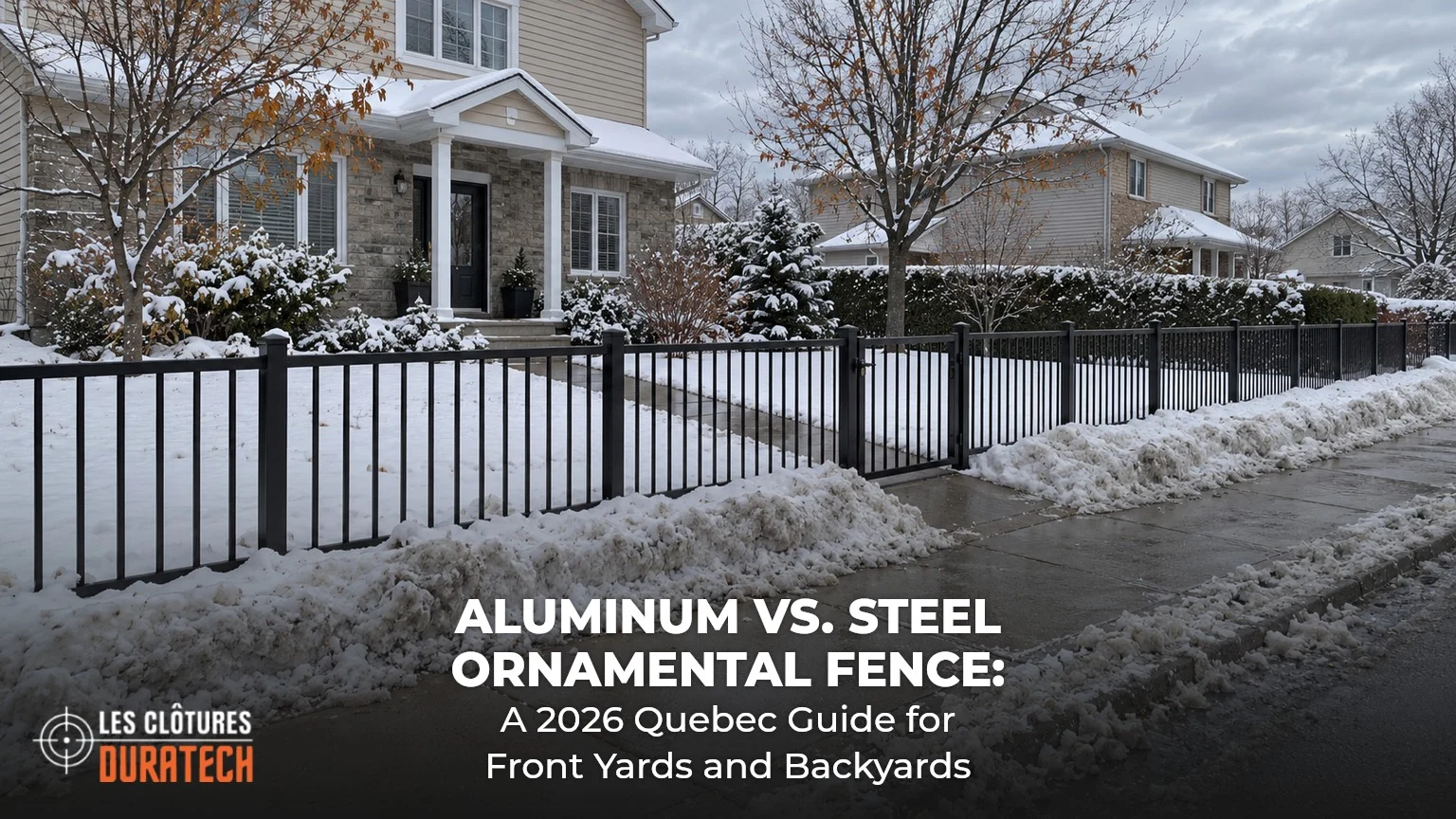
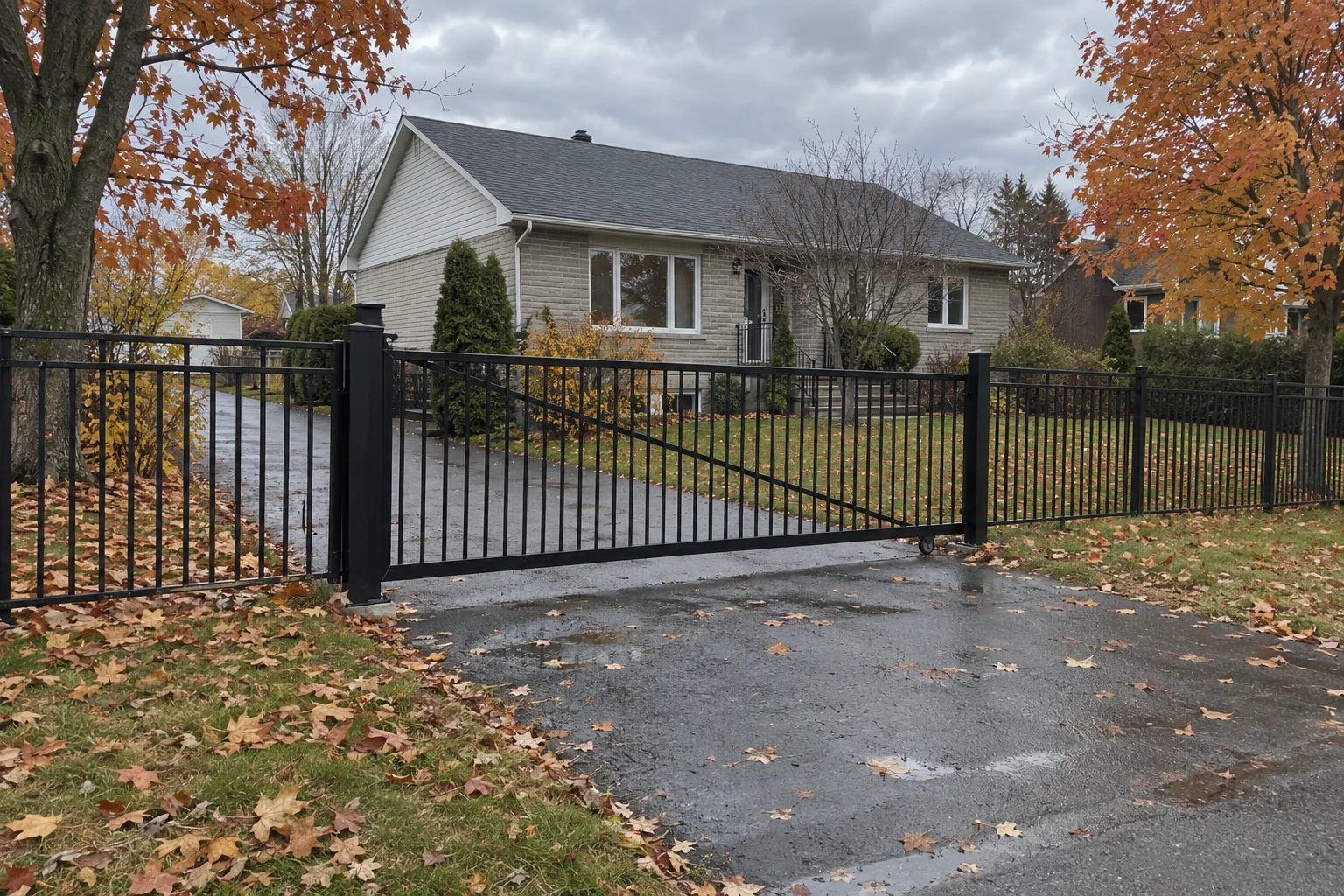
A homeowner calls us wanting a fence across the front of the lot, not around a pool — something that matches the house, a clean line along the driveway, and nothing that needs re-staining every few years. By the end of that first conversation, the choice almost always comes down to the same fork: which metal fence — aluminum or steel — and how tall the city actually lets it be where the street can see it.
We’ve already covered ornamental aluminum for pool enclosures in our pool fence guide, where the driving factor is chlorine or salt water, not curb appeal. This article goes narrower: the pair of materials you’d actually put along a front yard or backyard — aluminum versus steel ornamental fence, what “wrought iron fence” really means today, and the municipal height rules that decide what you’re allowed to install before you order a single panel.
Aluminum, Steel, or “Wrought Iron”? Clearing Up the Terms
“Wrought iron fence” is the term most people search for, but the product almost never matches the name anymore. Genuine wrought iron — low-carbon iron worked by hand or mill, with slag fibers running through it — stopped being produced commercially decades ago; in the United States, the last mill closed in 1969, according to a history of the material published in Fabricator, the trade journal of the National Ornamental & Miscellaneous Metals Association.
What’s sold today under names like “wrought iron fence,” “rod iron fence,” or “rot iron fence” (all common ways people search for the same thing) is mild steel, welded and shaped to look like the old ironwork. That’s not a knock on steel — it’s simply the honest name for the ornamental steel fence most of the market, including ours, actually installs. The real decision in front of you is between that steel and aluminum. (If you’re still choosing between ornamental metal, wood, and chain-link, start with our fence type comparison.)
Why One Rusts and the Other Doesn’t
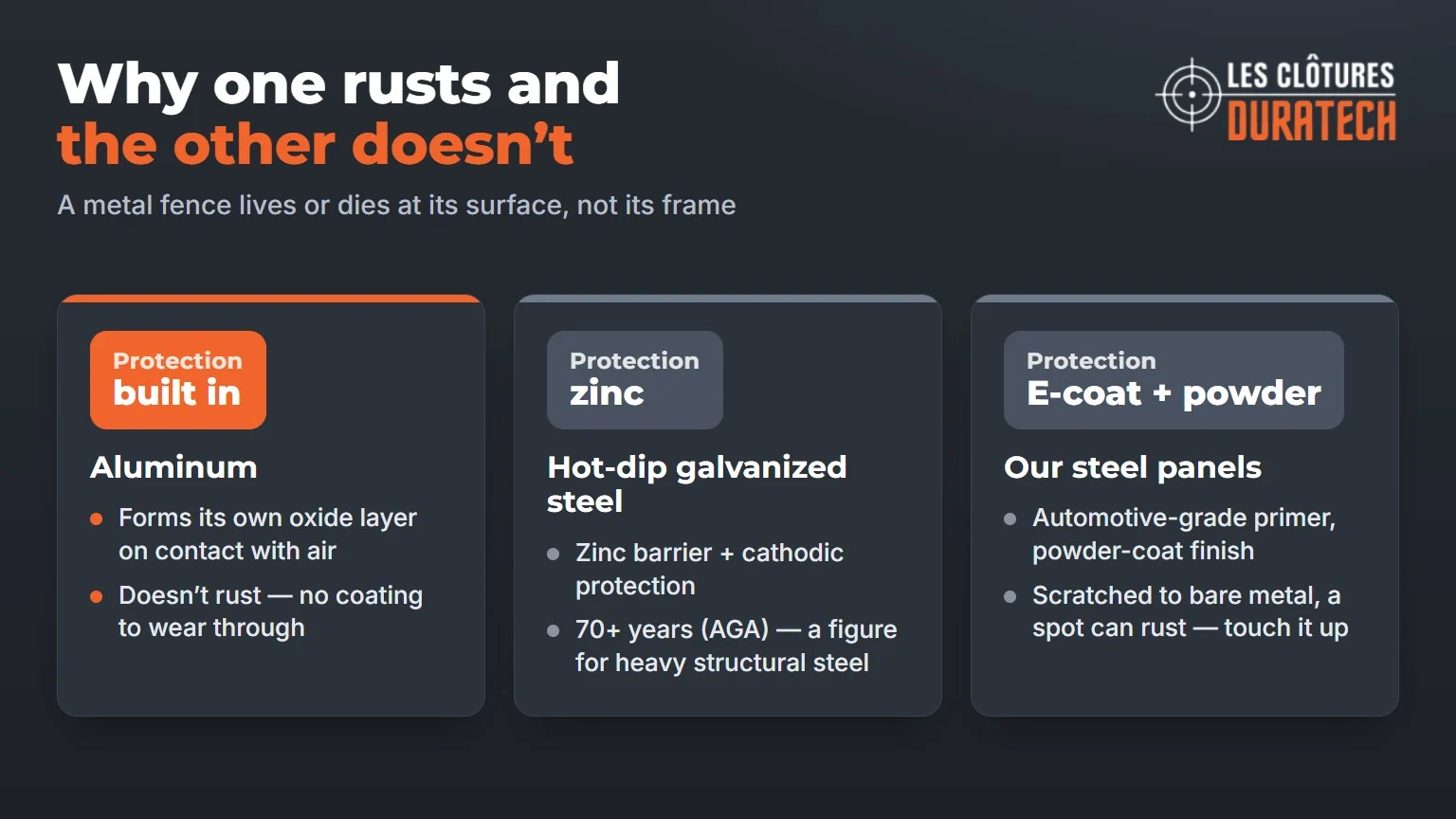
A metal fence lives or dies by what happens at its surface, not its frame. Aluminum forms its own protective oxide layer the moment it meets air or water — a thin barrier called alumina that keeps corrosive atmospheres away from the metal underneath, according to AluQuébec, the Quebec aluminum industry association. That’s why aluminum doesn’t rust, and its protection doesn’t depend on a coating that can eventually wear through.
Steel needs help from the outside. The most common industrial protection, hot-dip galvanizing, combines a zinc barrier with cathodic protection.
According to the American Galvanizers Association, steel galvanized to the ASTM A123 standard commonly provides over 70 years of corrosion protection with minimal maintenance, and the association’s specifier’s guide puts structural steel thicker than ¼ inch at 72 to 73 years before first maintenance, even in the harshest industrial atmosphere. Those figures describe hot-dip galvanized steel to that standard — the second one heavy structural sections — not every galvanized fence post on the market, so it’s worth asking what coating a given post actually carries.
Our own ornamental steel panels use a different process built for a flat, decorative surface: an E-coat (cataphoresis) primer — the same automotive-grade technology used on car bodies — followed by a powder-coat finish. Steel protected this way is extremely resistant, but if a scratch goes all the way down to bare metal, that spot can rust over time, though it’s easy to touch up before it spreads.
Location matters too. Canada applies roughly 6 tonnes of road salt per kilometre of road a year, more than most other cold-climate countries, according to a 2023 Transportation Association of Canada conference paper by Carleton University researchers, who describe corrosion from winter road-salt application as a major infrastructural problem. A fence that sits close to a plowed, salted street or driveway sees more of that exposure than one set well back on the lot — worth factoring in on top of whichever material you pick.
Aluminum vs Steel Ornamental Fence: Side by Side
Black is the most common finish for a front-yard or driveway aluminum fence — it all but disappears against grass and pavement. Steel earns its place where the job calls for more rigidity, usually at gates.
| Factor | Aluminum | Steel |
| Rust | Never rusts — self-forming oxide layer | Highly resistant with E-coat + powder; can spot-rust if scratched to bare metal |
| Weight and rigidity | Roughly one-third the weight of equivalent steel | Heavier and more rigid than aluminum, for a sturdier physical barrier |
| Upfront material cost | Generally higher | Generally slightly more affordable, but heavier to transport and install |
| Long-term upkeep | Minimal — an occasional rinse and a seasonal hinge and latch check | Seasonal check for chips; touch up scratches before winter |
| Wide driveway gates | Fine for standard widths; extra-wide openings need a reinforced frame | Welded steel frames hold up better against a wide single gate without sagging |
The gate line in that table comes up more than people expect. A gate doesn’t sag just because it’s heavy — it sags because of leverage: as a gate gets wider, its center of gravity moves farther from the hinge post, and if the frame and corners can’t resist that leverage, the latch side drops and a rectangle turns into a parallelogram.
One fence builder’s guide (written about wood gates built on a welded steel frame, not about ornamental metal gates) notes that a welded steel frame allows single gates up to roughly 10 feet wide without that kind of sagging. The same leverage principle applies to any wide single-leaf gate, aluminum included, which is why we size the frame to the opening instead of assuming a stock width will hold.
How High Can Your Ornamental Fence Be at the Front of the House?
This is where a front-yard or backyard project differs completely from a pool enclosure, which answers to the province’s pool-safety regulation on top of any municipal rules. For an ornamental fence facing the street, the rule that matters is your city’s zoning bylaw, and it is not the same number everywhere.
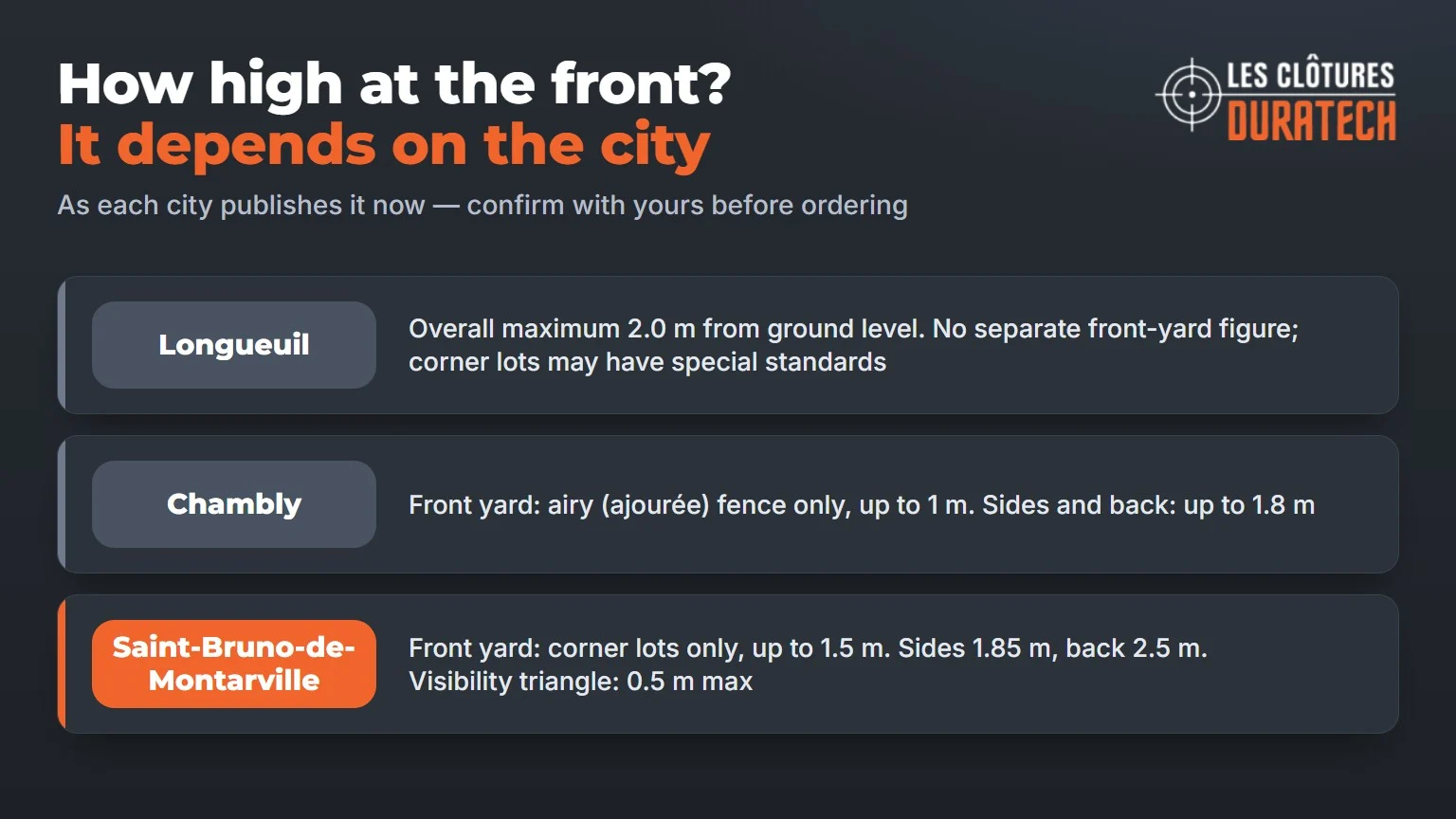
Longueuil’s fence and wall information page sets an overall maximum of 2.0 metres from adjacent ground level and lists painted wrought iron and factory-prepainted metal among accepted materials. It gives no separate front-yard figure and notes that particular standards may apply to corner lots, so both are worth confirming with the city before you settle on a height.
In Chambly, the municipality’s zoning bylaw (2020-1431) allows only airy (“ajourée”) fences of wood, vinyl or wrought iron in the front setback (“marge avant”), up to 1 metre, while the sides and back allow up to 1.8 metres. Aluminum isn’t on that front-setback list — the bylaw’s general list of fence materials names aluminum only as mesh — so whether an ornamental aluminum or steel picket fence is accepted there as “wrought iron” is a question to put to the city before you order, not after.
Saint-Bruno-de-Montarville’s fence bylaw works differently again, and the rule is easy to misread. On an ordinary interior lot, a fence in the front yard generally isn’t permitted at all; the front-yard allowance of 1.5 metres applies specifically to corner lots.
In Saint-Bruno, side yards on any lot type top out at 1.85 metres, and the back yard at 2.5 metres. Corner lots add one more constraint: inside the visibility triangle at the intersection, nothing can exceed 0.5 metres measured from the sidewalk or curb.
Saint-Bruno also requires a certificate of authorization (certificat d’autorisation) for any fence on a residential lot. The bylaw’s list of accepted materials caps one steel product specifically: factory-prepainted architectural steel panels may not exceed 1.2 metres. If the steel option you’re considering is sold as a panel rather than as open pickets, ask the city which category it falls under.
Municipal fence rules vary from one South Shore city to the next, and bylaws get amended — the numbers above reflect what each city publishes now, and confirming the current version with your own municipality before ordering is part of a normal quote, not an extra step. We go deeper on height rules generally, across fence types, in our fence height rules guide.
What We’d Steer You Away From
A few mix-ups come up often enough to call out directly. Assuming the pool-fence rule — 1.2 metres, non-climbable, self-closing and self-latching gate — applies to a front-yard fence is one; it doesn’t, because it’s a separate regulation covering pool enclosures specifically. A second is installing a solid, opaque front-yard fence — or assuming aluminum is accepted without asking — in a city like Chambly, where the front setback allows only airy fences of wood, vinyl or wrought iron.
On a corner lot, skipping the visibility triangle is an easy miss, since a fence can be fully compliant with the general height limit and still violate the triangle a few feet away. Ordering a single wide driveway gate without asking whether the frame is reinforced is another — the leverage problem shows up months later, not on installation day. And letting a deep scratch on a steel panel sit untouched through a winter near a salted street gives corrosion exactly the opening it needs.
How We Handle an Ornamental Quote
If you’re torn between the two metals, ask us to price both for the same layout at the site visit, so you’re comparing two real numbers for your own property rather than guessing from a general range. Your city’s front-yard rules — height, the visibility triangle on a corner lot, whether a permit applies — are worth settling at that same stage, not after an order is placed: the permit is yours to obtain, and we provide the panel specifications the city requires for the application.
Before anything goes in the ground, we handle the Info-Excavation request to locate underground utility lines; private lines like an irrigation system or a pool heater line fall outside that locate and are the homeowner’s to flag.
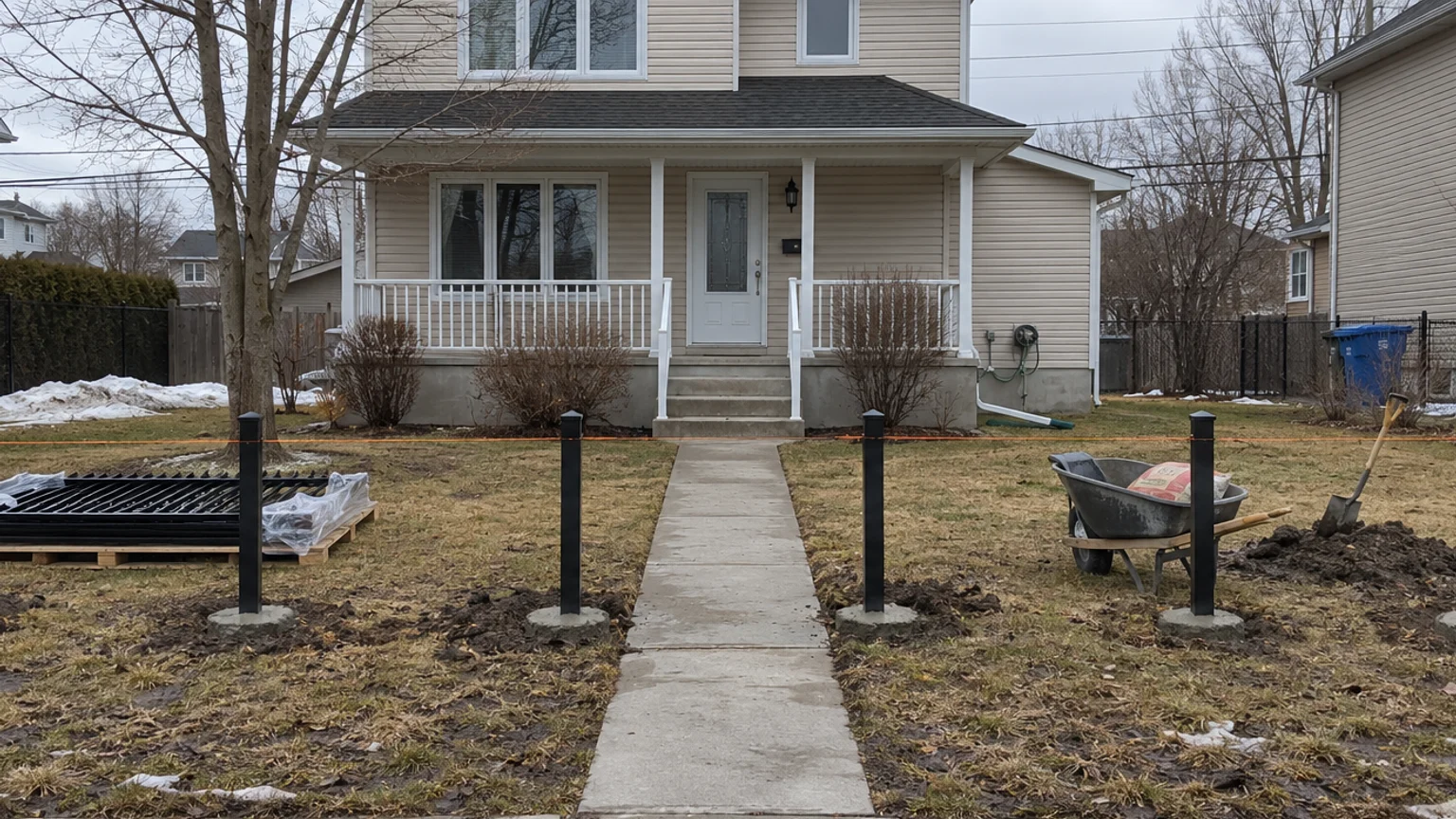
Posts go into concrete footings drilled below the frost line, so frost heave — the ground lifting as water in the soil freezes, a real risk in wet, fine-grained soils like clay — doesn’t lift them out of line and leave a gate dragging or missing its latch after a winter. And we hold to our own 14-day concrete cure before a gate or panel run takes any load — our standard at Duratech, not a general building-code requirement, but the difference between a footing that’s actually set and one asked to carry weight too soon.
What Drives the Price
We don’t publish a fixed price for ornamental steel or aluminum. The general figure on our site — roughly $25 to $60 per linear foot for a professional 6-foot residential fence — isn’t broken out by material or style. What actually moves a real quote is panel height and style, the number and width of gates, whether a post needs to carry a driveway gate versus a walk gate, slope and site access, finish color, and removing an old fence first.
For a wider sense of the market, a Canadian aluminum fence company’s 2026 comparison page (a company that sells the aluminum side of this comparison) lists installed aluminum fencing at roughly $80 to $120 per linear foot, and steel at $60 to $200 “depending on type” — a range that, by the page’s own note, runs from chain-link at the low end to welded steel at the high end, so its bottom isn’t an ornamental price. It’s also a sales page, not a regional survey, and not Montérégie-specific.
A separate 2026 price guide from an overseas aluminum panel manufacturer quotes material alone at $40 to $70 per foot, with installation priced separately at $20 to $40 — useful mainly as a reminder that material cost and installed cost are two different numbers, and that neither of these outside figures reflects the South Shore market directly.
Winter, Salt, and When to Touch Things Up
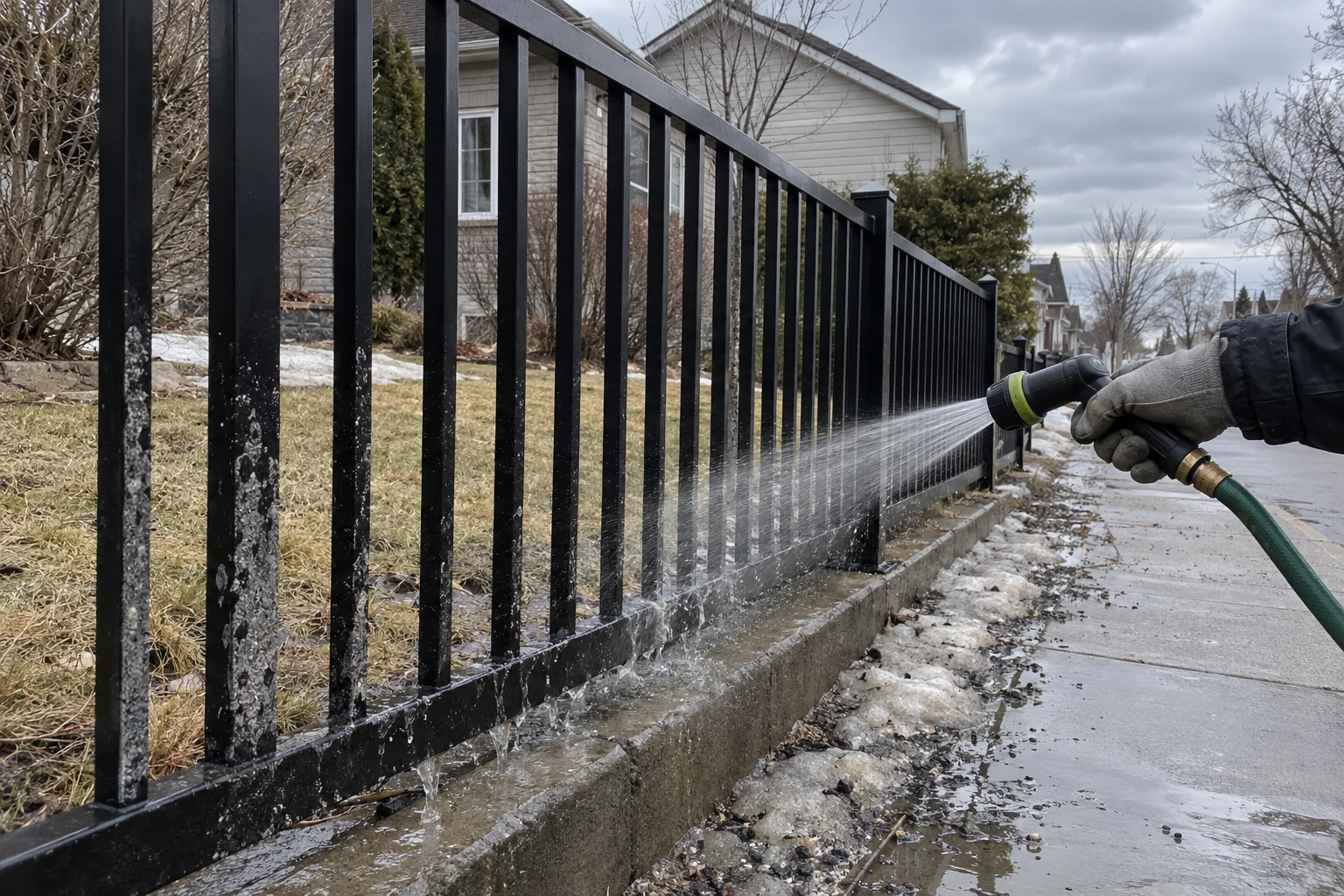
The practical maintenance difference between the two materials shows up in late fall. One fencing contractor’s maintenance guide recommends checking a metal fence twice a year, in spring and fall, for chips, scratches, and early rust spots, noting that a chip the size of a pencil eraser left alone can grow into a visible rust patch within a year. Steel is the material that benefits most from that habit; on aluminum, the seasonal check comes down to the gate hinges and latch.
Touching up a scratch properly means sanding down to bare metal, applying a rust converter if any corrosion has started, and finishing with touch-up paint matched to the panel — powder coat itself can’t be repaired in the field, since it has to cure in a factory oven. Doing that before the ground freezes and the street gets salted is simpler than doing it in February.
2 Real Cases
A corner lot in Saint-Bruno. A homeowner wanted a black aluminum fence wrapping both street-facing sides of a corner property. Because it’s a corner lot, a front-yard fence was permitted in the first place — but only up to 1.5 metres and only in the part of the front yard the bylaw permits.
Where the fence turned into the side yard, it could step up to 1.85 metres, and inside the visibility triangle at the intersection nothing could exceed 0.5 metres, so we kept the fence out of that triangle altogether. We laid out the panel run and gate placement around it first, then filled in the rest of the fence to the allowed heights on either side; the homeowner obtained the city’s certificate of authorization before we started.
A busy street in Longueuil. A homeowner initially wanted steel for the look along a driveway that sees heavy winter plowing and salt spray off the road. We walked through the maintenance trade-off: aluminum would need very little attention in that exposure, while a steel run in the same spot would mean checking for scratches each fall. They went with aluminum for the fence line and kept steel for the single driveway gate, where the wider opening benefited from a stiffer welded frame — one steel gate is a far easier fall check than a whole steel fence line.
Frequently Asked Questions
1. How much does an ornamental metal fence cost in Quebec, aluminum or steel?
There’s no single published number for ornamental specifically — our general residential range runs $25 to $60 per linear foot for 6-foot fencing, and one Canadian aluminum fence company’s comparison page puts installed aluminum around $80 to $120 per foot and steel $60 to $200 depending on type — a range whose low end is chain-link, not ornamental steel. None of those figures account for gates, slope, or your specific layout, which is why the only reliable number comes from an on-site evaluation.
2. Will a steel ornamental fence rust?
Steel protected with our E-coat and powder-coat process is highly resistant, but a scratch that goes down to bare metal can rust locally over time if it isn’t touched up. Aluminum doesn’t carry that maintenance item: it forms its own protective oxide layer and doesn’t rust.
3. Which material is better for a front yard, and do I need a permit?
It depends less on the material and more on your municipality’s front-yard bylaw — height limits, visibility-triangle rules on a corner lot, and whether the front-yard allowance even applies to your lot type vary from city to city, as the Longueuil, Chambly, and Saint-Bruno examples above show.
On the material itself, aluminum is usually the lower-maintenance pick near a salted street, provided your city accepts it in the front yard (Chambly’s front-setback list doesn’t name aluminum), while steel earns its place where rigidity matters, such as a wide gate. Some cities require a permit or certificate of authorization even for a residential fence — Saint-Bruno does for any fence on a residential lot. Getting it is the homeowner’s responsibility, so confirm the current rule with your own municipality before ordering either material.
4. How long does an ornamental fence last, and how much maintenance does it need?
Aluminum’s powder-coated finish typically lasts for decades, and the fence needs little more than an occasional rinse and a seasonal check of the gate hinges and latch. Steel holds up well with its coating intact but benefits from a seasonal check for chips or scratches near the ground line. We go deeper on expected lifespan by material, across all our fence types, in our fence lifespan guide.
5. Can I get a single wide gate without it sagging?
Usually, but the frame matters more than the material. A wider gate puts more leverage on the hinge post and corners, not just more weight, so a reinforced welded steel frame generally holds up better on an extra-wide single-leaf driveway gate than a standard aluminum frame built to the same width. That’s why we size the frame to the opening as part of the quote.
6. Can an ornamental fence follow a sloped front yard?
Yes. We install ornamental aluminum and steel panels stepped: each panel stays level and steps down with the grade from one post to the next. On a steeper run, stepping leaves a small triangular gap under the downhill end of each panel, so if you need the bottom closed — for a small dog, for example — mention it at the site visit, since it affects panel layout and height.
7. How soon can I use the gate after the posts are set?
Our standard is to let the concrete footings cure 14 days before a gate or panel run takes any load, so plan for that gap between setting the posts and full use.
Disclaimer: The prices mentioned in this article are general market ranges, not a quote for your property — your final price depends on an on-site evaluation of your layout, gates, and site conditions. Municipal rules on fence height, front-yard setbacks, visibility triangles, and permits vary by city and can change; confirm current requirements with your own municipality before ordering a fence, as the permit is the homeowner’s responsibility. This article is for general informational purposes only and does not constitute engineering, legal, or municipal compliance advice specific to your property.
If you’re weighing aluminum against steel for a fence your neighbors and the street will actually see, send us your city, your lot type (corner or interior), and roughly how many linear feet and gates you’re picturing. We’ll confirm the details at a site visit and price both materials for your layout in a written quote.
Phone: (438) 830-3436
Email: lescloturesduratech@gmail.com
Website: lescloturesduratech.com
We serve homeowners across the South Shore and Montérégie, in English and French.