

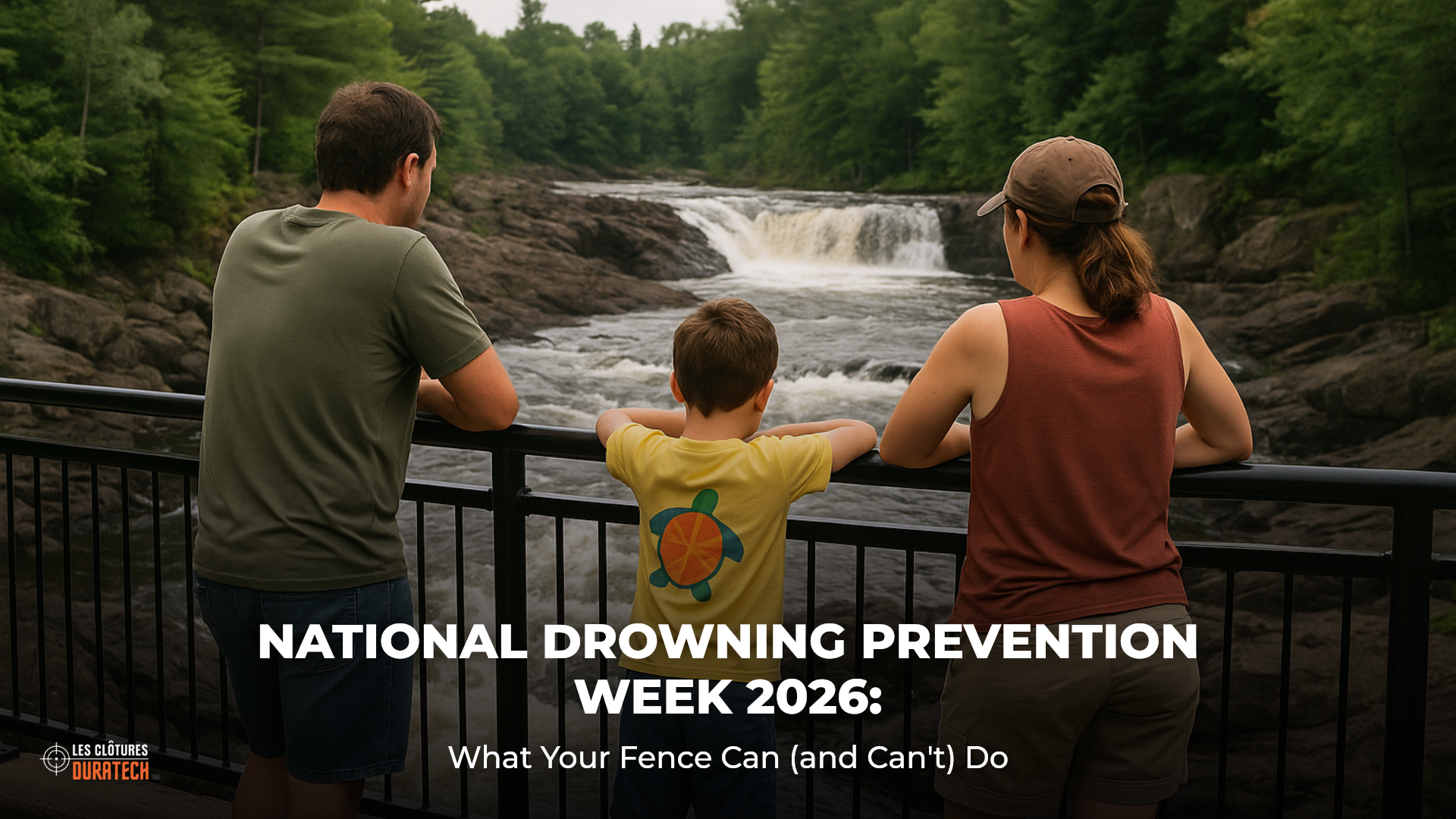
Every July, the Société de sauvetage marks National Drowning Prevention Week to remind Quebec families that water safety is not a one-week conversation. This year the week runs from July 19 to 25, 2026.
The numbers explain why it matters. More than half of the drownings recorded in Quebec between 2013 and 2022 happened in open water — rivers, lakes, and the St. Lawrence (le fleuve Saint-Laurent) — not in backyard pools. And when a young child drowns, it usually happens fast and silently, often during a brief lapse in supervision.
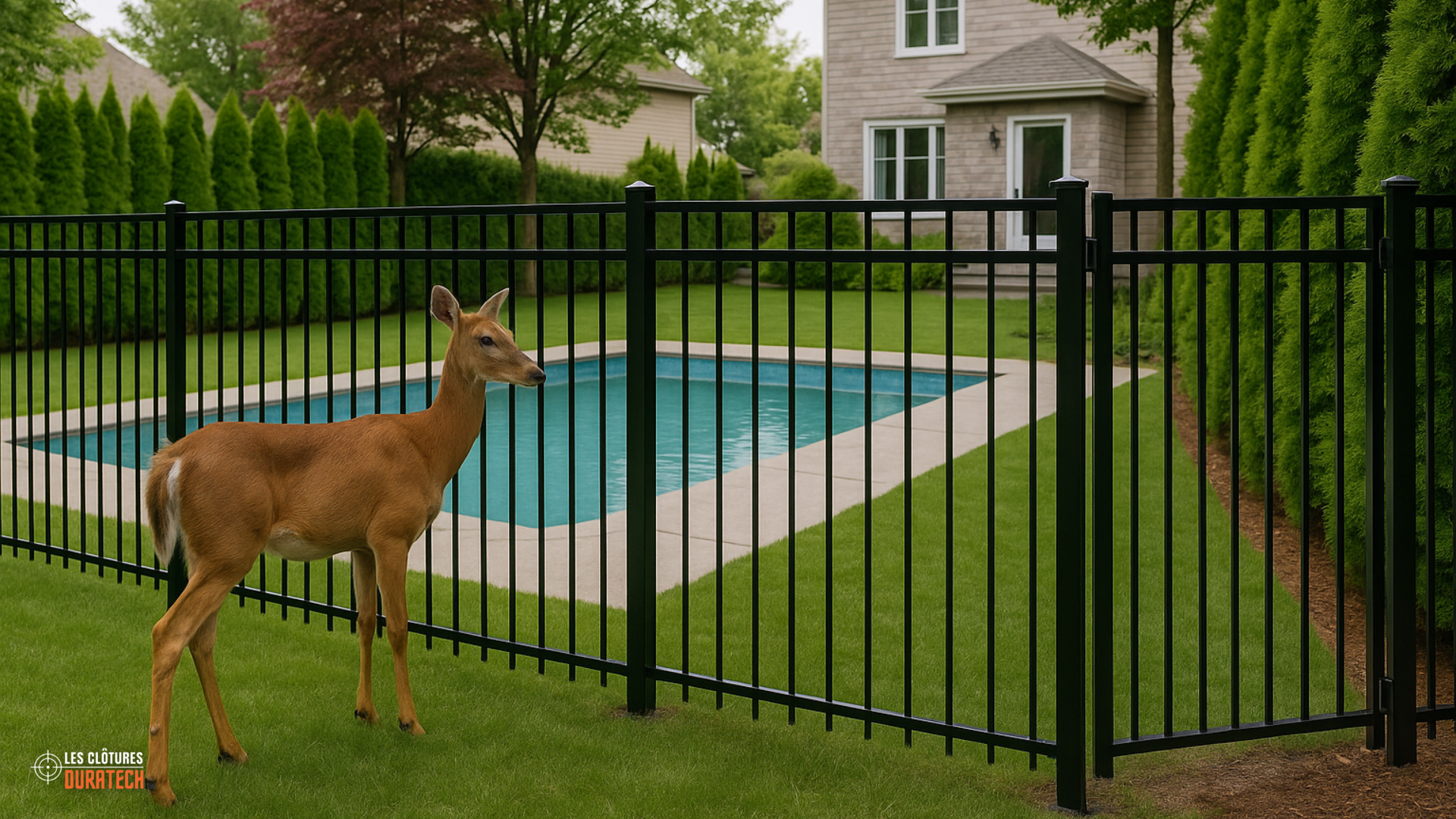
For homeowners on the South Shore, this hits close to home. Between the St. Lawrence, the Richelieu River, and the lakes scattered across Montérégie, most of us live minutes from open water, a backyard pool, or both. We get asked often whether a fence is required, or even helpful, around each type of water. The honest answer depends entirely on which kind of water you’re dealing with, so we’ll walk through both.
Open Water: Rivers, Lakes, and the St. Lawrence
Open water drownings tend to follow a pattern our lifeguard and public-safety colleagues see year after year: an adult swimming without a life jacket, a boating mishap, or a young child wandering toward the shoreline for a few unsupervised minutes. A fence alone does not address the main causes of open-water drowning, and it can’t replace active supervision, life jackets, or safe boating practices — worth saying plainly before we talk about fencing at all.
Quebec law does not require homeowners to fence a natural lake, river, or the St. Lawrence. There’s no equivalent of the pool safety regulation for open water on private waterfront property.
In fact, it can work the other way. If your property borders a lake or river, part of it likely falls within a shoreline protection area — the bande riveraine — typically 10 to 15 metres wide depending on the slope and height of the bank. Under Quebec’s modernized framework for shorelines, littoral zones, and floodplains (in force since March 1, 2026), work within or near that strip may be restricted or require municipal authorization. The applicable rules depend on the property, the type of water body, current flood and mobility mapping, and municipal requirements — so it’s worth checking with your municipality before planning anything along the water’s edge.

So why do South Shore waterfront homeowners fence their property at all? Usually for reasons that have nothing to do with a legal mandate: privacy from neighbours or a public path, shelter from wind off the water, or simply keeping young kids and dogs from wandering unsupervised toward the shoreline. All of those are legitimate reasons to fence — they’re just voluntary, and they usually need a municipal permit and a setback that respects the bande riveraine.
Material choice near water follows its own logic, too. The exposure isn’t salt spray — this is fresh water — but it is constant moisture, wind off the water, and ice buildup in winter. Powder-coated aluminum is highly resistant to rust and holds up well against that combination, and glass panels keep the view intact, which matters when the water is the reason you bought the property. Properly coated steel can perform well near water too, as long as any damaged coating is repaired before it starts to corrode.
Wood, by contrast, tends to deteriorate faster in a consistently damp environment than it would set back from the shore. Our ornamental steel and aluminum fencing line was built with exactly this kind of exposure in mind, and it’s one of the more common requests we get from South Shore waterfront properties.
Pools: Where the Law Actually Requires a Barrier
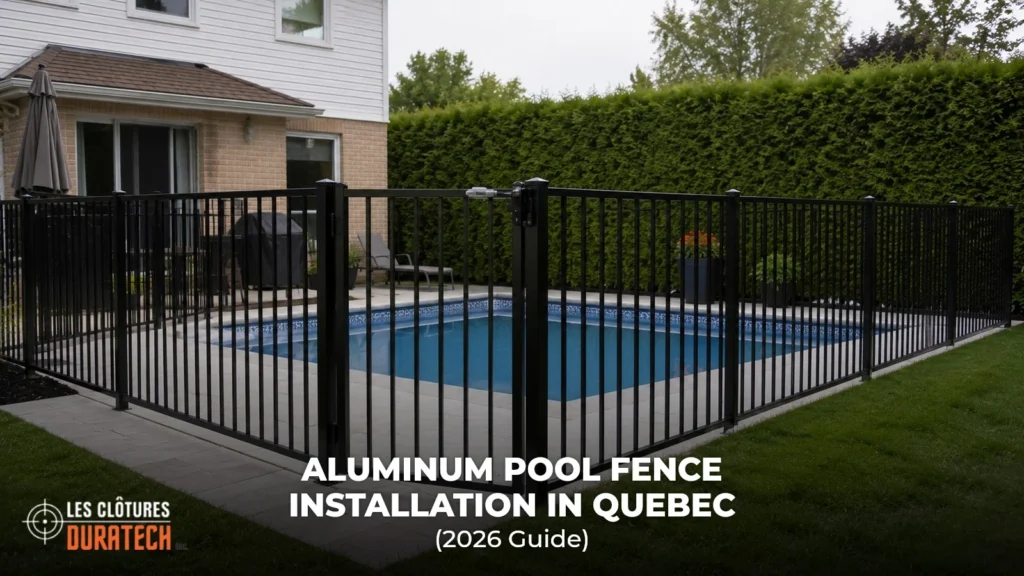
Unlike open water, residential pools in Quebec are governed by a specific provincial regulation, and the requirements are not optional. Here’s the short version; we cover the full regulation in detail in a separate guide to pool fence requirements in Quebec, so we won’t repeat every clause here.
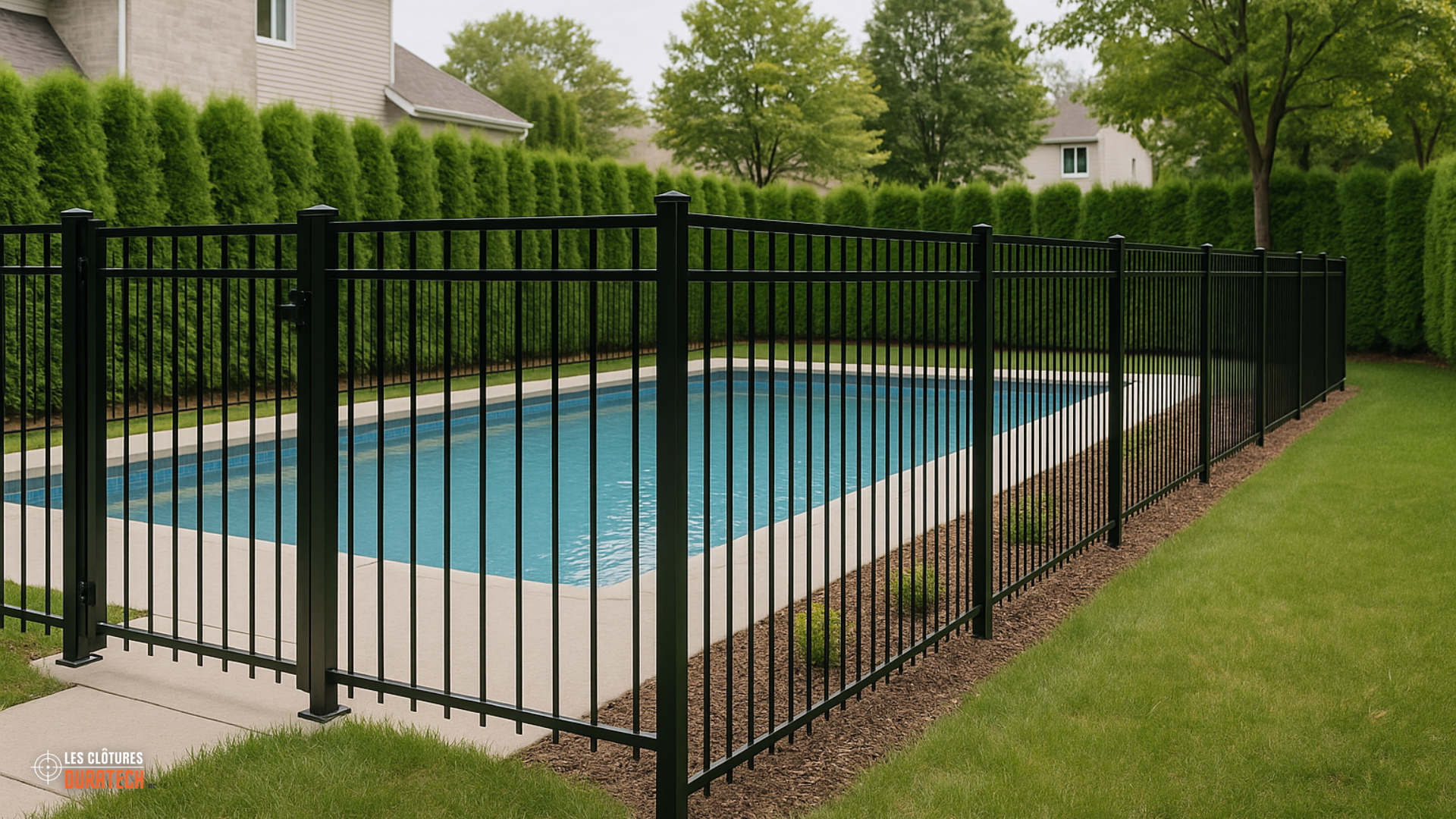
- The barrier around the pool area must be at least 1.2 metres high.
- Gaps and openings can’t allow a 10 cm sphere to pass through — that includes the space at the bottom of the fence.
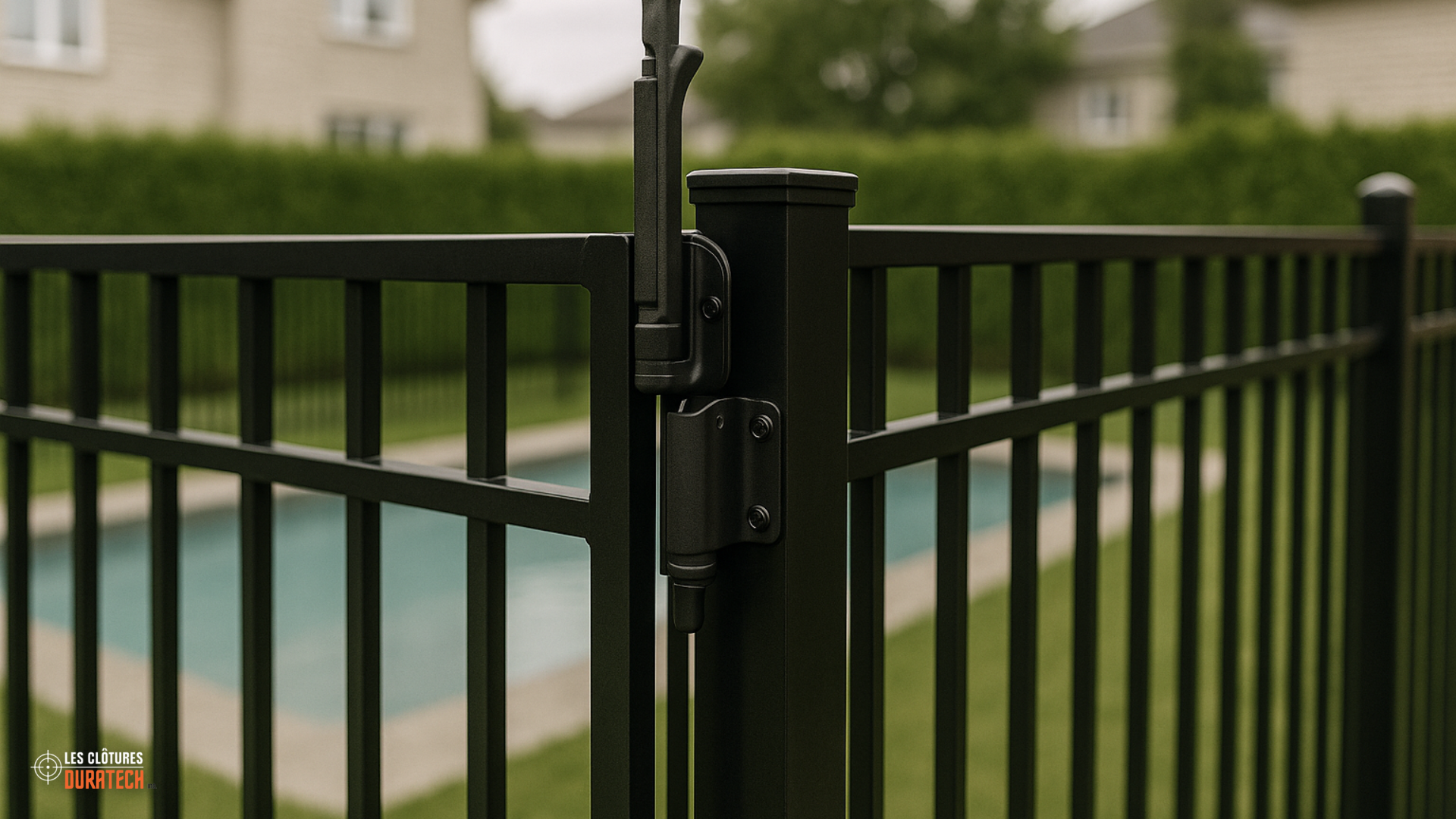
- Gates must be self-closing and self-latching. If the latch is accessible from outside the enclosure, it needs to sit at least 1.5 metres up.
- Pool equipment and fixed structures that could be used to climb over the enclosure generally must sit more than 1 metre from the barrier; it’s also prudent to keep movable objects like planters and furniture back from it.
- Non-compliance is enforced by municipalities under the provincial Regulation S-3.1.02, r. 1 respecting the safety of residential swimming pools: a first offence can bring a fine of $500 to $700, and repeat offences $700 to $1,000.
The deadline that trips people up. If your pool was installed before November 1, 2010, your enclosure needs to meet current standards by September 30, 2027. That date was pushed back from an earlier September 30, 2025 deadline, and a lot of older pages online — and more than a few homeowners — are still working from the outdated date. If you’ve been putting off a pool fence upgrade because you thought the clock had already run out, it hasn’t, but it is getting closer. Quebec’s own guide to securing your residential pool is the best place to confirm the current requirements for your situation.
A few installation details matter more here than people expect. We hold every gate post to our standard 14-day concrete cure before any hardware goes on, because a self-closing hinge and a self-latching mechanism only work correctly if the post underneath them hasn’t shifted. Applying load too early raises the risk of post movement and gate misalignment — which can quietly put you right back out of compliance. We also drill below the frost line on every pool fence job, since a post that heaves even a few centimetres over a Quebec winter is enough to throw off gate alignment and open a gap where there shouldn’t be one.
A Quick Fence Check for Homeowners
Whether your fence sits around a pool or along a waterfront, a few minutes of inspection tells you most of what you need to know. Use this as a starting point, not a substitute for a full compliance check.
| What to check | Why it matters |
|---|---|
| Fence height at its lowest point | Pool barriers must clear 1.2 m everywhere, including on sloped ground |
| Gap at the bottom of the fence | A 10 cm sphere shouldn’t pass through anywhere along the barrier |
| Gate swing and latch | Gate should close and latch on its own, every time, without being pushed |
| Latch height | 1.5 m minimum if the latch can be reached from outside the pool area |
| Objects near the fence | Keep pool equipment and fixed climbable structures more than 1 m from the barrier |
| Post stability | Leaning or wobbling posts often mean frost heave or a rushed concrete cure |
| Waterfront setback | Confirm your fence sits outside the bande riveraine, or has municipal approval |
If any of these raise questions, it’s worth requesting a fence quote and having someone look at the fence on-site rather than guessing from a tape measure.
2 Real Cases
Case 1 — A 2006 pool getting ahead of the 2027 deadline.
A homeowner in Chambly installed their pool in 2006, well before the current regulation existed. The original wood fence had gaps wide enough to fail today’s 10 cm rule, and the gate latched manually with no self-closing hinge. We replaced the gate hardware with a self-closing, self-latching set at the correct height, closed the bottom gaps with our custom pet-contour fitting so the fence followed the uneven grade without leaving room for a curious toddler or the family dog to squeeze through, and reset two leaning posts that hadn’t been drilled below the frost line originally. The owner didn’t wait for 2027 — the upgrade was done in a single project.
Case 2 — A waterfront property respecting the bande riveraine.
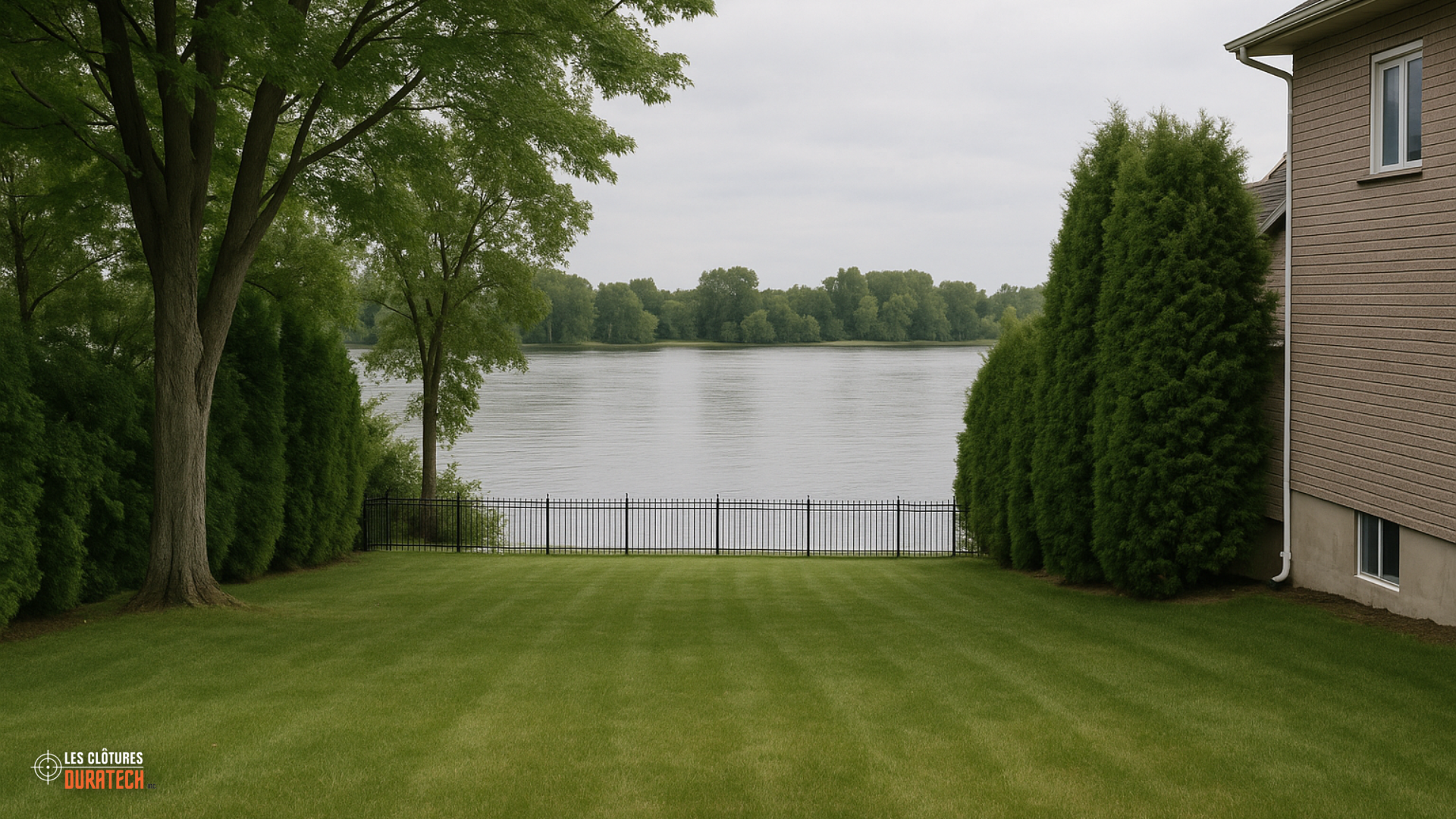
A property along a lake in Montérégie wanted a fence to keep young grandchildren from wandering toward the water during family visits. Because the lot bordered the shoreline, we first confirmed the width of the bande riveraine with the municipality before proposing anything. The fence line was set back outside the protected strip, using our ornamental aluminum fencing so it would hold up against constant moisture without the maintenance a wood fence would need that close to the water. The result gave the family a physical boundary between the yard and the shoreline, without touching the protected riparian strip.
Frequently Asked Questions
What usually causes a pool fence to fail an inspection?
In our experience it’s rarely the height. The recurring culprits are gaps at the bottom on uneven ground, a gate that no longer latches on its own every single time, and a latch mounted low enough for a child to reach. Those three are also the cheapest to overlook and the easiest for an inspector to spot.
How much does it typically cost to bring a pool fence into compliance?
Costs vary with the length of fence involved, the gate hardware needed, and whether posts need to be reset or re-drilled below the frost line. We can give you a realistic range once we’ve seen the site, since slope, existing materials, and access to the yard all affect the final price.
How long does an aluminum fence last near water, and what upkeep does it need?
Powder-coated aluminum resists rust well, so near a pool or shoreline it typically outlasts wood by years with far less work — an occasional rinse and a periodic check of the gate hardware. Properly coated steel holds up too, as long as any chips in the coating are touched up. Wood in a consistently damp spot needs sealing or staining more often and still tends to reach the end of its life sooner this close to the water.
Should I repair my existing pool fence or replace it before the 2027 deadline?
It depends on what’s failing. A single worn latch or a tired hinge is usually a straightforward repair. Wide gaps, rot, or posts that have heaved out of alignment often mean the barrier can’t be brought to standard piece by piece, and a replacement is the more reliable route — we can tell you which side you’re on after a look on-site.
Will a self-closing gate stay reliable through a Quebec winter?
It should, provided the posts were set correctly to begin with. We drill below the frost line and give concrete footings a full 14-day cure before mounting hinges or latches, specifically so the gate doesn’t shift or misalign once the ground starts freezing and heaving.
Disclaimer: The pricing ranges and timelines mentioned in this article are general estimates, not a final quote. Actual pricing depends on site conditions such as slope, access, existing materials, and current supply costs, and is confirmed through an on-site evaluation. Fence height and setback rules are set by each municipality and vary from one to another. Pool enclosures must meet the provincial minimum (Regulation S-3.1.02, r. 1), though some municipalities add stricter requirements on top of it; please confirm current requirements and obtain any necessary permit from your local municipality. This article is provided for general information only and does not constitute legal or engineering advice.
Not sure whether your fence would pass a pool inspection, or whether your waterfront plans respect the bande riveraine? We’re happy to take a look on-site and walk you through what applies to your property before you commit to anything.
Reach out to schedule an on-site evaluation:
Phone: (438) 830-3436
Email: lescloturesduratech@gmail.com
Website: lescloturesduratech.com/en
We serve the South Shore and Montérégie — Marieville, Chambly, and surrounding areas — in English and in French.