

Black chain link is the easy part of this project. Most homeowners pick the color in five minutes — it’s the privacy slats that raise the real questions: how much privacy do they actually add, does your city treat a slatted fence differently than an open one, and what does that upgrade do to the wind load and the price?
At Duratech, we install black chain link — what we call Frost fence once it’s vinyl-coated for residential use — with privacy slats across the South Shore and Montérégie. The color makes the mesh disappear into the landscaping. The slats are where the real decisions live: coverage, classification, structure, and cost.
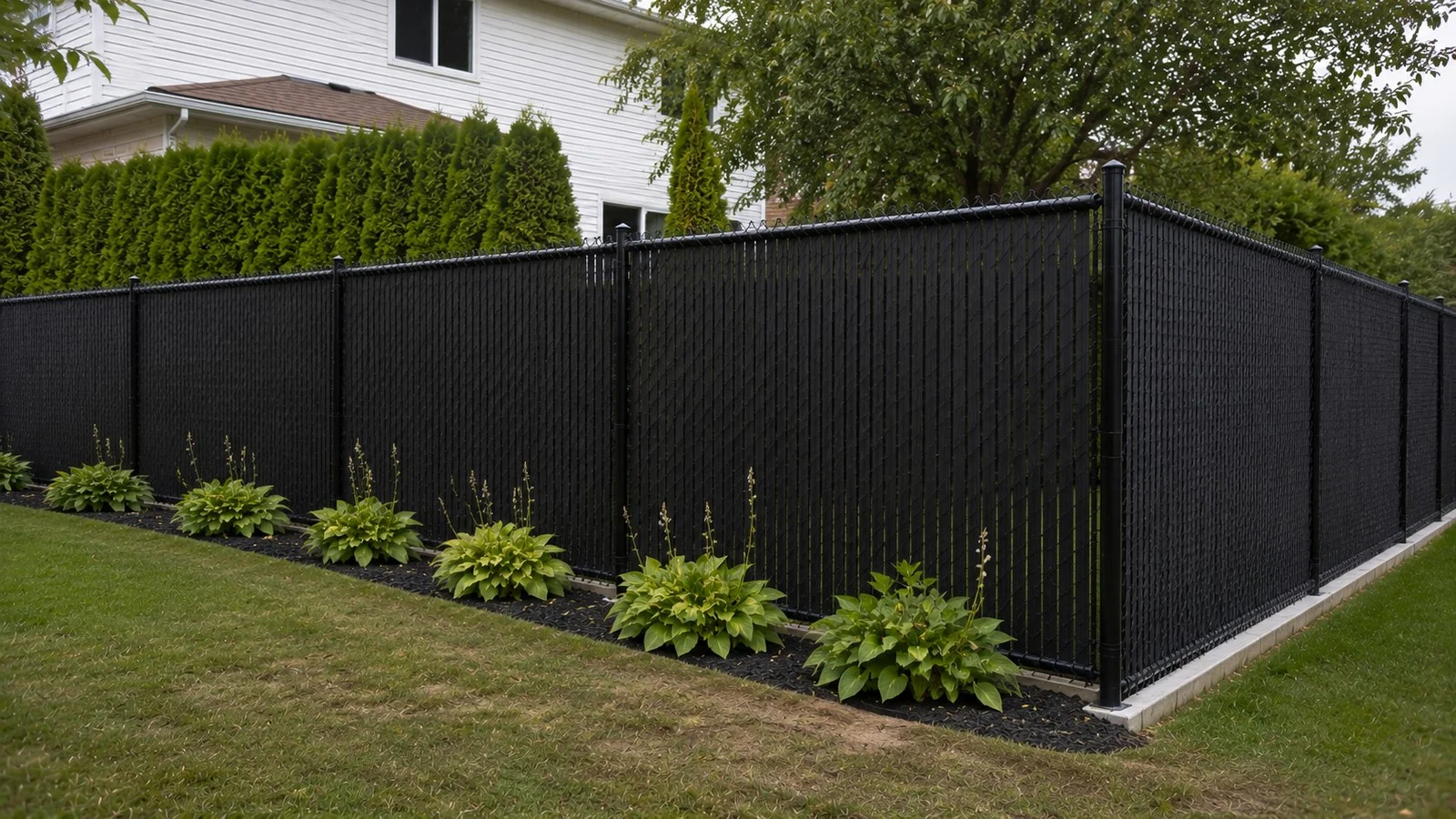
Why Black Chain Link Disappears Into the Yard
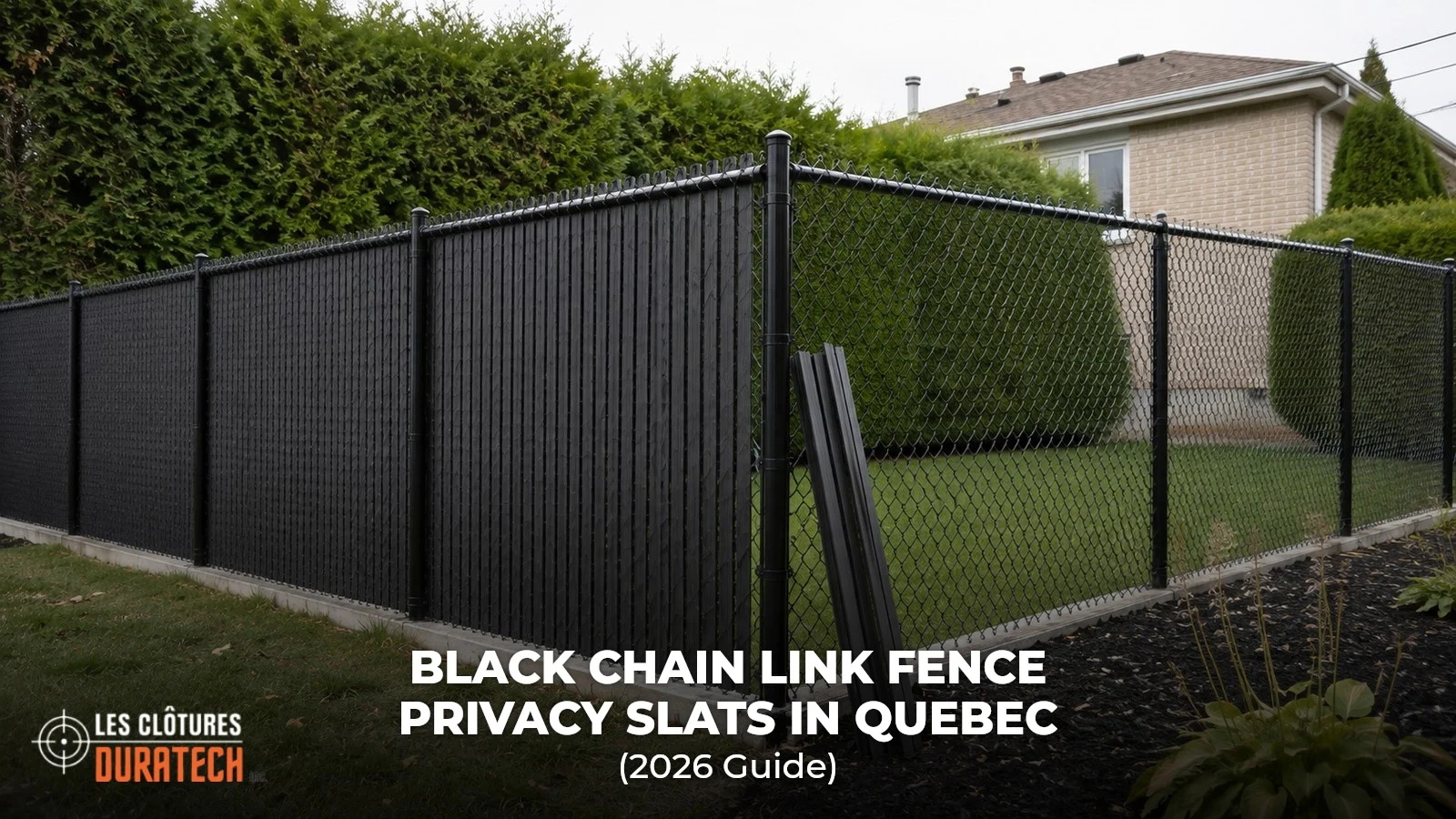
Standard chain link is bare galvanized steel — silver, reflective, and hard to miss against grass or hedges. A vinyl coating changes that entirely. We offer it in black, brown, white, taupe, and green, and black is consistently the most requested color on residential jobs.
The reason is simple: black reads as shadow, not structure. Instead of drawing the eye along the property line, the mesh recedes into whatever is planted behind it — a hedge, a tree line, a neighbor’s fence. Homeowners often tell us it’s the closest a chain link fence gets to “invisible” without adding a single slat.
That coating is also what separates a Frost fence from raw chain link, and the two get confused constantly in Quebec.
Frost Fence vs. Chain Link: Two Different Products, One Confusing Name
In everyday conversation, “chain link” and “Frost fence” get used interchangeably, and that causes real confusion when someone starts pricing a project. At Duratech, we draw the line clearly.
In this guide, we use “chain link” to describe the broader mesh-fence category and “Frost fence” to describe the residential vinyl-coated version we most often install in Quebec. On commercial and industrial sites, chain link is often left as raw galvanized silver mesh, where appearance matters less than cost, speed, and function. For residential projects, our Frost fence uses the same steel-core principle, but with a coloured vinyl coating and deep, concrete-anchored posts sized for our freeze-thaw climate. You can see the full breakdown on our Frost fencing page for the South Shore.
Polymer-coated chain-link fabric is covered by ASTM F668, the industry standard for PVC, polyolefin, and other polymer-coated steel chain-link fence fabric. The standard identifies different coating classes based on how the polymer coating is applied and bonded to the steel wire, so “vinyl-coated” is not one single specification.
Vinyl-coated mesh is commonly cited at 25 to 40 years of service, against roughly 20 to 30 years for hot-dip galvanized wire and 10 to 15 for electroplated wire — ranges that overlap enough that the coating is only part of the story.
If you want the fuller picture of what “Frost fence” covers before adding slats, our guide to what a Frost fence actually is is a good starting point.
“Black chain link” is how most people search for this product, and it’s the term we use throughout this guide for the vinyl-coated residential version — on a written quote, though, it’s listed as Frost fence.
How Much Privacy Do Slats Really Give?
This is the number most product pages get vague about. Coverage depends on the slat design and the size of the diamond in your mesh. The Chain Link Fence Manufacturers Institute sorts slats by design — vertical, bottom-locking, winged, and hedge-style — but doesn’t publish coverage figures for them. The numbers the trade quotes are roughly 70% for a standard vertical insert, about 90% for a winged or fin-style slat, and around 95% for a dense hedge-style weave. Those are supplier figures, not a measured standard, and that distinction matters once a bylaw starts counting gaps.
On our own installations, we publish a range of 75% to 95% blockage, depending on the slat width and the size of your mesh diamond — a range that sits inside that broader industry spread, just narrower. Which type actually fits your fence still comes down to which mesh you have and how much privacy you’re after.
Treat these percentages as planning estimates, not as legal measurements. If a bylaw depends on whether a fence is considered open or opaque, the municipality’s interpretation matters more than the supplier’s privacy percentage.
| Slat type | Typical coverage | Durability | Appearance |
| Standard vertical insert | ~70% | Good; the economical, widely available option | Mesh pattern still faintly visible up close |
| Winged / fin-style | ~90% | Stronger UV and wind resistance, thicker profile | Denser, more uniform “wall” look |
| Hedge-style (woven) | ~95% | Most rigid, heaviest option | Reads as nearly solid from a distance |
Slats also come in a few materials: PVC is the lightest and most common, HDPE (polyethylene) is more flexible and resists UV and chemical exposure a bit better, and aluminum is the rigid, highest-strength option. We install slats through our chain link privacy slats service; which type makes sense for your fence is something we work out together, based on your mesh and the coverage you want.
The Legal Catch: What “Opaque” Actually Means
Quebec doesn’t have one province-wide fence law. Height, setbacks, and the question of ajourée versus opaque are all set by each municipality’s own bylaw — pool safety is the one major exception, where the baseline is provincial (more on that further down).
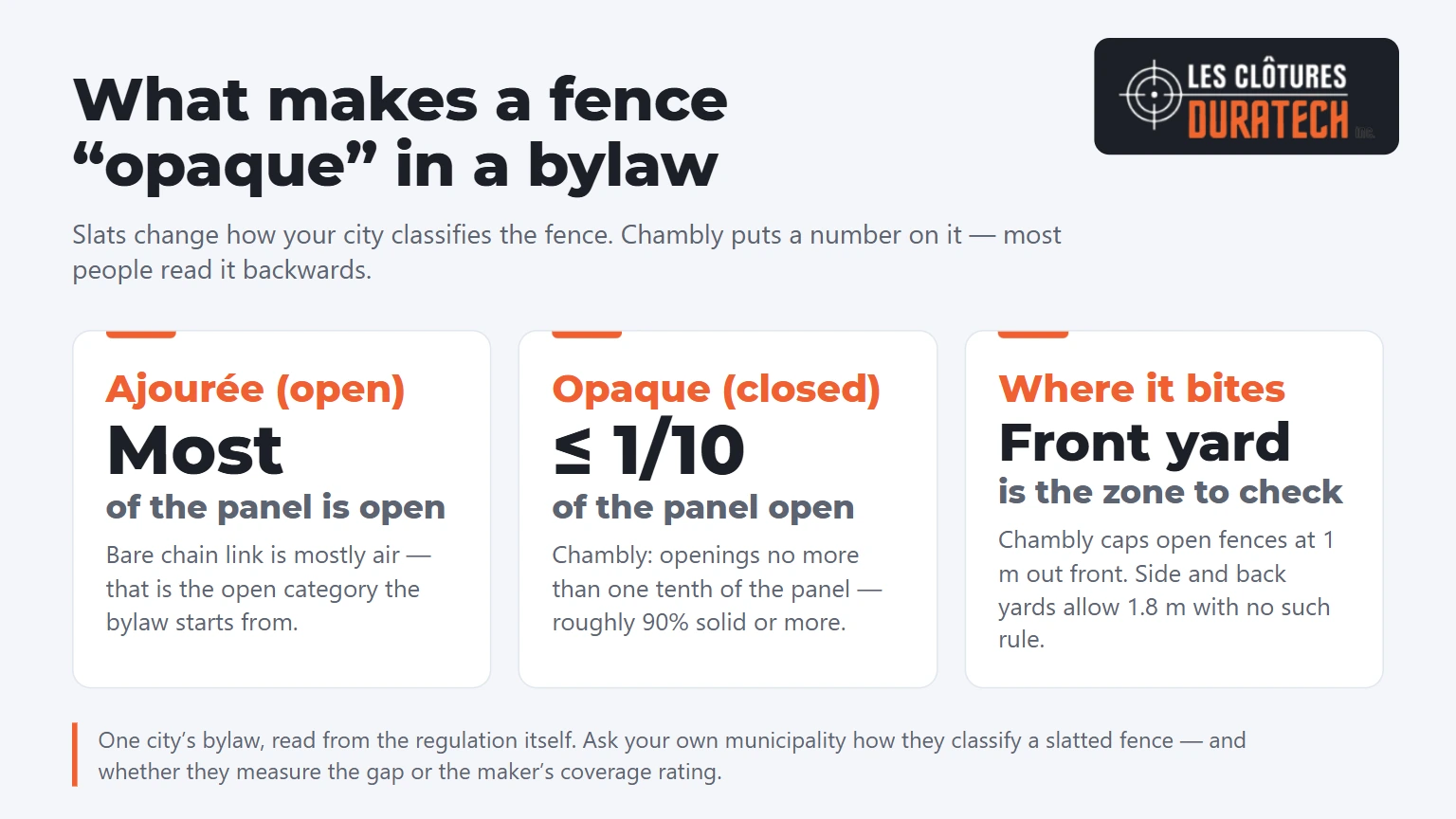
Add privacy slats, and a chain link fence can shift from what many bylaws call “ajourée” — open, see-through — to “opaque” — closed, solid. Whether that actually happens on your fence, and what it means for your project, depends on how your city draws that line.
Chambly’s zoning bylaw spells out a numeric threshold. Its definition of an opaque fence, translated, reads: a fence “built of non-transparent materials that do not allow a view through, and that is open (ajourée) by a maximum of one-tenth (1/10) of the width of the panels or elements making up the fence.” In plain terms, a fence only counts as opaque once its openings drop to roughly a tenth of the panel or less — meaning it’s about 90% solid or more. You can read the full Chambly zoning regulation here.
Run the numbers on that threshold and the picture is more nuanced than it looks at first. A standard vertical-insert slat, at roughly 70% coverage, leaves around 30% openings — well above Chambly’s one-tenth limit, so it doesn’t meet the numeric definition of opaque on its own. A dense, hedge-style weave, closer to 95% coverage, leaves only about 5% open — that’s the type that reliably clears the threshold. A winged slat at roughly 90% sits right on the line, about a tenth of the panel open, and that’s exactly the case to put to the city in writing instead of guessing at.
There’s a second wrinkle worth knowing. Manufacturers advertise slats by the percentage of view they block; a bylaw like Chambly’s measures the width of the actual gap left in the panel. Those aren’t quite the same number, and which one your municipality applies when it looks at your fence is their call, not the slat maker’s.
Chambly’s height and location rules show where this actually matters in practice. In the front yard, ajourée fences are capped at 1 meter — a rule written specifically for open fences, which is exactly where a dense slat weave can create friction. In the side and rear yards, Chambly’s general residential rule allows fences up to 1.8 metres, and it does not state the same ajourée condition that applies in the front yard. Slats are therefore usually less contentious there, although site-specific rules should still be confirmed. A lot next to a park or walking path has its own rule: an ajourée fence up to 1.2 meters, using galvanized mesh with a 50-millimeter diamond.
The bylaw also spells out what’s allowed and what isn’t. Wood, steel or aluminum mesh, PVC, wrought iron, brick, and stone are permitted; chicken wire, sheet metal, corrugated plastic, particleboard, and concrete block are not.
The practical upshot: a backyard fence with slats is usually the least contested version of this project. The zone to double-check is the front yard — Chambly writes the ajourée rule directly into the text, and municipalities are generally strictest closest to the street. Worth asking before you order material, not after.
Before you order slats, ask your municipality:
- How they classify a chain-link fence with slats — ajourée or opaque
- Whether they measure the actual gap in the panel or the manufacturer’s stated coverage percentage
- Whether the height limit or the allowed location changes once a fence counts as opaque
- Whether your permit application needs the slat specs, or just the fence height
Longueuil’s public summary page presents the rule more simply: most residential fences and low walls are capped at 2.0 meters, measured from adjacent ground level, with no ajourée/opaque threshold spelled out the way Chambly’s zoning bylaw does. That page is a summary rather than the full zoning text, so if your fence runs across the front yard or screens a shed, ask the city directly whether a separate rule applies.
We handle the Info-Excavation request before any drilling starts; pulling the construction permit is on you as the homeowner, and we supply the technical specs your city will ask for. Important: Info-Excavation locates underground infrastructure owned by its member companies and municipalities. Private lines, irrigation systems, pool or spa electrical lines, landscape lighting, propane lines, or infrastructure owned by non-member organizations may require separate verification by the homeowner.
Wind Load: Why We Reinforce the Structure Before Slats Go In
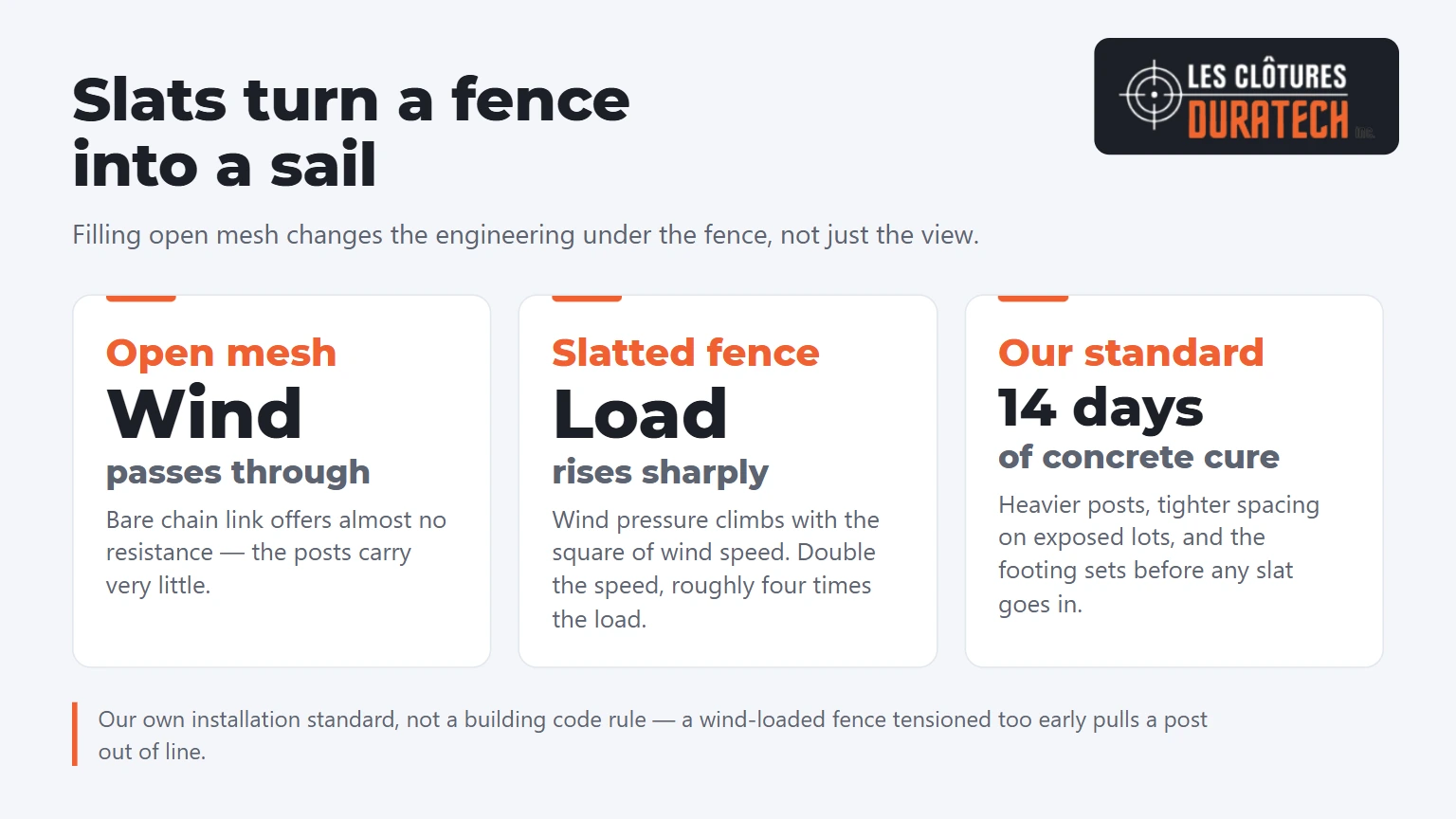
Open mesh lets wind pass through with almost no resistance. Fill that same mesh with slats, and the fence behaves less like a screen and more like a sail. Wind pressure rises roughly with the square of wind speed, so doubling the wind speed can roughly quadruple the load on the panel.
One supplier-style published example illustrates the scale of the issue: a 10-by-6-foot section of privacy-slatted fence works out to roughly 1,500 pounds of force. Read that number with its conditions attached — it comes from a 100 mph design-wind calculation, a code-level extreme rather than an ordinary windy afternoon, and before any adjustment for exposure or terrain. It isn’t what your fence sees every autumn; it’s why solid infill changes the engineering.
Two things change once slats are part of the plan. First, post spacing: a standard 10-foot spacing sometimes tightens to 6–8 feet on exposed lots, depending on how much wind the site sees and the post gauge. Second, and this is our own standard: we hold to a 14-day concrete cure before we stretch the mesh or hang slats, and we use heavier-duty posts on slatted fences. If we tension a wind-loaded fence before the footing has fully set, that tension goes straight into concrete that hasn’t reached full strength, and the post moves.
Frost heave works on the footing itself: water freezing in the soil grips the post and lifts it, which is why we drill below the frost line and pour proper footings rather than relying on anything above ground. Much of Rive-Sud sits on clay, which holds water and moves more through freeze-thaw cycles than sandy ground does. A slatted run is simply where a shifted post shows up first — the wind load is higher, and a filled panel makes a lean obvious from the street. The slatted fences we get called out to straighten are almost always ones where the footing was loaded too early.
For a sense of how that reinforcement affects the final bill alongside labor and hardware, our Frost fence cost guide breaks down what’s usually included and what tends to get added later.
What Slats Actually Add to Your Fence Cost
We publish a price range rather than keep it vague: a professional 6-foot residential fence typically runs $25 to $60 per linear foot. Privacy slats, corners, gates, reinforced posts, and site access all move a specific project up or down inside — and sometimes past — that range.
We also warn clients about what we call the online quote trap. A lot of companies advertise a low $25/ft base price, then leave out corner posts, gates, and travel fees until the final bill arrives. Once privacy slats, the labour to install them, corners, gates, reinforcement, and access conditions are included, the final price can land significantly above the advertised starting number. In some projects, that difference can approach 40%, which is why we build a full on-site quote instead of relying on a per-foot estimate.
For a slatted fence specifically, several things move that number up or down:
- Total linear footage of fence
- Height — usually 4, 5, or 6 feet
- Slat type — standard vertical insert, winged, or hedge-style; each has a different material cost
- Number of corners and gates
- Reinforced posts and tighter post spacing, if your site is windy enough to need them
- Slope and site grade
- Removing an old fence or existing mesh before the new one goes in
- How easily equipment can reach your yard
Slats are still the cheaper way to add privacy to a chain link fence you already have, or one you’re installing anyway — that’s the comparison worth making, not slats versus a full panel replacement (more on that trade-off below).
None of that is visible from an address — which is why we don’t hand out a final number without walking the yard, and why a rough online estimate and a real written quote so rarely land on the same figure.
Winter: Cold, Snow Removal, and What to Protect
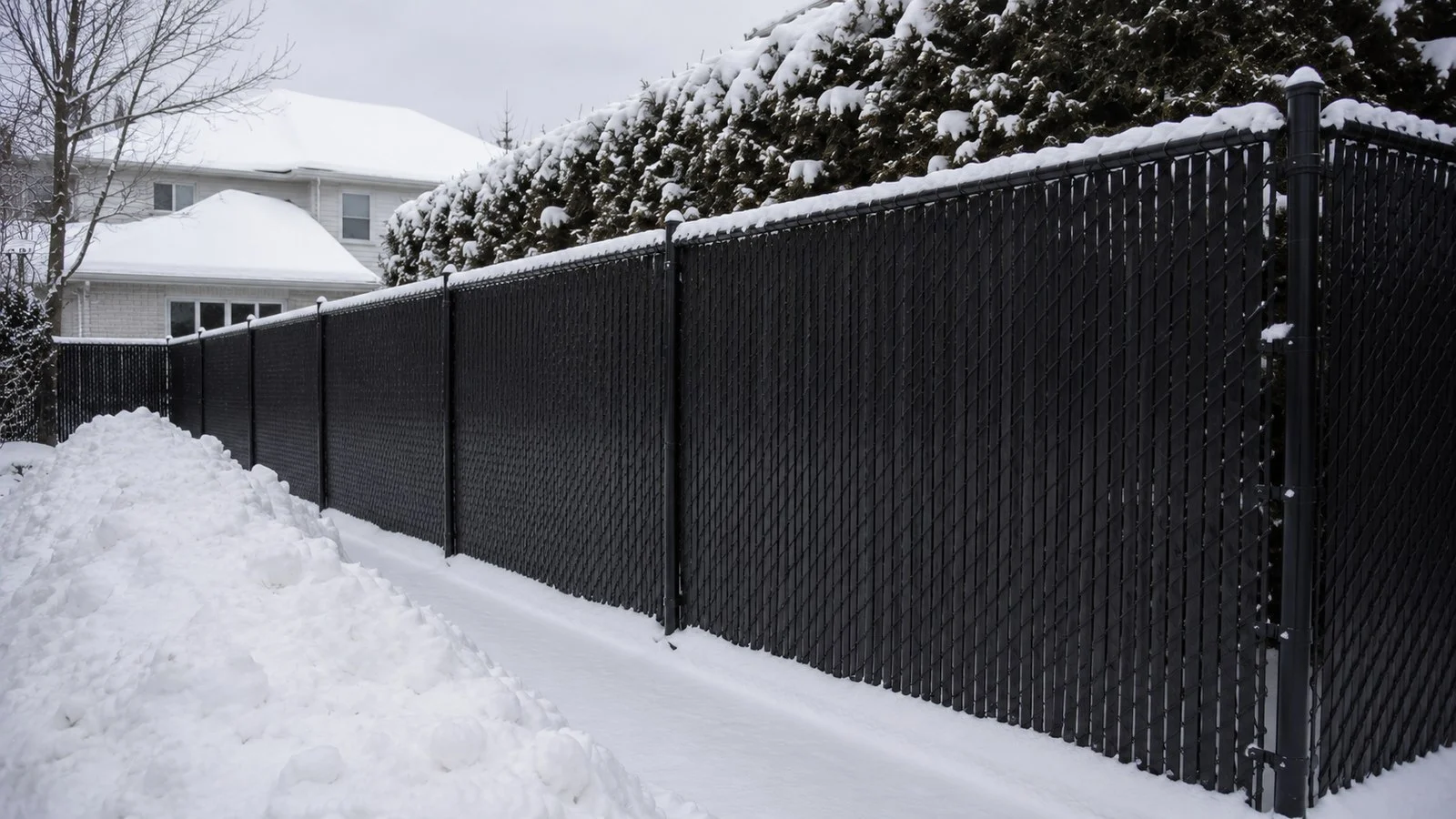
PVC, as a material, gets more brittle as temperatures drop — that’s a property of the plastic itself, not something specific to privacy slats. Manufacturers don’t publish impact ratings for slats at Quebec’s coldest temperatures, so we won’t quote one.
What we do tell clients: treat the fence with more care in winter than in summer. A snowblower chute, a thrown shovel of ice, or a branch dropped from a snow-loaded tree hits harder — and PVC has less give — when it’s cold. Keeping equipment a few feet clear of the fence line during snow removal is a cheap habit that avoids a cracked slat in February.
There’s a practical upside to how this fence is built, too. A cracked slat is a strip you slide out and replace, because the structure carrying the fence is the steel mesh behind it — not the slat itself. On a solid PVC panel fence, the cracked piece is the structure.
When Slats Aren’t the Right Call
Slats are a strong option when you want to soften a chain link fence without replacing it, but they’re not the answer for every situation.
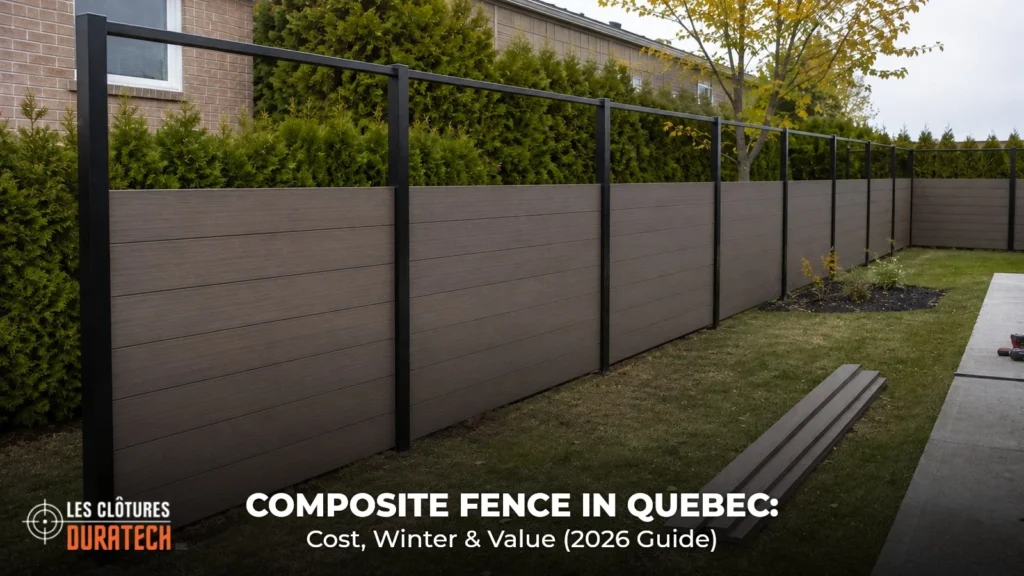
If you want full, edge-to-edge privacy with no visible mesh under any light or angle, a solid panel fence — like our Hybrid Wood & Composite systems, wood or composite infill on a steel frame — gets you closer than even the densest slat. It costs more, but it’s a different level of coverage entirely.
One thing that stays in the mesh’s favor even with slats: we contour-fit the bottom of the mesh to your yard’s actual grade so there’s no gap at ground level for a dog to slip through — a fit that’s harder to match on a rigid panel system.
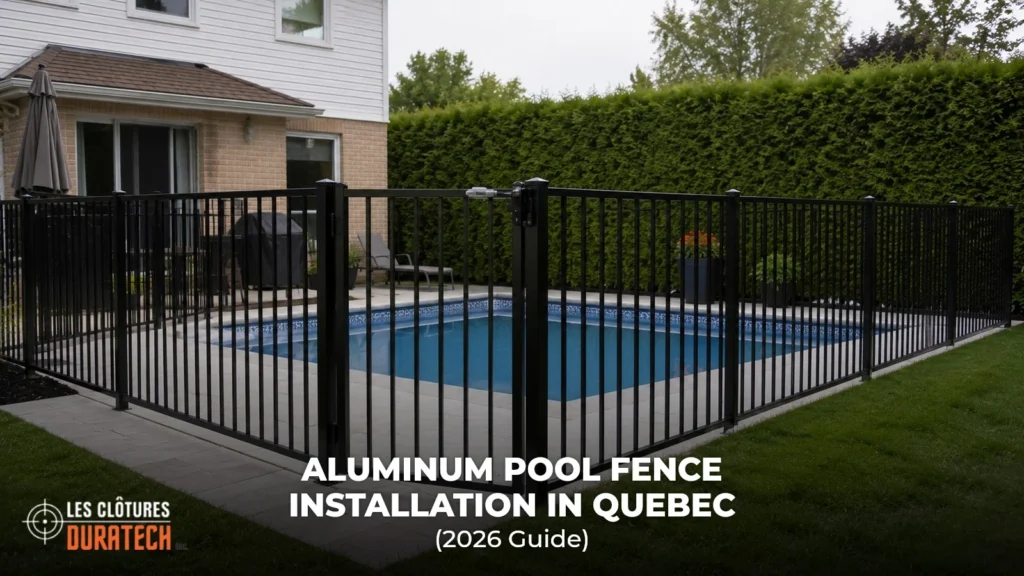
Around a pool, our position doesn’t change: we generally don’t recommend privacy slats. They reduce visibility into the water, which works against you if you’re trying to keep an eye on kids or guests. For pool enclosures, we typically steer clients toward ornamental steel or aluminum instead, which keeps the water in view while still looking finished. Whether a given enclosure complies is settled on the installed fence, not by the material you choose.
Quebec’s residential pool safety rules set the baseline regardless of fence type: minimum height of 1.2 meters, no gap wide enough for a 10-centimeter sphere, and self-closing, self-latching gates — with pools installed before November 1, 2010 given until September 30, 2027 to bring their enclosure into compliance, and pools installed on or after November 1, 2010 are already subject to the Regulation.
There is also a specific chain-link rule for pool enclosures: if the enclosure is made of chain-link, the mesh must be no wider than 30 mm. If slats are inserted into the mesh, the remaining openings must not allow the passage of a spherical object more than 30 mm in diameter. This is another reason slatted chain-link around a pool should be reviewed carefully before installation.
Full details are on Quebec’s official pool safety page; see our pool fence requirements guide for the fuller breakdown.
2 Real Cases:
Chambly — checking before slatting a front-yard fence. A homeowner wanted dense, hedge-style slats along a chain link fence running across the front yard, facing the street. Chambly’s bylaw sets a specific height cap for ajourée fences in that zone, and a weave that reads as opaque could put the fence outside that rule. Before ordering material, we walked the client through the distinction and suggested confirming with the city how a fully slatted front-yard fence would be classified. The permit process took a bit longer, but the homeowner avoided ordering a fence that might have needed a second application.
Marieville — retrofitting slats onto a twelve-year-old fence. A homeowner wanted privacy slats added to a chain link fence installed about twelve years earlier. Before ordering material, we checked the wire and tension across the full run — two sections had degraded enough to need replacing, so we replaced those and kept the rest. Slats went into the refreshed mesh without any need to rebuild the whole fence.
Frequently Asked Questions
1. How much privacy do chain link privacy slats actually give?
It depends on the slat type: standard vertical inserts cover roughly 70%, winged slats around 90%, and hedge-style slats up to about 95%. From a normal viewing distance, even the standard option can look nearly solid, though up close the mesh pattern is still faintly visible.
2. Do I need a permit after adding privacy slats to an existing fence?
That depends on your municipality, and it’s really two separate questions: whether slats need their own permit application, and whether they change how your fence is classified under the bylaw — open versus closed. On our projects, the construction permit is the homeowner’s to pull; we supply the technical specs the city asks for.
3. How long do the mesh and the slats last through Quebec winters?
The vinyl-coated mesh itself is built for our freeze-thaw cycles, and it’s commonly cited at 25 to 40 years of service — a supplier figure, not a measured rating. PVC slats do get more brittle in deep cold, like most rigid plastics, so we recommend keeping snow-clearing equipment a few feet away from the fence line during winter to avoid impact damage.
4. Can I add slats to a fence that’s already installed?
Usually, yes, as long as the existing posts and mesh are sound and straight. We can slide slats into most existing chain link mesh, or replace the mesh first if the wire has degraded. It’s worth a quick site check before ordering slats for an older fence.
5. How much does adding privacy slats cost?
We can’t give a number without seeing the property, but here’s the frame: a professional 6-foot residential fence typically runs $25 to $60 per linear foot, and privacy slats plus the labor to install them are one of the main reasons the final bill often lands well above that advertised starting number — in our experience, the gap can run as much as 40%. From there, corners, gates, reinforced posts, and site access move the number further.
6. Are privacy slats worth it on a chain-link fence?
Privacy slats are usually worth considering when the existing fence is still straight, the posts are solid, and you want more screening without replacing the entire fence. They make less sense when the mesh is rusted, the posts have shifted, the site is very exposed to wind, or the fence is part of a pool enclosure where visibility and compliance matter more than privacy.
7. Do privacy slats work around a pool?
Generally, we don’t recommend them there. Slats reduce visibility into the water, which works against pool safety rather than for it. For pool enclosures, we typically suggest ornamental steel or aluminum, which can be built to the height, spacing, and gate rules while keeping sightlines to the water open — final compliance is confirmed on the installed enclosure.
Disclaimer: The pricing figures in this article are the published ranges we quote publicly, not a quote for your property — slat type, height, corners, gates, reinforcement, and site access all affect the final price, which we confirm only after an on-site evaluation. Municipal bylaws on fence height, opaque vs. ajourée classification, and pool enclosures vary by city and change over time; always confirm current requirements and obtain any required permit from your own municipality before starting a project. This article is for general informational purposes only and does not constitute engineering or legal advice specific to your property.
Thinking about adding privacy slats to a chain link or Frost fence? We’ll walk your yard, explain how the slats you’re considering affect your fence’s classification and wind load, and give you a clear, written quote.
Phone: (438) 830-3436
Email: lescloturesduratech@gmail.com
Website: lescloturesduratech.com
We serve homeowners across the South Shore and Montérégie, in English and French.