

Search “composite fence Quebec” and most results show the same thing: a manufacturer’s kit, composite boards slotted between composite posts, sold as a complete system. That’s rarely what a South Shore property actually needs, and it’s not what we install.
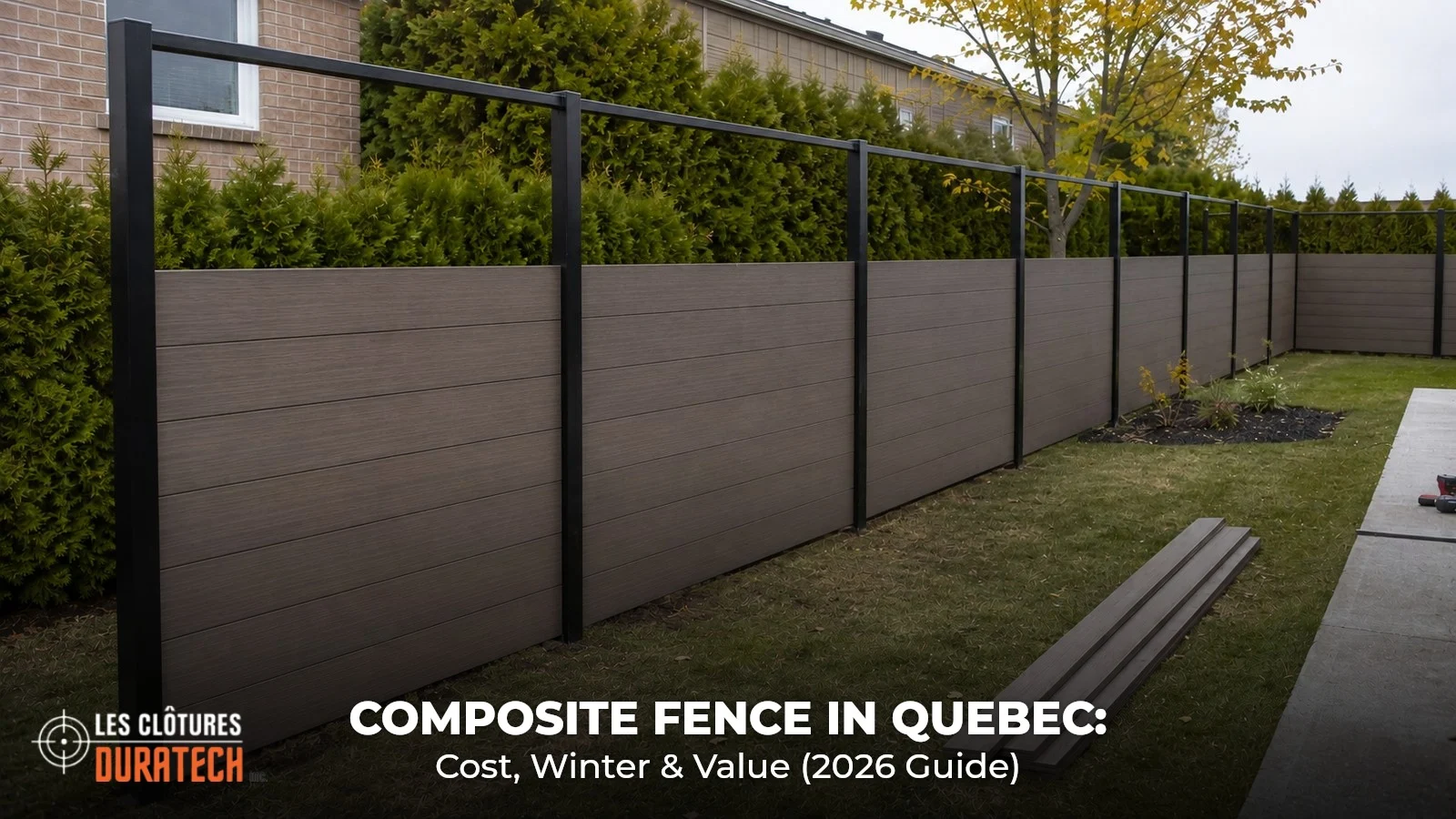
At Duratech, we build a hybrid instead: black steel posts and rails carry composite infill boards. The frame is steel, not composite, and that single choice changes how the fence handles a Montérégie winter more than the board material does.
This guide walks through what composite fencing actually is, how our hybrid differs from a full composite panel kit, how the boards behave through freeze-thaw season, and what really drives your final price.
What “composite” actually means
Composite decking and fencing boards blend wood fiber or flour with plastic and a binder. Trex’s fencing line, one of the brands sold in Canada, states its boards are made from roughly 95% recycled wood and plastic.
Composite boards come in two finishes. Capped boards have a protective polymer shell over a composite core; it resists fading, staining, and scratching noticeably better than uncapped composite, which is cheaper but needs more upkeep over time.
Composite boards can show some normal colour variation and weathering after installation, especially as they adjust to outdoor exposure. Trex also makes clear that colour variation and normal weathering are not treated as product defects under its warranty. The exact appearance change depends on the product line, colour, exposure, and installation conditions, so it should not be treated as a defect unless it falls outside the manufacturer’s warranty terms.
Full composite kit vs. our steel-and-composite hybrid
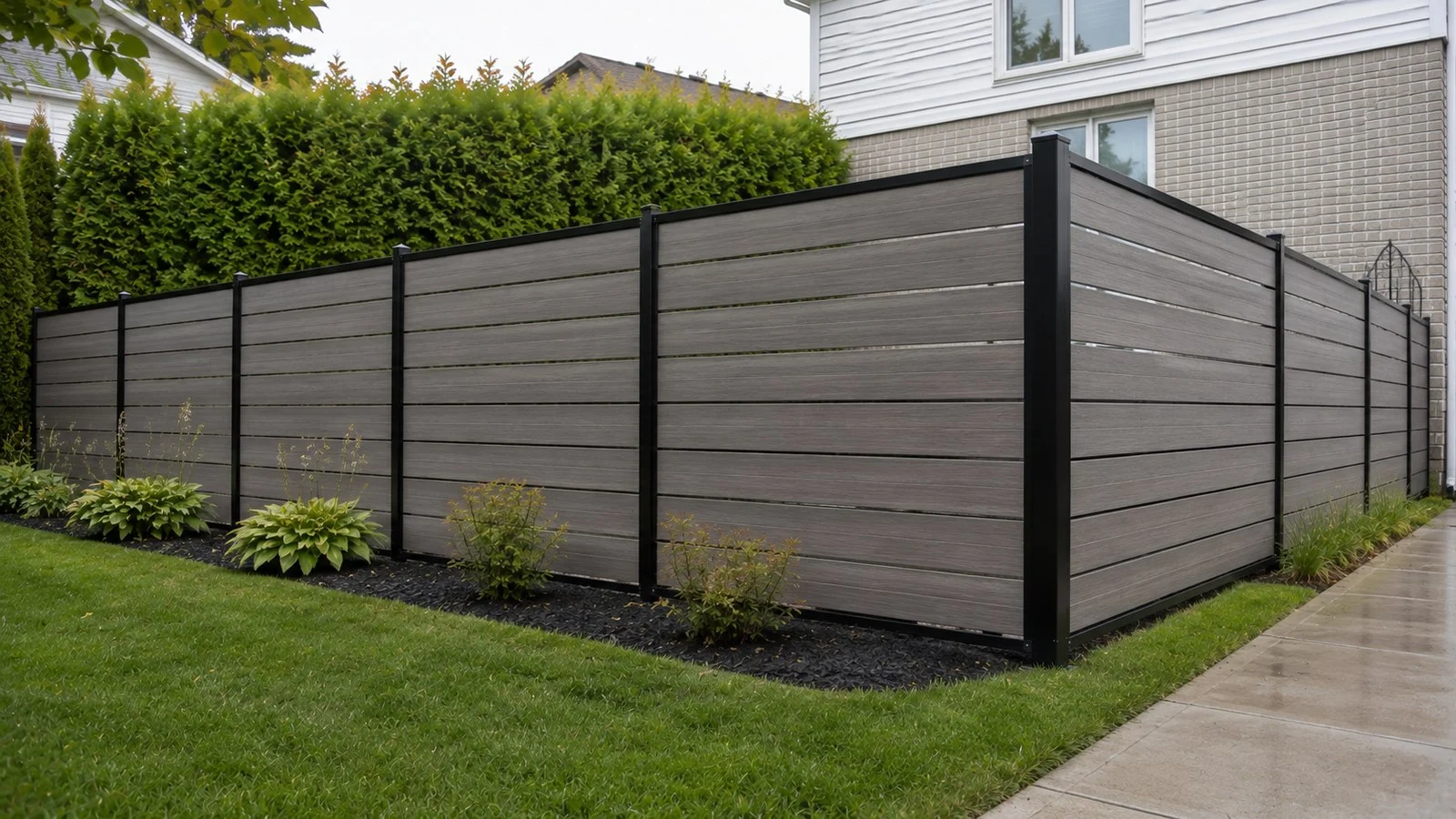
A full composite system uses composite posts as well as composite boards. Our Hybrid Composite system keeps the composite boards but swaps the posts and rails for a black steel frame — standard 2½”×2½” posts, or 3″×3″ posts with four rails instead of two on windy lots and longer runs.
A post is where a fence actually fails. Wood rots where it meets the soil, and a composite post that isn’t held in a properly cured footing can lean if the ground under it moves. A steel post set below the frost line in cured concrete is stiffer at exactly the point where stress concentrates. You can see the full system on our Hybrid Wood & Composite fencing page.
The honest trade-off: a steel-and-composite build costs more upfront than a wood infill, and darker board tones run warmer in full sun. What you buy for that is a post that doesn’t rot and boards that don’t need staining.
Composite boards on our steel frame come in horizontal or vertical layouts, in grey, brown, and cedar tones. A solid composite privacy fence in either layout blocks sightlines at normal viewing distance — many homeowners tell us the horizontal version also makes a backyard look larger, and it pairs well with a modern deck.
How composite fencing handles a Quebec winter
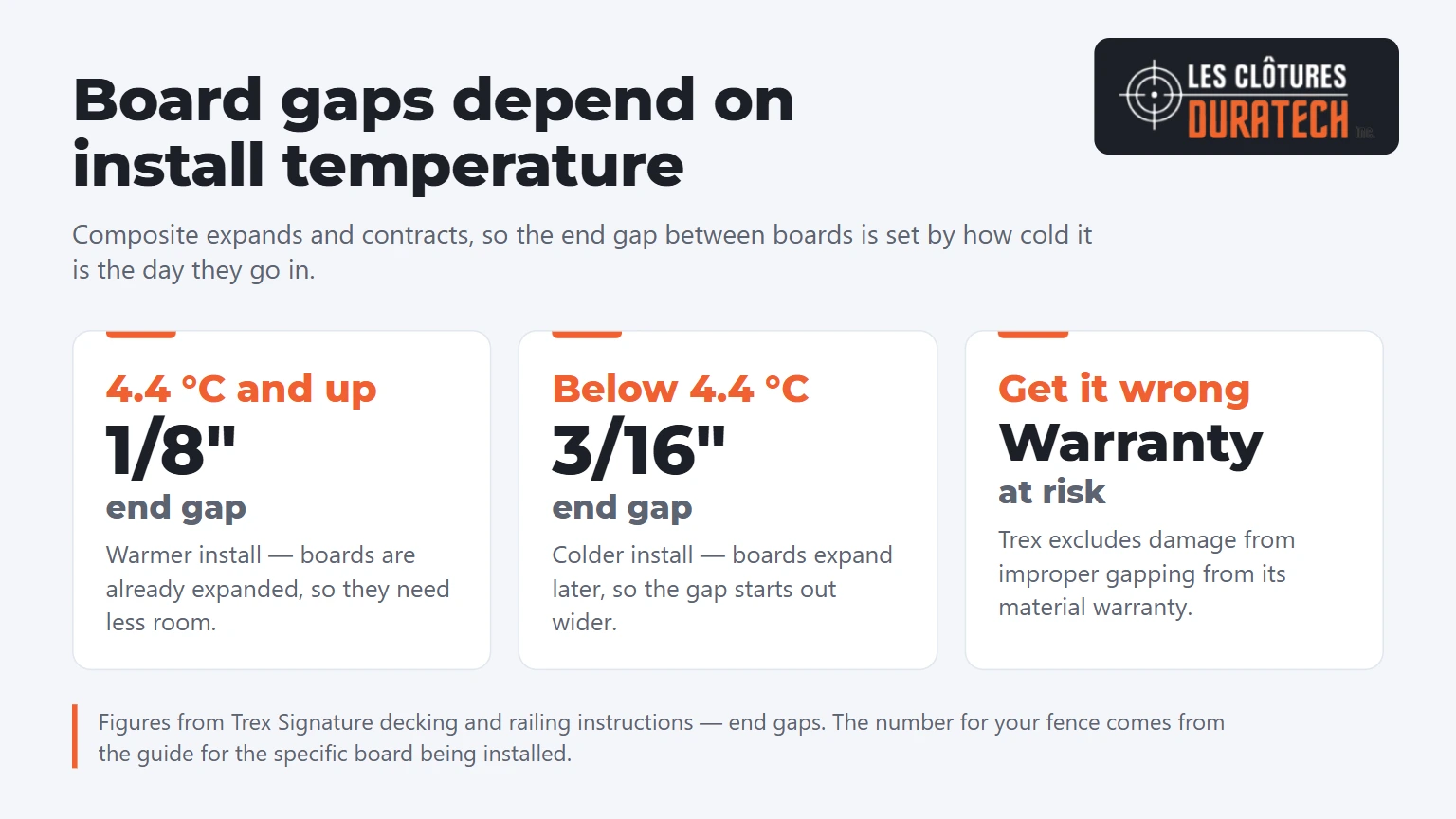
Composite expands and contracts with temperature, so an installer has to leave gaps between boards. That temperature rule comes from Trex’s installation instructions for its decking and railing line (Trex Signature): roughly 1/8 inch of end gap when boards go up at 4.4°C or warmer, and closer to 3/16 inch when installed below that.
The same expansion logic applies to composite boards set into a fence frame, but the exact spacing must come from the installation guide for the specific board and system being used. Decking or railing numbers are useful only as a reference for how temperature affects composite movement; they should not be treated as the universal fence-board spacing. Installing near the yearly average temperature keeps the math simpler.
It’s not just a cosmetic detail, either. Trex’s fencing warranty excludes damage from “improper installation of Product and/or failure to abide by Trex’s installation guidelines, including but not limited to improper gapping.” Get the gap wrong, and the material warranty can be void before the fence sees its first real winter.
Manufacturers don’t publish a number for what happens at -30°C, and we won’t invent one. What we can say is that composite is engineered around movement, not against it: correct gaps let boards expand and contract without buckling or popping loose from the frame.
For contrast, solid PVC or vinyl panel fencing — rigid plastic sheets, not a vinyl coating over a steel core — can become more brittle in deep cold and may crack under impact, depending on product quality, temperature, and installation conditions: a shovel, a hockey puck, a falling branch. That’s a different product than our Frost fence line, where the vinyl coating sits over a steel mesh core, or the PVC privacy slats we weave into that mesh; both are built on a steel skeleton rather than a solid plastic sheet.
Composite’s wood-fiber content generally holds up well to that kind of impact too, though “generally” is doing real work in that sentence: performance depends on the specific product and how it was installed.
Composite vs. cedar vs. PVC vs. aluminum vs. Frost fence
Set side by side, the real trade-off with composite comes down to upfront cost against long-term upkeep — and it helps to see where it lands next to the other systems we install, including our vinyl-coated Frost fence line:
| Criterion | Composite (hybrid) | Cedar / wood | PVC / vinyl panel | Aluminum (ornamental) | Frost fence (vinyl-coated chain link) |
| Typical lifespan | Long, especially on a steel frame | Shorter without upkeep; posts are the weak point | Long if it doesn’t crack | Very long, doesn’t rot or rust | Long; vinyl coating resists rust, deep posts resist frost heave |
| Maintenance | Occasional cleaning, no staining | Staining/sealing every few years | Occasional cleaning | Virtually none | Virtually none |
| Appearance | Wood-look boards, several tones | Natural wood grain, warm | Uniform, plastic look | Open picket, classic or modern | Open mesh in several colors; privacy needs added slats |
| Winter behavior | Expands/contracts; needs correct install gaps | Swells, can warp; posts vulnerable to rot at grade | Can turn brittle and crack in deep cold | Not prone to cold-cracking; posts still need proper footings | Deep-post installation is built specifically to resist frost heave |
With the comparison laid out, here’s what actually moves your price up or down.
What actually builds your price
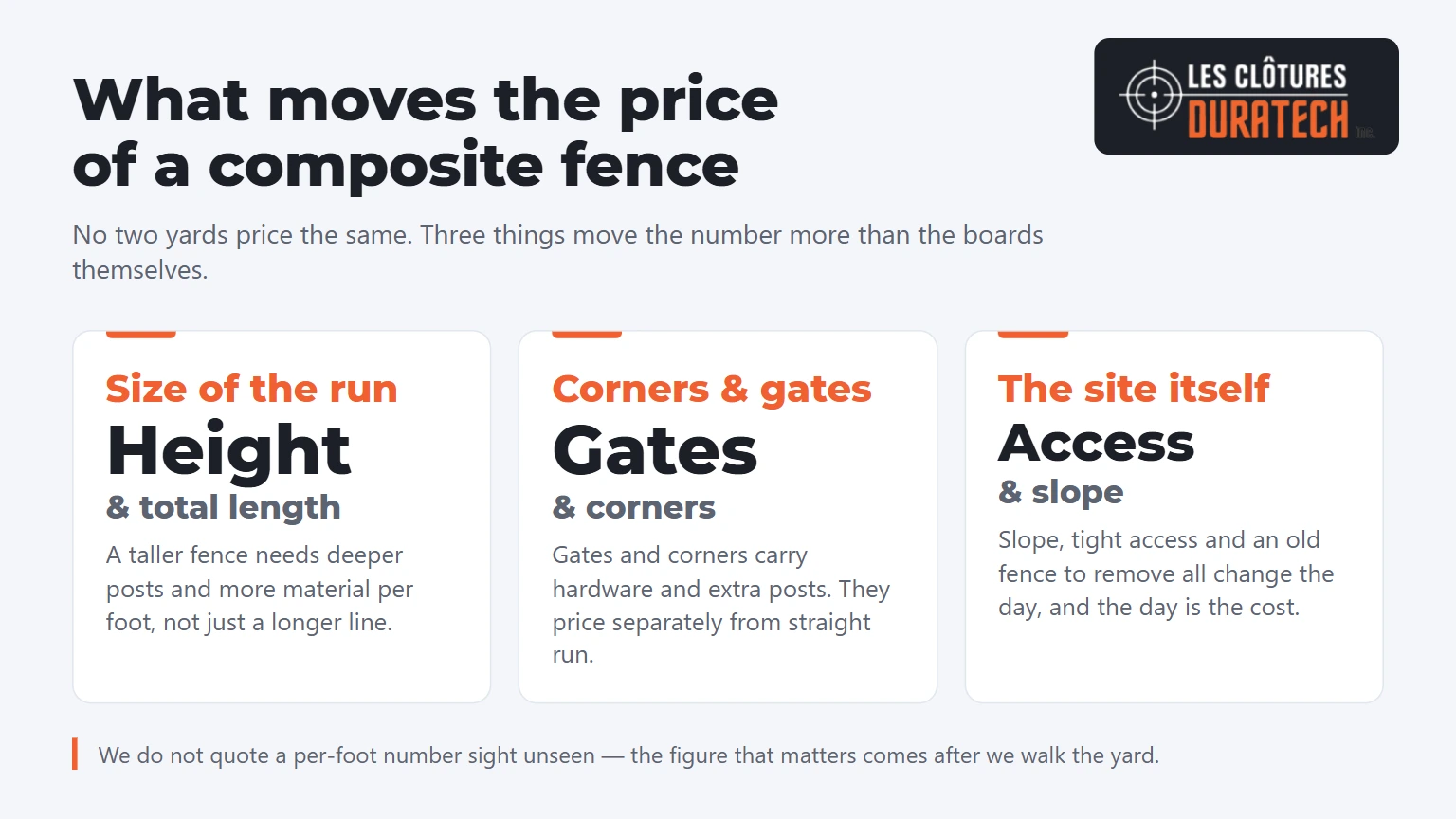
We won’t quote a per-foot number here, because the range you’ll find online — from big-box retail kits to premium installed pricing — spans several multiples depending on where it’s sourced and what it includes. What actually moves your price up or down:
- Fence height and total length
- Number of corners and gates
- How easy it is to get equipment onto your lot
- Slope
- Whether an old fence needs to come out first
- Whether your site needs the reinforced 3″×3″, four-rail structure for wind exposure
Relative to other materials: a composite hybrid costs more upfront than a wood hybrid, because the boards themselves cost more than lumber. It can cost less over the life of the fence, because there’s no staining or sealing in normal use. Where it lands against ornamental steel or aluminum depends on height, layout, and hardware — that comparison only means something once it’s run on your actual site, not as a general rule.
We don’t give a final number without seeing the yard. Slope, root systems, soil, and access all change the job — that’s true whether you’re comparing us to another installer or to a retail kit.
Is a composite fence worth the higher upfront cost?
A composite hybrid fence is usually worth considering when you want privacy, a clean modern look, and lower maintenance than wood. The higher upfront price makes the most sense when the frame, posts, footing depth, and installation method are designed for Quebec conditions. If the installation is rushed or the posts are not set properly, the board material alone will not protect the fence from leaning.
Store-bought panel vs. professional installation
Here’s where the “just buy composite panels” plan runs into a problem most homeowners don’t see coming: the warranty. Trex’s fencing warranty covers 25 years residential and 10 years commercial on materials — but it explicitly excludes normal weathering, color variation, staining from outside substances, and, critically, improper installation and ground movement.
Read that last part again. If a post wasn’t set deep enough, or the footing wasn’t given time to cure before the panels went up, and the fence leans two years later, that’s an installation failure, not a material failure. The manufacturer’s warranty won’t cover it, no matter how good the boards were.
A composite panel from a hardware store is only as good as the posts it’s sitting on.
What to ask any composite fence installer:
- How deep are the posts going, and what’s that depth based on?
- How long do they wait for the concrete to cure before the panels go up?
- Whose installation manual sets the board gap, and what number does it call for?
- Is the board capped or uncapped?
- Who submits the Info-Excavation request, and who pulls the municipal permit?
Installation: posts, concrete, and our 14-day cure
Our process starts with Info-Excavation: we submit the request to locate underground utility lines before any drilling begins. You, as the homeowner, are responsible for pulling the municipal construction permit — we provide the specs your city will ask for. Important: Info-Excavation locates underground infrastructure owned by its member companies and municipalities. Private lines, irrigation systems, pool or spa electrical lines, landscape lighting, propane lines, or infrastructure owned by non-member organizations may require separate verification by the homeowner.
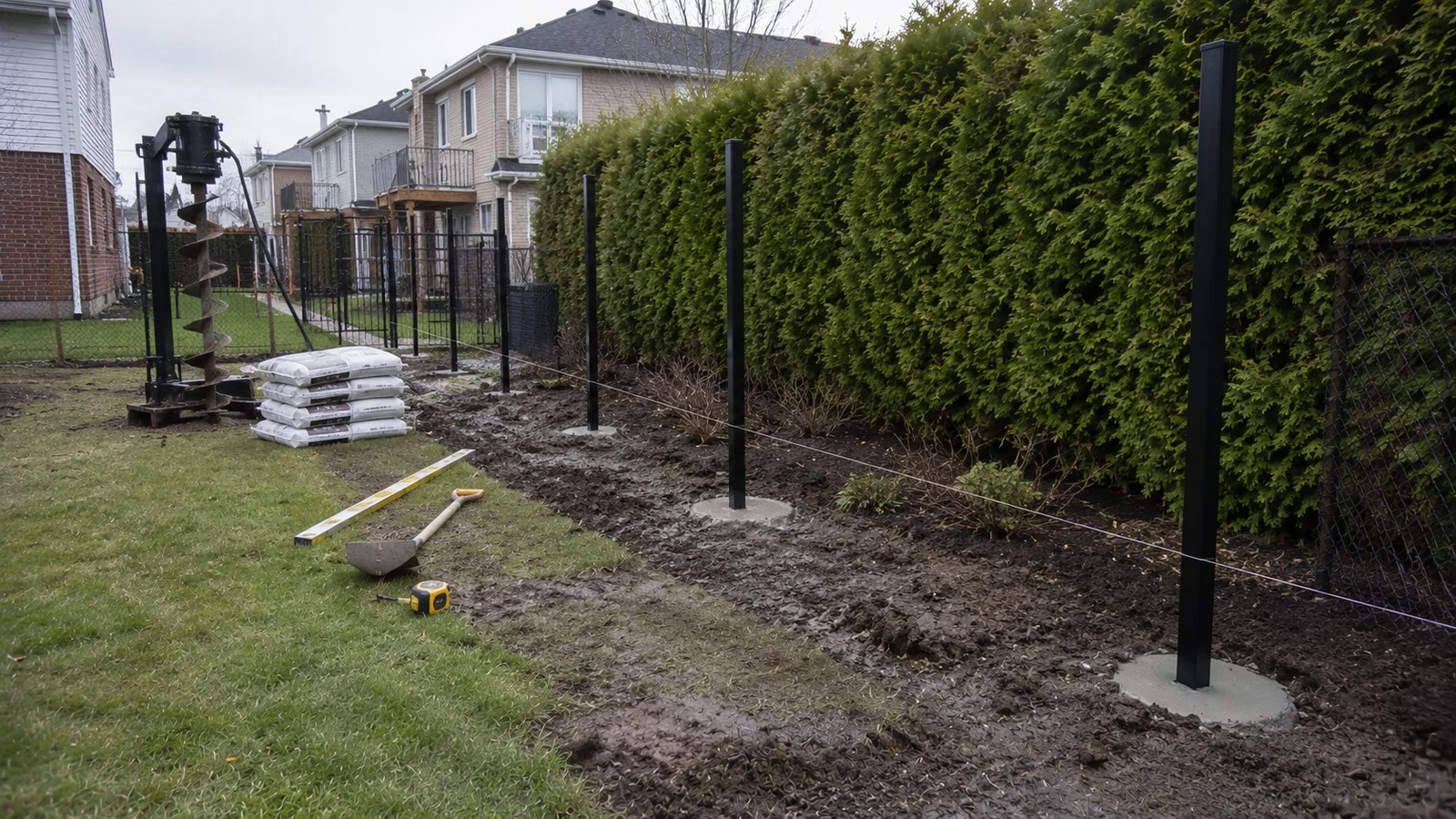
We drill posts below the frost line; the exact depth depends on your site and your municipality’s own requirements, not a single provincewide number. Then we pour concrete footings and wait.
We hold to a 14-day concrete cure before we install composite panels — this is our own standard, not a general building code requirement. The reason is simple: a solid composite panel catches far more wind than open mesh, and if we tension or hang panels before the footing has fully set, that load can pull a post out of alignment before it’s had a fair chance.
On a sloped yard, we step the panels down the grade rather than tilting them to follow it: each section sits slightly lower than the one before it, so the horizontal lines in the boards stay level instead of racking downhill. Stepping does leave a small triangular gap under each section where the ground falls away, so we plan the step heights around the grade — and if you’re fencing in a dog, tell us before layout, because that gap at grade is exactly where a determined dog finds its way out. On our Frost fence line we solve it differently: the mesh itself is custom-fitted flush to the ground.
South Shore soil adds its own wrinkle. Much of Montérégie sits on clay, which holds water and moves more with freeze-thaw cycles than sandy soil does. Combined with frost heave — the seasonal push as groundwater freezes and expands — a shallow or rushed footing is, in our experience, the most common reason a “good” fence starts leaning by its third winter. For more on how different materials age here, see our fence lifespan and warning signs guide.
Permits and municipal rules
Quebec doesn’t have one fence law that applies everywhere — height limits, setbacks, and permitted materials are set city by city. Longueuil, for instance, caps most residential fences at 2.0 meters and sets minimum setbacks from hydrants and streets.
Marieville’s bylaw is stricter close to the street: within 5 meters of the front property line, height tops out at 1 meter; between 5 and 10 meters back, it rises to 2 meters. In Brossard, homeowners should verify the applicable requirements under REG-362 and the City’s current residential exterior-work guidance before installing a fence. Even when a project appears simple, the installation must still comply with the local bylaw.
Pool safety works differently: the baseline rules are provincial, set by Quebec’s residential pool safety regulation rather than written city by city — though your municipality still issues the permit and can apply stricter requirements of its own. One consequence for design: an enclosure has to be non-climbable, and closely spaced horizontal boards can give a child a foothold. We often keep a composite privacy wall on the outer sides of the yard and use ornamental steel or aluminum for the enclosure right at the water, where visibility and non-climbability matter most.
Timing matters too: pools installed before November 1, 2010 have until September 30, 2027 to bring their enclosure into compliance, while pools installed on or after November 1, 2010 are already subject to the Regulation.
The takeaway: don’t assume your neighbor’s height limit is yours. Check with your own municipality before you finalize a design, and budget time for the permit where your city requires one — it’s on the homeowner’s side of the process, not ours.
Our guide to fence height rules across Quebec covers more municipalities in detail; if you’re weighing composite against other materials first, our wood vs. chain-link vs. ornamental comparison is a useful next read.
2 Real Cases:
Chambly — a windy, exposed backyard. A homeowner near open farmland wanted a composite privacy fence around a new patio, but the lot sat exposed to wind with no tree line to break it. We moved them to our reinforced structure before a single panel went up, specifically because solid horizontal boards act like a sail in open wind. Two winters in, the line is straight.
Saint-Jean-sur-Richelieu — replacing a rotted wood fence on clay soil. The original wood fence had posts rotting at grade after roughly a decade, made worse by heavy clay soil that held moisture around the base all season. We replaced it with our Hybrid Composite system, drilling below the frost line and holding our 14-day cure before installing panels. The composite boards mean no more re-staining every couple of summers, and the steel posts remove the rot risk that ended the last fence’s life.
Frequently Asked Questions
1. How much does a composite fence cost in Quebec?
It depends on too many site-specific factors — height, length, gates, access, slope, and whether an old fence has to come out — for us to give a meaningful number without seeing your property. Composite generally costs more upfront than wood infill and less over time thanks to lower maintenance. We give a firm written quote after an on-site evaluation.
2. If I add a fence section years later, will the color match?
Not exactly, at least not right away. Manufacturer warranties exclude color variation as a matter of course — Trex’s, for example, doesn’t cover “variations or changes in color of Product” — and boards that have already been outside for a season or two have finished their initial weathering while new boards haven’t started theirs. The tones are close enough that most homeowners are comfortable with it, but if an exact match matters to you, say so before we order — we can plan the layout or timing around it.
3. Is fall or spring better for installing a composite fence in Quebec?
Either can work, but the installation temperature matters more than the season name: on the boards we install, the manufacturer’s guide typically sets a tighter gap above 4.4°C and a wider one below it. What matters just as much is having enough mild weather left after installation for our 14-day concrete cure to finish properly before hard frost sets in, which is why we plan the schedule around your specific dates rather than a fixed calendar month.
4. Do I need a permit for a composite fence?
In most Quebec municipalities, yes, though the exact rule — and whether a permit is required at all — varies by city. We submit the Info-Excavation request to locate underground utilities, but pulling the construction permit from your municipality is the homeowner’s responsibility.
5. What does the warranty actually cover, and how long does a composite fence actually last?
Manufacturer warranties cover defects in the board itself — not normal weathering, color variation, or damage from improper installation or ground movement. The term also varies far more than people expect within a single brand: Trex® Fencing warranties vary by product and component. Trex Fencing materials may carry a 25-year residential and 10-year commercial limited warranty, while Horizons frame kits have their own shorter limited warranty. Gates, hardware, frames, boards, and accessories may not all be covered for the same term. Read the warranty document for the exact product and component, not just the headline number.
In our climate, the foundation is usually the limiting factor, not the boards: a fence with a 25-year board warranty can still start leaning in a few winters if the posts weren’t set deep enough or given time to cure.
6. Can composite boards go on the posts of an existing fence?
Sometimes, if the old posts are sound, deep enough, and set in concrete that hasn’t cracked or shifted. That’s not something to guess at from the yard — it comes down to an inspection of what’s actually holding those posts in the ground, and whether it meets what a composite panel needs to carry.
Disclaimer: This article doesn’t quote fixed prices — any cost comparison here is relative, and your final price depends on an on-site evaluation of your property, including slope, access, and existing conditions. Municipal bylaws on fence height, setbacks, and permitted materials vary by city and change over time; always confirm current requirements and obtain any required permit from your own municipality before starting a project. This article is for general informational purposes only and does not constitute engineering, legal, or professional advice specific to your property.
Ready to talk about a composite fence for your property? We’ll walk your yard, explain what your site needs, and give you a clear, written quote — no hidden add-ons after the fact.
Phone: (438) 830-3436
Email: lescloturesduratech@gmail.com
Website: lescloturesduratech.com
We serve homeowners across the South Shore and Montérégie, in English and French.